Guilderland ZBA allows for BESS, urges town to create law
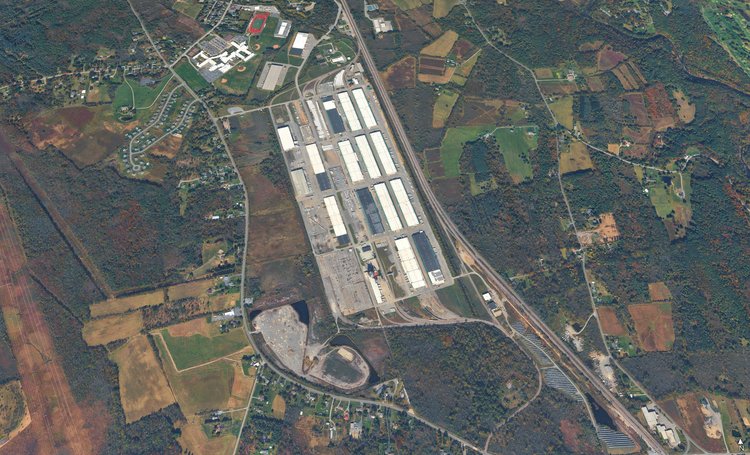
— From Google Earth
The Guilderland Zoning Board of Appeals in March said battery energy storage systems met the town code definition of a wholesale trade and distribution operation, paving the way for a proposed BESS in the Northeastern Industrial Park, pictured above.
GUILDERLAND — A recent decision by the Guilderland Zoning Board of Appeals has opened the door to large-scale battery storage in portions of town.
During its March 18 meeting, the board was asked to weigh in on a request from Nexamp Solar about its proposed five-megawatt battery energy storage system for the Northeastern Industrial Park.
The town code makes no mention of battery energy storage systems, meaning it was up to the zoning board on March 18 to decide whether the proposed BESS fit into an existing use category, “wholesale trade and distribution,” which, while the actual phrase does appear in the pages of Guilderland’s code, itself is not readily defined under town law.
Wholesale trade and distribution generally refers to the business of bulk purchasing goods or commodities, then turning around and selling those goods not to the general public but rather to other businesses, institutions, and industrial organizations. Examples include regional food and beverage distributors; electrical-supply wholesalers; and bulk chemical distribution facilities.
Under the town’s zoning code, a wholesale trade and distribution operation is allowed in the Northeastern Industrial Park; in terms of regulatory oversight, the project would need only a site-plan review from the town’s planning board.
In its project narrative submitted to the town, Nexamp invoked Merriam-Webster’s definitions of wholesale and distribution, arguing the “Proposed Use should be classified as ‘wholesale trade and distribution’ because it includes the bulk purchase of electricity, which is a commodity, which is then stored and wholesale distributed for resale to consumers.”
The letter goes on to state, “Similar to other commercial enterprises that operate in the Northeastern Industrial Park, the Proposed Use is importing a commodity, storing said commodity, and then selling the same on the wholesale market.”
And “while the commodity in question is not a traditional tangible good that one can physically hold and does not arrive at the Property via a traditional method such as by truck or rail, but rather electrical distribution lines, it is very much a necessary commodity utilized by all in today’s society,” Nexamp argues.
Therefore, the company concludes, the proposed use is “consistent with the commonly used definitions of ‘wholesale’ and ‘distribution’ and the Zoning Code should be construed to permit the Proposed Use as these terms are not defined therein.”
Concerns raised
During the March 18 hearing, safety concerns were top of mind for both board members and the public, as worries were raised about fire risk, toxic emissions, and whether local fire departments were equipped to respond to a battery blaze.
Residents worried about the risk of an explosion in a warehouse district with unknown neighboring contents, the unproven readiness of local fire departments to handle a BESS fire, and the broader absence of consistent protocols across municipalities.
Earlier in the meeting, project attorney John Ahearn and Nexamp representative Michael DeAngelo addressed some of the issues raised.
When asked about a code provision that prohibited uses deemed “noxious or offensive” due to the potential for fire, smoke, or toxic fumes, Ahearn argued that the primary intended use of a battery energy storage system is not to produce fires or noxious gas, and that any standard warehouse could theoretically catch fire, but that risk alone did not disallow a warehouse to be built.
Addressing the phenomena of thermal runaway — a cycle of chemical reactions that can occur in a BESS that releases heat and accelerates as the temperature rises, which can result in a fire — DeAngelo responded that the systems, which are each as large as a shipping container, would be spaced to meet the safety clearances laid out in the recently-updated New York State Fire Code, and that the project would also comply with the recent updates to the state building code as well as the National Electric Code.
The board voted unanimously on the motion by its chairwoman, Elizabeth Lott, agreeing that the BESS was an allowed use within the Industrial Park District, concluding the facility met the town’s definition of wholesale trade and distribution because the site would be storing energy to be later distributed and sold to National Grid.
Following the vote, the board also agreed to recommend that the town board consult a model law from the New York State Energy Research and Development Authority to create a comprehensive legal framework for reviewing and approving future battery storage applications.