Lessons from history: Local farmland preservation should be a priority for our governments
— Photo from Timothy J. Albright
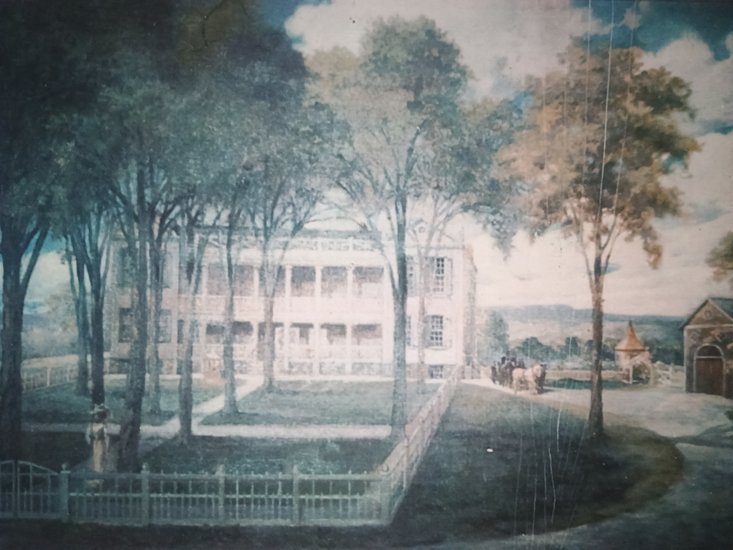
Whitehall: A 1,000-acre farm with a mansion built in the mid-1700s is where Peter Gansevoort Ten Eyck was born. It burned in the 1880s and is now Whitehall Road.
To the Editor:
Our treasured John Boyd Thacher State Park was not always in the public domain. John and his wife, Emma Treadwell Thacher, spent summers in the Helderbergs during the late 19th Century. In 1900, they purchased a summer cottage near the Helderberg Inn overlooking the village of Altamont.
The summer cottage became a summer home and eventually a full-blown mansion called “The Ravines” due to its proximity to a large ravine carrying runoff from the mountain into the village of Altamont below.
The Thachers were very involved socially with prominent people like Verplanck Colvin, who played a critical role in the preservation of the Adirondack Mountains. He is widely considered the “father of the Adirondack Park.” He also began his career as a topographer, writing about the Helderbergs in an 1969 edition of Harpers magazine.
It was a wonderfully descriptive and romantic account of the beauty surrounding the original site of the legendary Indian Ladder at the place we now call Thacher Park.
The Thachers wanted to join with other land preservationists and decided they would try to protect the Indian Ladder region of the Helderberg Escarpment, from future private ownership.
A 1905 report in The Altamont Enterprise states that John Boyd Thacher was “anxious that this part of the mountain he owns shall be preserved from the ravages of man.”
Also of concern to them was the possibility of industrial quarrying or mining as was occurring near Howes Cave by the Helderberg Cement Company.
So John and Emma began acquiring land along the escarpment around 1906 including the Dearstyne Farm and the Winne property until they obtained a total of 350 acres of some of the most geologically significant and beautifully scenic portions of the escarpment informally known by many as the “Indian Ladder Park” even though it was privately owned.
The Thachers called it “Indian Ladder Farm” as it was a farm, with early American dwellings and outbuildings that supported farming for over 100 years.
John Boyd Thacher, who lived from 1847 to 1909), was a prominent businessman involved in his father’s company, The Thacher Car Works, which made railroad-car wheels and undercarriages supplying the New York Central Railroad. Both his family and Emma’s have ancestry important to the history of the United States.
John was also a two-time mayor of Albany, as was his father and later his nephew.
He was a collector of history and an author, as well as a state senator.
After John died in 1909, Emma was determined to carry out their plans to put their Indian Ladder Farm in the hands of the people by working with the state of New York.
In 1914, the New York State Legislature accepted the farmland donation, and per Emma’s suggestion placed the park under the custodianship of the American Scenic and Historic Preservation Society, to be forever known as John Boyd Thacher State Park.
Mrs. Thacher also donated another 50 acres on Thompsons Lake in 1920 that was used by the Civilian Conservation Corps and Camp Thacher while later expanding to be the Thompsons Lake State Campground and home to the Emma Treadwell Thacher Nature Center further supported by the philanthropy of Martha and Fred Schroeder in 1999.
Now I want to bring two histories together for you.
Peter G. Ten Eyck
John Boyd Thacher and Congressman Peter G. Ten Eyck, who lived from 1873 to 1944, were associated through their prominence in Albany politics as active members of the Democratic Party. Ten Eyck was a native of the town of Bethlehem, born on the famous Whitehall Farm and a descendent of several Dutch American families, including the Ten Eycks that arrived in the mid-1600s, and the Gansevoorts who also settled in the Hudson Valley in the mid-17th Century.
Peter Gansevoort Ten Eyck was a well-known and respected citizen of Albany. He was a graduate of the Albany Academy and Rensselaer Polytechnic Institute. He went to work as a signal engineer for the New York Central Railroad and later became an inventor, vice president, and general manager for the Federal Railway Signal Company.
Mr. Ten Eyck was involved with the Port of Albany Commission that was responsible for making the Hudson River navigable by ocean-going ships coming up the Great River from New York City.
He was a congressman who also ran for president. He was invested in banking, real estate, and the insurance industry. He also became the New York State commissioner of agriculture and was on the board for the Albany County Agricultural Society and Exposition known as the Altamont Fair.
The Ten Eycks had at one time been associated with “The Whitehall Palace” later called the “Ten Eyck Mansion.” It was a very early prominent colonial-era country house built around 1750 and later greatly enlarged.
It became a massive estate featuring extensive farmland, formal gardens, and outbuildings, totaling around one-thousand acres in the late 18th Century.
It was located near the present day Whitehall Road in Albany. In 1883, the Whitehall/Ten Eyck mansion burned to the ground.
Indian Ladder Farms
By 1916, Mr. Ten Eyck had been in search of farmland and found what he was looking for in the town of New Scotland.
He purchased the Andrew Smith Farm along what would later be the Altamont-Voorheesville Road. This would be the first of seven properties he would eventually buy and consolidate: five small farms and two other parcels of land. The Smith Farm had two large barns across the road from the main farmhouse, which Mr. Ten Eyck began to rebuild into a new Ten Eyck Mansion.
It is a beautiful showcase home. The building has a rustic elegance on a massive luxurious scale with hand-hewn beams, stone fireplaces, stone pillars, red cedar siding, porches, and commands a wide panoramic view of Thacher Park and the Helderberg Escarpment. The Biscone family has owned it since 1984 and has done a wonderful job restoring it to its original grandeur.
Peter G. Ten Eyck began to build his farm into an exemplary model of what a dairy farm should be. All the buildings were re-sided in red cedar shingles from Canada, and all the buildings were connected by Helderberg bluestone sidewalks.
The farm operated with a dairy herd of approximately 100 purebred prize-winning Guernsey cows. Apples were always a mainstay crop on the farm, which was greatly expanded in 1930 when the main building/barn that is used now as a retail market, was built for apple cold storage.
So the Ten Eycks needed a name for this new farming venture in 1916.
Since the Thachers “Indian Ladder Farm” was now known as John Boyd Thacher State Park, the name was up for grabs. Mr. Ten Eyck decided rightfully to call his farm directly below the Indian Ladder cliffs, Indian Ladder Farms in the plural because of the many small farms he pulled together as one.
And we are glad he did, because it is a great name for a farm and a nod and acknowledgement to local history that lives on to this day.
Indian Ladder Farms is well known to all and has been serving the community in many ways for 110 years. And in the same tradition of the Thacher family, the Ten Eyck family in 2003 put 320 acres of I.L.F. under a conservation easement with the Mohawk-Hudson Land Conservancy, which permanently preserves the land for agricultural use.
This was a significant undertaking by the family, the conservancy, the state, and the town of New Scotland.
The family made a huge financial sacrifice, as land in this area is in high demand and worth much for development. Farmland is quickly being consumed for purposes other than farming.
Peter G. Ten Eyck II, who lived from 1938 to 2025, and his daughter, Laura Ten Eyck, are great advocates of small farms and their sustainability.
Throughout Pete’s life, he continuously spoke of the critical importance of local agriculture.
Preservation matters
By some estimates, the United States is losing farmland at a rate of 2,000 acres a day, which threatens food security, environmental stability, and economic vitality.
Once farmland is developed, this irreplaceable resource is lost forever, leading to increased food prices, loss of biodiversity, and the destruction of irreplaceable wildlife habitats. Something for all of us who live in the state of New York's Capital Region to consider, is that this area where we live and call home, does not produce enough food to feed us all.
Without the importation of food we would all start to go hungry very fast.
People like to shrug that fact off quickly. But, as we lose our farmland to development, and create more housing, with more people, and take up more land, with more commercial development, shouldn’t we, and our leaders, consider where our food comes from and how it gets here, to be an issue of homeland security?
I’m asking where does the development end and localized farming take hold again? While we citizens of the United States watch people starving around the world, we don’t ever imagine our own food supply becoming unstable.
Over one in nine people living in the Capital Region are estimated to be experiencing food insecurity.
If the importation of food were hindered for any reason it would severely exacerbate food insecurity here, likely causing immediate supply shortages and rapid price inflation.
Supply shock could lead to empty shelves, reduced nutritional access, and poor health particularly for low-income people.
This possibility may seem unlikely, but who knows?
Look at the shortages that occurred during the recent pandemic. Local farms and farmland preservation should be a priority for our governments. Government is talking about it but not doing enough, fast enough, just like with climate change and climate issues, and pollution.
Don’t you think so? Aren’t you worried about the future enough to vote for change?
Timothy J. Albright
Meadowdale
Editor’s note: Timothy J. Albright spent his career working at Indian Ladder Farms, retiring as farm manager.