Super proposes long lists of cuts to close $4.1 M budget gap
Enterprise file photo — Michael Koff
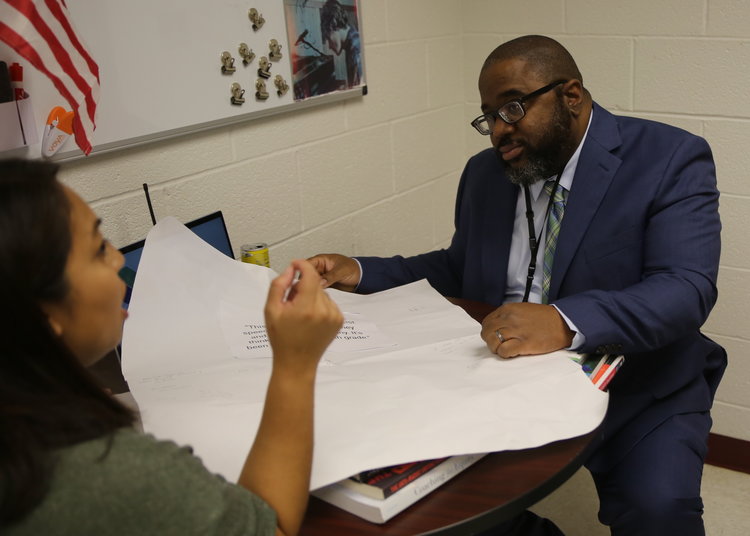
Derek Westbrook, right, Guilderland’s director of Diversity, Equity and Inclusion, is pictured soon after his 2023 appointment with Leah Werther, a teacher on special assignment. The DEI director’s post is slated to be eliminated while the teacher-on-special assignment post is to be preserved.
GUILDERLAND — Presenting his first Guilderland budget, Superintendent Daniel Mayberry had the unhappy task of reading a long list of proposed cuts.
While the situation is not as dire as when his predecessor was new — in the midst of the recession, Guilderland cut over 130 jobs — the current combined increase in health-insurance costs and decrease in enrollment has led to a sizable gap.
Mayberry said that, in the middle of February, the district was faced with a $4.1 million gap between projected revenues and expenses. School leaders then identified $2.3 million in proposed cuts, which Mayberry detailed for the school board on March 10.
That still leaves a $1.8 million shortfall. So there are more cuts to be made.
The district will hold a question-and-answer forum on the budget at 7 p.m. on March 17 in the high school’s large-group instruction room at 8 School Road in Guilderland Center.
The school board is slated to adopt the budget on April 14 and the public will have its say on May 19.
“We can’t offer everything and do everything that we want to do and still come within the financial guardrails that we have within the state of New York and how we fund our schools, unfortunately,” said Mayberry.
Mayberry went over the results of an online survey in which 425 “stakeholders” participated, showing their top priority was maintaining low class sizes, followed by preserving rigorous academic programming.
Third-tier priorities included increasing teaching assistants, supporting students who need academic help, and preserving a wide variety of electives. This was followed by continuing support for social-emotional learning and then preserving offerings in the arts and athletics.
Assistant Superintendent for Business Andrew Van Alstyne said, “The budget choices we make are part of much larger structural challenges the district is looking at and trying to address for the long term.”
He noted the strong support — roughly three-quarters of voters — for the current $127.5 million budget in which spending increased 1.88 percent and the tax levy was up 2.22 percent.
Van Alstyne displayed two graphs to illustrate Guilderland’s two biggest problems. First, while net enrollment is currently flat — up 12 students for next year — there is “a deeper enrollment crisis,” he said. There is nearly a 100-student gap at the elementary level.
The district currently serves 4,788 students supported by 967 employees, which includes 511 teachers, 430 support staff, and 26 administrators.
Van Alstyne’s second slide compared, over the last decade, the increased cost of health insurance (up 88 percent) with salaries (up 42 percent) and the tax levy (up 27 percent).
Van Alstyne noted that, to override the state-set levy limit, requires a supermajority vote — more than 60 percent — as opposed to a simple majority vote if the district stays under the tax cap.
Guilderland’s maximum allowable levy increase for next year is 3.42 percent. Two-thirds of Guilderland’s budget is paid by the local tax levy.
“For the second year in a row,” Van Alstyne said, “our health-insurance increases are larger … than our overall tax cap.”
The district’s health-insurance increase for next year is $2.4 million, which is up 10.8 percent.
Other areas of significant increase for Guilderland next year include an 8-percent hike, of $1.1 million, in special-education costs; a 15-percent increase, of $892,000, for transportation; and a 13-percent increase, for $827,000 for operation and maintenance.
Mayberry said serving students’ increasing level of needs is a national problem.
“While we may be getting fewer students,” he said, “some of those students do have greater needs than what we have traditionally seen over the past 10 to 20 years.
Van Alstyne notes rising energy costs and transportation costs are also universal.
“The tax cap is posing a real challenge to school districts across the state,” Van Alstyne said.
He noted, “The state finally funded Foundation Aid fully but hasn’t really updated or changed the formula in almost two decades now. And this is a real challenge because expenses change, the structure of education changes, the expectations and the requirements for public education change, the impact of student need changes.”
Although final state-aid numbers aren’t known until the legislature adopts a budget — often past the April 1 deadline — the governor’s budget slates Guilderland for a 4.77-percent increase in state aid overall.
Proposed cuts
Mayberry read a long list of proposed cuts, and the savings they would bring, which are posted to the district’s website.
While most of the cuts involve eliminating stipends for clubs and activities or reducing staff hours, the proposal calls for cutting the post of the district’s director of Diversity, Equity and Inclusion.
Matthew Pinchinat, a Guilderland social studies teacher, was the first to fill the post when it was created in 2021; Pinchinat left the district in 2023 to work as deputy managing director of DEI for the state Teachers’ Retirement System. Derek Westbrook replaced him that year and is still in the post.
“We still plan to continue our DEI work,” said Mayberry. “We still will be funding the TOSA [teacher on special assignment] position, which provides direct support to teachers and students in the classrooms and in the programs that we currently offer related to DEI.”
Other posts slated for elimination include first-grade teaching assistants and some special-education teaching assistants as well as a utility worker position.
At the elementary level, two sixth-grade sections, at Lynnwood and Pine Bush elementary schools, would exceed the district’s recommended class sizes.
Cuts would be made to elementary art and reading staff and first-grade teaching assistants would be eliminated. The Positivity Project would be eliminated as well as the enrichment supplies budget.
At the middle school, co-taught Spanish would be eliminated as would a studio art class and the TV studio position. There would be reduced enrichment offerings.
Stipends would be eliminated for Charlotte Award; Community Service; FACS Cares, collaborative community programs designed to support family well-being and child protection; Future Cities; MASK, which puts on plays; Math Counts; Organic Garden; Peer Mentors; Stage Band; TV News; and Vocal Thunder.
At the high school, a science teacher position would be cut and hours would be reduced for teaching social studies, art, physical education, and music. A library clerk position would be cut and monitors’ and aids’ hours would be reduced.
Stipends for these high school activities would be cut: Alliance; Art Club; Chemistry Club; Fall Play; Feminist Club; Garden Club; Investing in DECA, virtual simulation where members manage a portfolio of stocks, bonds, and mutual funds; Masterminds; Math League; Model United Nations; National Art Honor Society; Pep Band; Photography; SADD, Students Against Destructive Decisions; Science Olympiad; Shakespeare Society; Students for Inclusion; Tri-M Music Honor Society; and Vex Robotics.
Cuts to athletics would include eliminating: 9th-grade modified boys’ and girls’ soccer, girls’ basketball and softball; freshman football; freshman boys’ basketball; and freshman baseball.
For special education, one co-taught instructional position would be eliminated through attrition and five six-hour special-education teaching assistants would be cut.
After reading the list of proposed cuts, Mayberry said, “The budget year is challenging for staff, administration, the board of education, our community, and most importantly, our students and our families …. There are many things we want to keep but we are just not able to do so under the existing market and economic conditions that we have.”
He concluded, “It’s important that we come together as a district in productive ways to ensure that we finish the school year as positively as possible for all of our students.”
Board President Blanca Gonzalez-Parker responded, “Some of those things were hard to hear. I think all of us recognize it took a lot of time and effort on everyone’s part, including the delivery of that information.”