Fond recollections of country doctors who welcomed newborns and comforted elderly patients
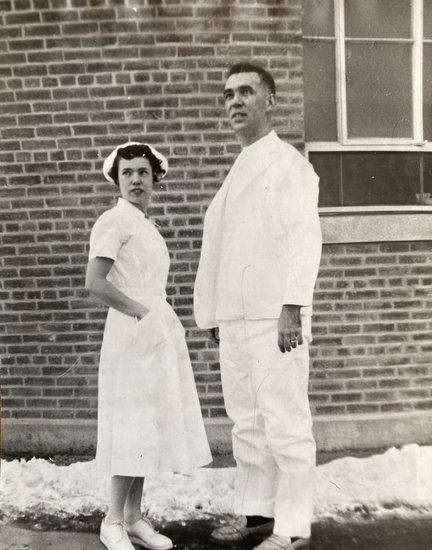
— Photo from Charlie Casey
In the mid-1950s, Shirley (née Atkins) Casey, originally of Westerlo, and her husband, Dr. Clifford Casey, stood outside of a building at Albany Medical Center. Charlie Casey said his mother had just finished nursing school and his father was a newly minted doctor; they wed in 1953.
To the Editor:
I think that many of us over 60 can agree that health care has changed a lot since the mid-20th Century. Many positive advances in medicine and care are giving us a better quality of life and possibly keeping us alive longer.
That's great and I can say that my wife, Susan ,and I have some caring and professional doctors we like very much! But there are times, like the 9- to 12-hour wait in the hospital emergency rooms, that have us wondering what would happen to us all if there was a major environmental catastrophe or, God forbid, civil unrest or an attack from another country.
Our hospitals can barely keep up with the regular or everyday flow of emergency room patients.
Albany Medical Center is the region's only Level 1 trauma center for both adults and children. It offers the widest range of medical and surgical services in a 150-mile radius. That's basically from the Canadian border to the outskirts of New York City, and from Central New York in the west to Western New England in the east.
No other Level 1 trauma centers exist between Albany and Canada. The nearest one in that area is the University of Vermont Medical Center in Burlington Vermont, which is 150 miles away. The closest one to the south is Westchester Medical Center, which is 120 miles away.
There are no Level 1 trauma centers in western Massachusetts or southern Vermont. The nearest facilities to the east are in Worcester or Boston well beyond the 150-mile mark. The next closest Level 1 trauma center to the west is Upstate University Hospital in Syracuse, which is 145 miles away.
So, that's the world we live in. The closer you live to one of these Level 1 trauma centers, maybe the better your chances of getting the help you need quickly, as long as they aren't being overwhelmed.
What choice do we have? They function as capitalists who are in the business of hopefully making a profit while being somewhat sympathetic to the needs of us all, and we are grateful!
There was a time when country doctors were one of the pillars of village life and operated their practice out of their own homes.
Over the centuries they were known by many titles. In many rural areas, local clergy acted as healers combining spiritual care with herbal medicine. Wise women or witches as they were called in isolated areas also used herbs and traditional remedies.
Sometimes it was the barber-surgeon or the local animal veterinarian that performed bloodletting, haircutting, dentistry, and whatever level of medical knowledge they could assist with. There was the apothecary where practitioners, like pharmacists, dispensed drugs and also gave medical advice and treatments to patients, like a doctor.
During the 19th Century, the general practitioner or family doctor became the go-to person for health care and compounded their own drugs and made house calls.
Some were university-trained physicians and surgeons. Some, while not always holding a medical degree, were still doctors affectionately referred to as “Doc” by their communities.
Some well-known rural and village doctors from western Albany County were Dr. Frederick Crounse of Altamont. He began his practice in 1830. Another from Altamont was Dr. Anthony Mastrianni.
Dr. Margery Smith of Berne was described as the “quintessential country doctor,” serving throughout the 20th Century. Dr. Anna Perkins also served the Helderberg Hilltowns. Dr. Platt Wickes served the Rensselaerville area.
Dr. Frances Vosburgh, a Voorheesville native born in 1897 who died in 1989, delivered 2,755 babies during her 60 years of practice. In 1979, at age 82, she was awarded the Planned Parenthood of America Margaret Sanger Award. Dr. Vosburgh was involved with the first family planning clinic in Albany.
Public acceptance of women doctors began in the late 19th and early 20th centuries, though full integration was slow. Women acted as healers for centuries but formally trained female doctors faced professional resistance until the early 1900s, with their numbers growing significantly by 1920.
True widespread acceptance and a significant presence in rural medicine occurred later, particularly after the 1970s as gender barriers fell and the number of female physicians surged.
My friend and historian, Catherine Weidman, left me some notes on the doctors of Voorheesville. They were Dr. Joslin, Dr. Oliver, Dr. Shaw, Dr. Land, Dr. Sutherland, Dr. Graff, and Dr. Casey.
When the undertaker, Frank Bunk, moved from Voorheesville to Delmar and built a house, there was a musical performance at Voorheesville where they sang, “Dr. Shaw, Dr. Joslin, and Dr. Oliver drummed the undertaker out because folks don’t die here.”
In his day, Dr. Oliver owned three horses and he'd pull out in the middle of the night and go even to East Berne. It was said of Dr. Oliver, “Anytime, anywhere, he'd go to doctor the needy.”
Doctor Shaw had one of the first cars in Voorheesville that he used for house calls. Dr. Shaw lived at 6 Voorheesville Ave. next to the old Methodist parsonage, followed by Dr. Graff and Dr. Casey.
When I was a boy in the 1960s, Doc Sutherland and Doc Casey were the only doctors I ever remember seeing, except when I went to St. Peter's to have my tonsils out at 5 years old.
I remember Doc Casey coming to see me on a house call when I was running a very high temperature.
Imagine, doctors coming to your house. Holy cow!
Clifford Casey and his wife, Shirley (née Atkins) Casey met the medical needs for the people around Voorheesville for nearly 50 years.
Shirley was a nurse from Westerlo. Cliff graduated from Bethlehem High School in 1944, attended Union College until 1949, served in the United States Navy hospitals, followed up by earning his medical degree from Albany Medical College in 1955.
He and Shirley were married in 1953, and started their mom-and-pop medical practice, from their home in Voorheesville, in 1959, while also raising a family. I remember Doc Casey as a very kind, friendly and calm man whom my parents would send me to see on my bicycle all by myself, if my medical issue was minor.
He was also the doctor who came to school to give all of us boys our general physicals. Sometimes Doc Sutherland would fill in.
Once I got between two dogs fighting out front of his house and got a good cut so I went in to get it treated and he calmly explained to me what poor judgement I used getting mixed up with trying to break up a dog fight.
His sons tell me he had a disarming and self-deprecating sense of humor often saying he was a “so-so doctor.”
Many people relied on his professionalism, medical knowledge, and kindness!
Doc Sutherland's home and office was closer to where I lived, on Martin Road near Voorheesville’s high school. His place was near the high school between there and the grade school on Route 85A.
He was quite a character who was also very friendly and helpful. I would also ride my bike to see him. The waiting room was in his house, just like at Doc Casey'’.
As a young boy who didn’t know much, I was struck by the fact that Doc Sutherland was overweight and examined me with a cigarette burning and bouncing around in his mouth, no hands, while he spoke to me.
I just have to laugh about how that would go over with people today.
But remember, these doctors were dependable and would do everything they could to help you, your family, and the community, in many different ways. Service to their fellow men and women was their calling.
We are grateful for all these so-called country doctors by any title for being available any time of day even to make house calls. Well those days are gone, pretty much ending here with the 20th Century.
In 1976, Catherine Weidman wrote this poem:
Doctor Sutherland
The world grew better, year by year
Because Doc Sutherland in his little sphere
Answered sick calls day and night
Disease, depression and illness to fight
He took temperatures, prescribed pills
To remedy mankind’s numerous ills
Soothed fevered brows, calmed our fears
Dispensed courage with medicine through the years
Blessed the newborn baby’s first breath
Closed the eyes that were stilled in death
He was tired, discouraged and ready to drop
For Doc’s day used to be “round the clock”
In the ’40s, ’50s, and ’60s, Doc traveled far
In a Ford, a Packard, Lincoln, then a Jaguar car
He longed to rest, and all the while
Wore the same old professional smile
Doc has lived among us thirty-four years
Helped our illness, heartaches and tears
The community loves him and Betty, his wife
We thank them for their sunshine in our life
So, Lord, our prayer is, grant Doc a home with you
When his counseling and doctoring days are through.
I think the difference between modern access to doctors and contacting them through social media, and the way we used to approach the country family doctors of our small communities in western Albany County is that you could get crucial, prompt, in-person care, reducing the need for a patient to travel to a possible distant hospital, which is vital for emergency situations and chronic health issues.
C.J. Dennis (1876-1938) a popular Australian poet and journalist described country doctors with a highly endearing and descriptive sentiment as “The comforters of age ... divorced from greed to serve man’s need, and give their lives to man.”
Wishing you all the best of health and happiness!
Timothy J. Albright
Meadowdale