Proposals: 27 houses and 210 storage containers
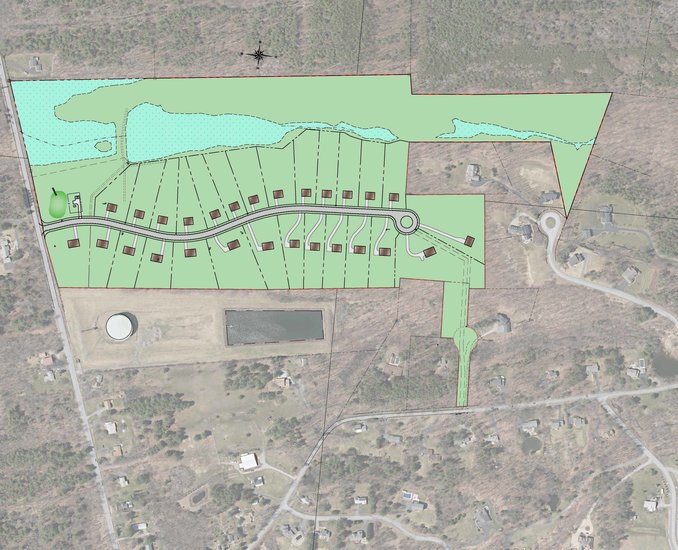
— Rendering from Camp Shelley, LLC submittal to the town of New Scotland
A developer has revived a decade-old proposal to build dozens of homes off of New Scotland Road.Summary
NEW SCOTLAND — A long-dormant proposal to build over two dozen single-family homes off of New Scotland Road was recently reintroduced to the New Scotland Planning Board.
Also on Feb. 3, the board heard about a commercial storage project proposed for Feura Bush Road.
As he did in 2014, project engineer Nicholas Costa presented board members with a proposal to subdivide a 68-acre parcel at 2281 New Scotland Road into 27 residential lots, up from the original 22.
The site, until the late 1970s, was home to Camp Shelley, which ran as a camp during the day and a theatre in the evenings. Costa noted the property included a prominent water feature, Kaye Pond, which has a dam registered with and regulated by the New York State Department of Environmental Conservation.
The size of the homes, the board was told, would be around 2,000 to 2,200 square feet and larger, resembling other nearby neighborhoods. The development would require bringing substantial infrastructure into a largely rural tract, with more than 2,000 linear feet of new road proposed, along with municipal water service, and a private wastewater treatment plant.
Chairman Jeffrey Baker told Costa and applicant Jameson Phillips, “The town has been very careful about investing resources in natural-resources mapping and looking to protect the natural resources and have some better designs, if possible, [rather] than a straight conventional subdivision.”
“So,” with that in mind, Baker said, “I’d like you to present and develop an alternative [cluster] development,” which he said should “show your ability to lay it out and how it will generally protect the resources; it doesn’t [have to] reach the level of a preliminary plat.”
Clustering development allows for certain zoning requirements to be waived, like lot size, lot width, lot depth, along with other yard requirements, as well as density bonuses in some areas.
But before an alternative design can happen, and with the last one completed over a decade ago, a new wetland delineation is needed, Baker said.
Building Inspector Jeremy Cramer said that, once completed, the delineation will “show the constrained lands, what the steep slopes are, what the wetlands are … [it’s] really the only way to start off with your cluster, and be able to get the numbers correct.”
Baker also wanted to see more information on the proposed on-site wastewater treatment plant, asking for financial projections detailing debt service and operating costs passed to homeowners, citing issues with previous projects.
Cramer raised the issue of ownership of the subdivision’s open spaces, specifically Kaye Pond and its DEC-regulated dam. “Do you foresee this being an HOA?” he asked, referencing a homeowners’ association. “Do you foresee the pond being used for recreational purposes outside of stormwater management? And what entity would be owning and operating knowing that this is a DEC-regulated dam?”
Costa said, “I think that it shows some trails would be open … There would be a way to get to it for the residents, but I’m not sure about the HOA.” That was a question for Phillips, he said.
“I would say whatever is the easiest to do for the community,” Phillips said. “Whether that’s the HOA or — people in the past have talked about giving it away to a land conservancy kind of thing.”
Baker said ownership needed to be clearly defined before the board could take action.
Baker closed the discussion by summarizing Camp Shelley’s next steps:
— Complete the new wetland delineation;
— Prepare a cluster alternative design;
— Re-engage with the water committee;
— Provide additional natural resource and habitat information, including eventual tree-clearing implications;
— Supply pro forma financial projections for the wastewater treatment plant; and
— Propose a formal ownership and maintenance structure for the pond and open space.
Storage
Flach Industries is seeking approval to operate a shipping-container storage and leasing yard at 1353 Feura Bush Road. The proposed project is located on property entirely inside Bethlehem’s municipal boundary, but the driveway to the site is located in New Scotland. Therefore, the state’s Town Law requires New Scotland review.
Flach is proposing to use roughly 1.66 acres of a 34.4-acre property in the town’s industrial zone that’s already permitted for a construction yard.
Plans submitted to the town show the site could house approximately 210 containers each measuring 20 feet long by 8.5 feet wide by 9.5 feet tall, which could be stacked three high.
What the board sought to make clear was: Was Flach proposing a long-term shipping-container storage facility or a rotating equipment yard?
“They’re not shipping containers,” members were told. “They are built to look like shipping containers,” but they’re actually storage containers.
Mark Beck of United Rentals told the board, “There’s a big difference between a shipping container and a storage container. A shipping container, for example, is what you would see at a port or what you’d see on a truck that is headed from a port to a retail establishment. And they go back and forth [across] the ocean. They cross the ocean … They get loaded up and come back here and offload, and go back to China — you know, back and forth, back and forth. That’s a shipping container.”
Beck said, “What we do is completely different. We buy from the same manufacturers. They build them to our spec, to our colors. They decal them. They do come across the ocean one time. They’re offloaded, and then they’re sent to our facilities all over the U.S., and then they’re used as storage containers, off-site storage containers for, like, construction projects, et cetera.”
He continued, “We do not, by the way, that’s one really important key point here, we do not allow any on-site storage. So if a customer were to come to us and say, ‘Hey, I want to use one of your storage containers and fill it up with all my stuff and keep it on your site,’ we do not allow that.”
When asked how returned containers were handled, Beck said customers are required to sweep out units before return; hazardous or leaking materials are prohibited. If a container comes back contaminated, he said, it’s pulled from the rental stream and sold off rather than being rented again.
As for traffic, Beck said activity would start with only a handful of pickups and dropoffs per week, but a “high-performing branch” sees approximately seven to 10 movements per day on weekdays
With the Albany County Planning Board still having to weigh in on the proposal, the board took no action on the application.