Friends of Thacher raises funds to update nature center
The Enterprise — Marcello Iaia
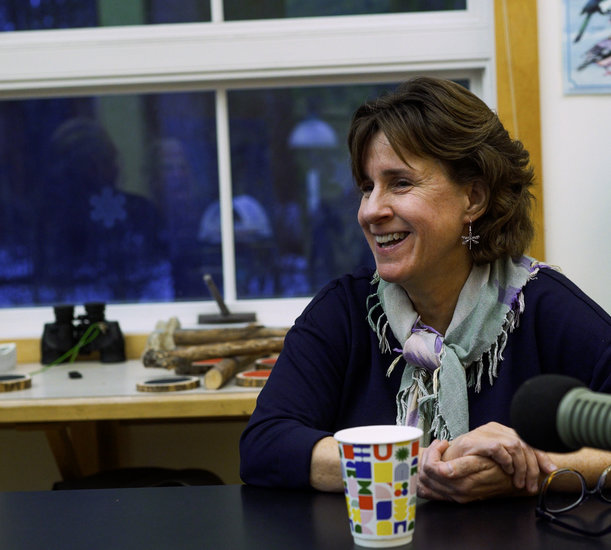
“We can recreate up here but we can do it in a way that preserves this resource for future generations,” said Laure-Jeanne Davignon, president of the Friends of Thacher State Park.
ALBANY COUNTY — John Anderson vividly recalls one of the first major donors he approached to fund a transformation of the Emma Treadwell Thacher Nature Center.
“I asked him, ‘Why do you support the park?’” Anderson recalled. “He said, ‘When I was 5 years old, I found a fossil in the park. And ever since then, I’ve had this strong relationship with the park.”
That sort of life-long relationship is what Anderson and Laure-Jeanne Davignon want to instill in youth.
Davignon is the president of the Friends of Thacher State Park. The volunteer group — 200 strong — is currently in the midst of raising money for what she calls “a reimagining” of the nature center.
The not-for-profit group under Anderson’s guidance has already passed its initial goal of raising $100,000 and on Jan. 14 he said, “We’re up to about $140,000 now.”
Then, on Jan. 16, the state’s Office of Parks, Recreation and Historic Preservation announced that $190,000 had been awarded to the project.
“Our grant was one of the larger ones across the portfolio,” said Davignon of the $2.25 million in awards.
Private-public partnership
The land on which the nature center stands as well as the building itself are part of a private-public partnership, something the Friends of Thacher State Park is furthering.
“We like to say there’s uppercase and lowercase Friends,” said Davigonon.
Dues-paying members receive a newsletter, which is also available on the Friends’ website. “But we have this whole community that gives time, effort, and spends time up here,” said Davaignon.
The Friends of Thacher Park formed in 1997 at first to help salamanders mate. The amphibians depend on vernal pools for breeding in the spring. “We’re cutting them off from those breeding grounds,” said Davignon.
So volunteers, on rainy spring nights, help the amphibians cross roads to get to vernal ponds without being squashed.
They also take on myriad other tasks from removing invasive species to maintaining trails as well as fundraising.
The nature center itself began as a private-public partnership and is following that model with the current upgrade.
In 2001, Fred and Martha Schroeder donated $400,000, handled through the National Heritage Trust, to build the center; they also donated another $350,000 to support it.
Fred Schroeder, a Brooklyn native, had worked for the Albany Boys’ Club for 30 years and directed Camp Thacher where the center now stands on the shore of Thompsons Lake.
The Schroeders requested that the center be named after Emma Treadwell Thacher and so it was.
Mrs. Thacher started the private-public partnership when, in 1914, she donated 350 acres along the Helderbergs in memory of her husband, which is now John Boyd Thacher State Park. She later donated another 50 acres on the western shore of Thompsons Lake with the stipulation that 10 of those acres be set aside for the Albany Boys’ Club as its summer camp, Camp Thacher.
The nature center displays the only two known pictures of Emma Treadwell — one of her face taken from a group photograph when she was a student at the Albany Academy for Girls; the other of her in an Adirondack guideboat with a rustic cabin in the background.
A six-sentence obituary in the Feb. 19, 1917 edition of The New York Times describes her as being married to Albany’s late mayor, John Boyd Thacher, whom she married in 1872, and as being the great-granddaughter of John Treadwell, “the last of the Puritan Governors of Connecticut.”
The obituary also says she gave to the state her summer home at Thacher Park, and to the Congressional Library at Washington “the great collection of incunabula or century printing for the use of all students of the world.”
Finally, the obituary notes, “She also possessed a fine collection of wampum belts, including the Washington peace belt of the Six Nations.”
When the nature center was built a quarter-century ago, “there was no visitor center,” said Davignon. “We had a very small booth.”
That building was constructed during the Works Progress Administration in the 1930s, Davignon said, and is currently used by the park police. The park’s $4 million visitors’ center wasn’t opened until 2016.
The two buildings share staff for various events throughout the year, Davignon said.
The mission
Both Davignon and Anderson speak with passion in this week’s Enterprise podcast about upgrading the nature center.
Davignon, who grew up in New Jersey near New York City said she “always had a hankering for the wild spaces as they were.”
She lived for 17 years on Ketchum Road in Knox near the park and now lives in Albany. Her job involves developing the workforce needed to transition to a carbon-free economy, while also trying to address historic inequities.
A lot of scientists and environmentalists are involved with the Friends of Thacher Park, she said “because they recognize just the really unique resources we have up here.”
Davignon went on, “My day job is clean energy. The reason I do that work, which is becoming more difficult every day, is because I care, again, about the future that we’re leaving for my pieces and nephews and for all our kids and grandkids. And because of my love for the wide-open spaces …
“I’ve been out in Wyoming doing the geological fieldwork and seeing the oil rigs in the middle of this beautiful, supposedly untouched wilderness … In addition to the inarguable fact that the carbon economy is impacting our environment, it’s also taking up a lot of the resources that are in our open and wild spaces.”
She concluded, “Our aim is not to be political here. However, that is a strong motivator for me in working with groups like the Friends to ensure that we can recreate up here but we can do it in a way that preserves this resource for future generations.”
Anderson grew up in northern Westchester County when it was still rural; he can remember having to stop a car to wait for a farmer to get his cows across the road.
“It’s a very different place right now, but I grew up loving nature,” said Anderson.
After a career in academia that included being president of both Alfred State and Millersville University, Anderson retired to Voorheesville.
He says the park is in his backyard and he uses it year-round, bicycling to Thacher in the warmer months and skiing there in the colder months.
He attended a Friends meeting where the director of the nature center, Rebecca Schneider, “presented a new vision for the nature center,” he recalled. “And the new vision really caught my eye because I have grandchildren now, and I take them to children’s museums and science centers ….
“I’ve noticed that, as young children, they focus on things that are much more interactive. And when you capture the young mind at an early age, you instill maybe subconsciously an interest in nature.”
The plan
Working with architects Saratoga Associates, the plan is to keep the building structure as it is.
“It’s not quite a full gut,” said Davignon. “We’re not going down to the studs … The basic building envelope will stay the same.”
The room that is used as a science lab for older children will also remain the same.
But the central center space will be structured around four habitats native to Thacher Park: meadow, pond, forest, and Devonian sea.
“We know about how kids and adults interact with things in the space they are in, and how they learn and how they retain knowledge,” said Davignon. “So, when you walk in, you’re basically going to be immersed in a number of micro-ecosystems that we have up here.”
The meadow portion will have hexagon structures stacked like a honeycomb so that children can crawl inside each cell as they learn about the life of honeybees.
A pond room will feature a stick-built beaver den and a blue heron nest set while the forest portion will feature a giant eight-sided wood framed “tree” that children can enter.
The ancient sea room will have an accessible fossil dig.
“It’s not just the present ecosystems that we’re featuring,” said Davignon. “It’s also the fact that this used to be an ocean. And the creatures that we see in the rock, the fossils, are part of why Thacher is a world-renowned spot that scientists have come to since they had boats to visit us.”
She noted that the park was designated as a National Natural Resource in 2023, largely because of its geology.
The nature center is visited by about 3,000 children annually. “Maybe two-thirds of the visitors are through school groups — elementary through high school,” said Davignon.
Campers at the nearby state campground on Thomsons Lake also frequently visit, especially if it’s rainy. Anyone, she said, can walk in.
The goal is to have exhibits and some trails accessible to people with handicaps and to reach a diverse population.
“I’m back in the city, so I know how it can be difficult to get out,” said Davignon, explaining the “two ways the Friends participate in bringing folks of all stripes up to the park — not only urban folks … There’s folks living out here in the rural areas that had never heard of a park and had an opportunity.”
The Friends have helped bus kids in for school trips and have also been part of a partnership with the Capital District Transportation Authority, which runs a free Nature Bus to the park from the city of Albany.
Davignon calls Anderson “an angel” and says he has never been turned down when asking a donor for a contribution for the nature center upgrade. He started with a list of donors to Thacher Park.
Anderson sees the importance of what he calls “margins of excellence.”
“You depend on private donations to do things that are a little different or enhance a program in some way,” he said.
He gave the example of someone asking, “Why should I give to Thacher Park Nature Center? That’s a state facility.”
“Well, it is technically,” Anderson explains. “But it’s the private support that created the building. It’s the private support that’s going to help really raise the margin of excellence for this nature center in terms of new exhibits that are appropriate now for the way we educate young people in terms of their environment; there's no line item in the state budget for exhibit upgrades.
“Look at our museum downtown … I took my children there as young children. I take my grandchildren there, and it’s the same exhibit. So that’s what I mean by margin of excellence. You want to do something above what’s baseline provided for you.”