Voorheesville gets $200K in state funds to start restoring hay-and-grain mogul’s headquarters
The Enterprise — Michael Koff
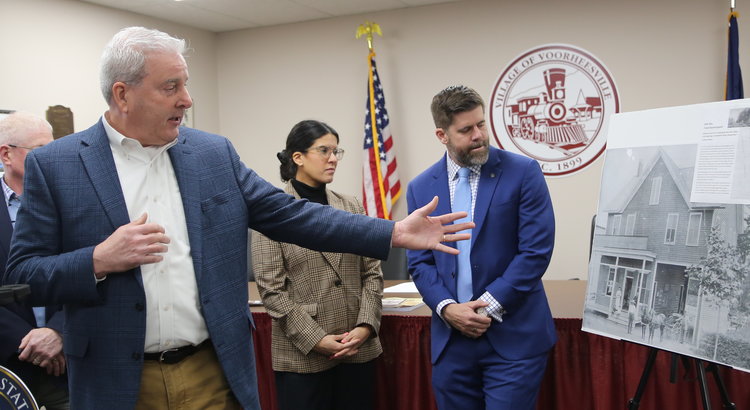
Voorheesville Mayor Richard Straut points to a picture of 18 South Main as it looked at the turn of the last century. Behind him are Assemblywoman Gabriella Romero and Albany County Deputy Executive Michael McLaughlin.
VOORHEESVILLE — An appreciation for history has saved an old building that may eventually serve a new purpose.
The village of Voorheesville purchased 18 South Main a year ago for $170,000 to use as a parking lot, needed for its revitalized business district, fulfilling a goal of the village’s 2018 comprehensive plan.
The vacant building on the property had long housed a hardware store. But, before it was demolished as originally planned, Village Historian Dennis Sullivan made Voorheesville aware of its history.
Frank Bloomingdale ran his hay and straw business, one of the largest in Albany County, from the building, shipping between 6,000 and 10,000 tons of hay annually to New York City and other principal markets, Sullivan wrote in his book, “Voorheesville, New York — A Sketch of the Beginnings of a Nineteenth Century Railroad Town.”
Bloomingdale was elected the village’s first mayor — titled then as president — on June 2, 1899. He called the newly elected officials together for a meeting at 18 South Main Street.
Bloomingdale, who died in 1933 at the age of 80, had, at the turn of the century, the largest amount of taxable property in the village and was one of Voorheesville’s wealthiest residents.
Sullivan termed him a “hay and grain mogul” — a phrase that was playfully repeated several times on Tuesday morning as local, county, and state officials gathered at Village Hall to celebrate $200,000 to begin work on restoring the building.
The state funds were secured by Senator Patricia Fahy and Assemblywoman Gabriella Romero — with each presenting giant checks for $100,000.
The money will be used for the first phases of renovation, including asbestos abatement, removing non-original building additions, and stabilizing the structure, which was determined to have “good bones.”
“This is a really exciting moment for Voorheesville,” said Mayor Richard Straut at the Jan. 6 gathering. “We have an opportunity to support economic development in the village and also preserve a key piece of our history.”
On Nov. 12, Straut had hosted a session where residents could share their views on the best uses for 18 South Main. Generally speaking, residents favored a multi-use space that serves the community while honoring the village’s heritage. More specifically, ideas offered included the creation of a community hub for events and services, an artisan maker space or co-op gallery, and various retail concepts like a general store or ice-cream shop.
“Our original thought was we might tear this building down, and we learned what we learned,” Straut said on Tuesday. “We went in and took a look at it and realized we can save this and it can become a key part of our history …. And a key part of our infrastructure in the village.”
Voorheesville and New Scotland together hired Hartgen Archeological Associates to complete a cultural resource survey in 2023, which found 10 resources in a proposed Voorheesville Historic District would be individually eligible for listing on the National Register of Historic Places among close to 100 contributing resources.
On Tuesday, Fahy noted that, when Straut reached out to her about funding, “You said the magic words: preserving our history.”
Fahy had been instrumental in keeping Guilderland Center’s historic Cobblestone Schoolhouse in public hands — it now belongs to the town of Guilderland — when the school district was selling it.
“Every day,” said Fahy on Tuesday, “we are forgetting the lessons of our history. I often say I don’t think we would be such a divided country if we had more appreciation and respect and reverence for our history. And some of that history really starts with remembering the shoulders we all stand on, right?”
Fahy said she loved that Bloomingdale was a “hay and grain mogul” and went on, “This was an important farming community, right here on the outskirts of the state capital … It’s just drowning in history.”
Children, Fahy said, can learn from history if it is not torn down “as we have such a habit of doing in this country. It teaches all future generations that these were farmers, often immigrants, hardworking individuals.”
She concluded by commending Sullivan and urging, “Remember who we are and what we are … That building is a visual, physical reminder of who we are and why it is so important that we appreciate more of our history.”
Romero said she was filled with joy and anticipation as she announced the $100,000 grant she had secured. Assembly members, she said, “have wide discretion to give capital grants to any corner of our district.”
The choice, Romero said, “really shows your values and your morals when you decide what you invest in.”
She described the Voorheesville project as a mixture of preservation and economic development. “This project will really revitalize an old historic space but provide, in the future, for a space for this kind of revitalized downtown.”
New Scotland’s supervisor, Dougla LaGrange, who lives on a farm his family has owned for generations, spoke of the “personal connection” he has to 18 South Main.
“I actually have a picture of my grandfather on a large pony or a small horse as a kid outside of the feed and grain store,” he said.
LaGrange also repeated an adage on history: If we don’t know where we’ve been, we don’t know where we’re going.
Michael McLaughlin, Albany County’s deputy executive, said that each of the county’s four villages has a unique character.
He and his family regularly come to Voorheesville, McLaughlin said, “to dine and spend time because of these projects. They accumulate over time and they create something that draws people in.”