In 2025, faced with problems endured by much of rural America, Hilltowns seek solutions
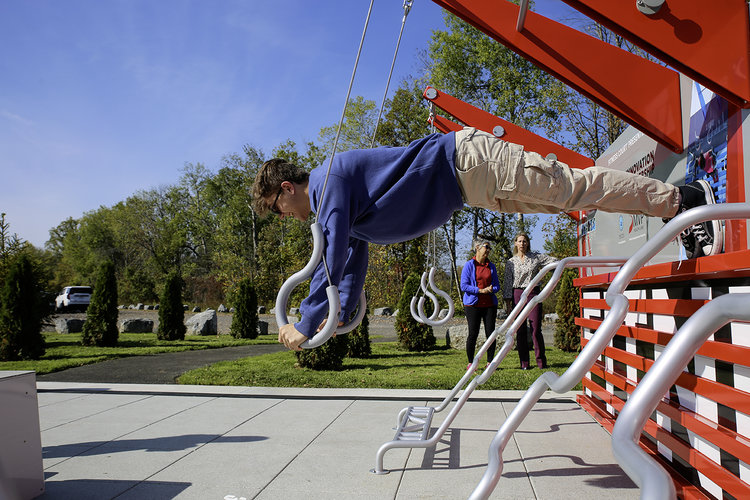
Enterprise file photo — Michael Koff
Brandan Redick, a Berne-Knox-Westerlo cheerleader, goes horizontal at the new Fitness Court in Berne's town park on Sept. 30, moments after the ribbon was cut. Albany County Executive Daniel McCoy said the county’s Innovation Partnership with MVP paid $195,500 for the court while the county paid an additional $50,000 in labor, equipment, and materials to construct the court.
HILLTOWNS — Our first edition of 2025 carried the sad news of several Hilltown fires — two in Rensselaerville, one in Knox, and another in Westerlo.
We reported on the losses — unbearable in the case of the Knox fire, which killed the couple whose home had burned — and also on advice that could prevent other cold-weather fires: clean stoves and chimneys, plug electric heaters directly into outlets, keep kerosene heaters clear of drapes and clothes.
We pictured the silent heroes who came in the bitter cold and the dark of night to fight those fires. All of the Hilltowns rely on volunteers, men and women who go through hours of training and drills and risk their own health and safety to rescue their neighbors.
That story was a metaphor for our reporting over the past year in the four rural Helderberg towns of Albany County. In 2025, the Hilltowns faced problems typical of country communities across the nation and in many cases helped to solve them or at least endure them because of the residents themselves.
Another example that spans the Hilltowns was the official opening in November of the Gathering Hope Food Pantry at the Thompson’s Lake Reformed Church, sponsored by the Helderberg Family and Community Organization.
Like the rest of the nation, the Hilltowns were buffeted by the federal government shutdown and the threat to SNAP (Supplemental Nutrition Assistance Program) benefits.
After a year of renovations, the not-for-profit group felt ready to shift its status from pending to being an active member of the Regional Food Bank but due to the cuts in federal funding, the Regional Food Bank had frozen all new and pending applications indefinitely.
Nevertheless, with support from 100 Women Who Care, local businesses, and local fire departments among others, the Gathering Hope Food Pantry opened.
The organization’s president, Maryellen Gillis, quoted anthropologist Margaret Mead at the opening ceremony: “Never doubt that a small group of committed citizens can change the world. Indeed, it is the only thing that ever has.”
Politically, the Hilltowns were also influenced by national trends.
In 2016, when Donald Trump was first elected president, he won across the Hilltowns although voter enrollment was, and still is, more Democratic than Republican. Subsequently, Republicans made inroads in the town boards in Berne, Knox, and Westerlo — which had been dominated by Democrats for decades — ending with town board members backed by the GOP.
This November’s elections saw Democrats making inroads in several Hilltowns.
Rensselaerville has a history, distinct from the three neighboring Hilltowns, of at least a half-century of bipartisan town boards.
Berne
In 2025, politics continued to be contentious in Berne as in January the town sued Governor Kathy Hochul over her inaction on an appointment to the town board.
The GOP-backed five-member board had been without a quorum since August 2024 when three of the board’s members abruptly and simultaneously resigned, claiming financial mismanagement and a toxic work environment caused by the supervisor, Dennis Palow.
Later in January, the governor appointed Democrat Melanie laCour, a lawyer new to politics, to the board, restoring a quorum. She was sworn in in February and in March, the board met for the first time since the previous July.
At that March meeting, laCour surprised her Republican colleagues by making a motion to restore public comment at that and all future meetings.
There was no second and Palow explained that he would not allow public comment at meetings because people were often “nasty.”
Palow did not seek re-election nor did Deputy Supervisor Thomas Doolin. All of the candidates who were elected — all posts were open — said they were in favor of having a public-comment period at meetings.
In May, laCour again was at odds with the other board members when she voted against entering into a contract with Albany County for ambulance service that will cost the town $225,000 — money it does not appear to have in its $2.6 million 2025 budget.
That money is due this January, after Palow leaves office and an all-new board takes over. The town had been showing signs of severe fiscal problems, having already overdrawn its payroll account several times in 2023 and letting utility bills go un- and underpaid for years.
New York State Town Law says that a town shall not enter into a contract it has not budgeted for unless funds are transferred to the appropriate account.
“I just don’t think I can vote ‘yes’ for something that I’m not sure where we’re going to get the money to pay for it,” laCour said, emphasizing that her concerns had nothing to do with the actual ambulance program from the county sheriff’s office which the town has relied on for years.
“This is a yearly expense,” said laCour at the May meeting of ambulance service, “and you just completely left it out of the budget. All the money in the budget is accounted for. And now you’re saying we’re going to add this on top of it, and you’re not telling me where that money is coming from … I am not going to enter into a contract I know we can’t pay for. That is fraud.”
Fifty-eight percent of registered voters in Berne — far higher than the norm — cast ballots in November, electing a bipartisan town board.
Joseph Giebelhaus, a Democrat who had been appointed to the board in April, was elected supervisor on three party lines: Democratic, Republican, and Conservative.
He had moved to Berne after working for 28 years for the city of Albany, including 18 years as solid-waste manager and seven years as deputy commissioner of the city’s general services department.
Among the four candidates who sought four-year terms on the town board, retiree Brian Bunzey, a Democrat, was the top vote-getter followed by Republican Casey Miller, a business owner.
Among the three candidates seeking two-year terms on the board, Scott Duncan, chief of the East Berne Volunteer Fire Company who works as Albany County’s deputy commissioner of public works, was the front runner followed by laCour.
In October, Giebelhaus released a $4.24 million preliminary town budget for 2026 that he said “rights the ship” by aligning revenues with actual costs, increasing town taxes by 38 percent.
The increase, Giebelhaus says, was to eliminate an average deficit spending of 30 percent from 2021 to 2023.
Typically, a supervisor, as the town’s chief financial officer, releases the budget but Palow ceded that responsibility to Giebelhaus.
“This came from Joe Giebelhaus,” said Palow of a budget and financial presentation during an Oct. 22 public hearing as the town board considered a law that would allow Berne to go over the state-set levy limit. “He did it on his own,” said Palow.
All four board members voted in favor of piercing the tax cap. Then, after a contentious public hearing on Nov. 12, all four board members voted to adopt the preliminary budget.
Palow used that November meeting to skewer Joel Willsey, a Democrat and former town board member.
Willsey had raised concerns about this year’s budget process since, by law, a town board member is not supposed to draft a town budget, and about the suspension and firing of Shawn Duncan, who had worked at the town’s transfer station for six years.
The Enterprise learned that Berne had never entered Duncan into the Civil Service system as it should have; the county has no record of his employment. The town has not addressed this apparent oversight.
In July, Duncan was suspended without pay one day after he spoke out against Highway Superintendent Randy Bashwinger to The Enterprise in a private conversation. Duncan claimed that it was an act of retaliation.
He alleged that Bashwinger had the highway department workers pose for a photo that he then posted on Facebook, where Bashwinger claimed — falsely, Duncan said — that he had the endorsements of all the employees as he sought re-election in November.
Duncan said that Bashwinger referenced these allegations and The Enterprise’s attempts to reach the involved parties as he was suspending Duncan on July 23, accompanied by Palow, Giebelhaus, and an Albany County Sheriff’s Deputy.
Duncan was fired by the town board at its Aug. 13 meeting.
“The charges against you include violations of town policy, failure to comply with workplace standards, insubordination, reports of harassment against both colleagues and residents, as well as creating a hostile work environment,” said the one-page Aug. 14 letter that was sent to Duncan.
Duncan was not at the Aug. 13 meeting but he talked to The Enterprise later, saying he had never faced any disciplinary measures and never heard complaints about his work from Bashwinger or anyone on the town board until the day after he spoke out against Bashwinger to The Enterprise.
“I never had no write-ups,” he said. “I do incredible work.”
Bashwinger was ousted in the November elections after the Republican Committee backed his opponent, Allen Stempel.
Stempel, a Republican, ran on the Democratic line after he didn’t get the nod at the GOP caucus. He garnered 57 percent of the vote.
When The Enterprise asked before the election why he was running, Stempel said, “To honor my family’s commitment and dedication to our community.”
The late Rudy Stempel, a Republican who ran the saw mill in town, had been Berne’s supervisor in the midst of decades of Democratic control.
Asked why he had lost the backing of the committee he once chaired, Bashwinger said then that the schism occurred after the three board members quit: “It was instant. The spark was because the three of them are pissed at me because I didn’t come out against Dennis Palow.”
Besides Bashwinger, two other candidates that were chosen at the GOP caucus had the Republican line on the ballot but were not supported financially or with publicity by the Republican Committee: Town Clerk Kristin De Oliveira; and Stephanie Audino, who is running for tax collector.
De Oliveira won handily while Audino won by 12 votes.
“We’re running a bipartisan slate, supporting candidates on both lines,” Joe Martin, the Republican chairman, told The Enterprise in September when asked about not supporting the three candidates who had been chosen at the caucus. “And every single resident tells us that they want normalcy back in town and are so tired of the toxic environment from past administrations.”
Knox
As farmland is decreasing dramatically across the United States, Knox has a proposal to preserve its own.
In September, the Knox Town Board heard from the head of the town’s agriculture committee about a plan to protect the one third of land in Knox that is used for agriculture.
Gary Kleppel, a sheep farmer and professor emeritus, said his committee has drafted an application to get a $25,000 grant from the state’s Department of Agricultural and Markets.
The Knox committee’s approach differs from the usual farmland protection plans that various municipalities have adopted. Those plans lock the farmland down by removing development rights.
“The focus of our proposal,” Kleppel told The Enterprise, “will be to secure and improve the livelihoods of farmers, to make farm families and farm livelihoods more economically and environmentally secure.”
Kleppel envisions surveys and sessions where farmers can “come and talk about what keeps them up at night,” he said. “When you know the problem, then you can solve it,” said Kleppel, adding, “Or at least you can decide whether it’s solvable.”
Kleppel thinks, for example, the karst topography in the Helderbergs affects more than just farmers. The thin layer of soil over the limestone means most Hilltown farmers don’t raise vegetables but rather focus on protein like meat or milk or eggs, he said.
The karst topography resulted from the limestone bedrock being dissolved by rain or groundwater causing caves and sinkholes and disappearing streams. It’s a fragile ecosystem.
“Our water supplies are sensitive — that is something that not only farmers but everybody in town has to be concerned about,” said Kleppel.
The town’s last dairy farm, the Gade farm, closed on June 2. “From 1974 to June 2025,” said Kleppel of the last half-century, “we went from 35 dairies to zero.”
If Knox is successful in securing the grant, rural planner Nan Stozenburg, formerly a farmer herself, “would take the lead in data collection, mapping, workshops … to develop a tractable plan, one that we can use,” said Kleppel.
Roughly 150 Knox residents, 6 percent of the town’s population, are farmers, he said.
“That doesn’t sound very high but remember that 1 percent of the people in the United States of America are farmers. So we have six times more farmers than the average."
Also, while many landowners are not farmers themselves, they lease their land to farmers for, say, grazing or haying. Knox Supervisor Russell Pokorny said that there are 1,500 agricultural exemptions in town as 33 percent of the land is farmed.
“We are an agricultural community,” said Kleppel. “Agriculture is our economic engine.”
This year, Knox developed a $2.8 million budget for next year, which is down over 12.5 percent from the 2025 spending plan.
The spending decrease is almost entirely due to an over 40-percent reduction in the town’s departmental budget for home and community services and can be attributed to a $250,000 line item in this year’s budget used to help pay for the rebuild of the town’s transfer station.
In 2022, the town’s 40-year-old transfer station was found to be in a state beyond repair.
In November, Knox voters elected the town’s first female supervisor and ousted the highway superintendent. About 43 percent of registered voters in Knox cast ballots in the election.
The two Republican-backed incumbents on the Knox Town Board, Kenneth Saddlemire and Karl Pritchard, kept their seats.
Town Clerk Traci Delaney bested political newcomer Democrat Chasity McGivern with 59 percent of the vote. Democrat Pokorny did not seek re-election, meaning the 2026 board will be entirely GOP-backed.
Delaney, who has been Knox’s clerk for eight years, wrote to The Enterprise before the election, saying, “I believe I am known for my integrity, teamwork, accountability, and dedication to doing the right thing, even if it is not the most popular decision.”
She also said her main goals are “to offer more community-based gatherings to bring our town residents closer together, to strengthen our town relationships with our surrounding communities, to work with a balanced budget that relates to the needs of the entire town and the town’s long-term financial stability.”
The Republican highway superintendent, Matthew Schanz, was ousted by Joshua Gebe, an independent, who ran on the Democratic and Conservative party lines and garnered 52 percent of the vote.
Schanz, who worked for the highway department since 2004, ran on his record.
Gebe works for the Berne Highway Department, has run his own trucking business, and volunteers as a firefighter.
He told The Enterprise before the election, “I’m running to offer the transparency, integrity, and steady commitment our community deserves.”
Gebe said the most important issue in the race was “the lack of collaboration between Knox and our surrounding highway departments … I would take a proactive approach to rebuild these relationships.”
This past winter, Knox disagreed with Albany County’s accusation that the town misappropriated $18,000 worth of road salt from the shed it shares with the county.
Asked about this, Gebe said, “Knox can either build its own salt shed for full control and transparency or pursue a shared resource agreement with Albany County. Independent storage ensures accountability but requires upfront investment. A joint oversight plan with clear tracking, regular meetings, and shared upgrade could rebuild trust and improve collaboration whole mating access to share resources.”
Westerlo
As the United States faces a significant housing shortage — particularly of affordable housing — the town of Westerlo made strides this year, streamlining the permitting process for accessory-dwelling units to make it easier for elderly residents who’d otherwise be looking for dedicated senior housing in the suburbs to stay close by.
Sometimes known as mother-in-law apartments, ADUs are secondary homes on a property that don’t require a subdivision due to their relatively small size.
Westerlo Supervisor Matthew Kryzak told The Enterprise last January that the endeavor is essentially a backup plan, having learned that it was very unlikely that a senior-housing developer would ever break ground in the rural community.
“I’ve looked into trying to entice senior living developers into Westerlo,”Kryzak said. “You need three things. Three-phase power, public water, and public sewer. Without those three items, it’s hard to support multiple dwelling units.”
The head of the town’s combined zoning-and-planning board, Bill Hall, who drafted the legislation, told The Enterprise that senior housing is a “big issue” in the town, and that more ADUs is a “no-brainer.”
In May, by a unanimous vote, the Westerlo Town Board did away with the requirement for a special-use permit to build accessory-dwelling units of a certain size. So any ADU up to 1,200 square feet of living space is permitted by right. A unit larger than that still requires site-plan approval and a special-use permit.
The town was rocked on June 30 by a fatal crash. According to the police accident report, the driver, traveling west on Route 404 in an SUV with five passengers, had run a stop sign at the intersection, colliding with a tractor trailer traveling north on Route 401.
Just after the fatal crash, Albany County Department of Public Works Commissioner Lisa Ramundo told The Enterprise in a statement that the intersection is fully compliant with applicable laws and regulations.
The intersection has been the scene of three other fatalities and 27 other accidents since 2007, state data shows, backing up community perception that it is dangerous.
However, speed was listed as a factor in only one crash.
At its July meeting, the Westerlo Town Board voted unanimously to request a blinking traffic light from Albany County at the intersection. At the same time, a petition calling for safety improvements at the intersection was circulated.
The petition garnered 2, 252 signatures. Westerlo has a population of about 3,200.
Albany County subsequently made a number of improvements, including installing more “stop ahead” advanced warning signs and LED-lit signs, clearing brush well away from the signs, adding orange flags to the tops of the stop signs, and painting the pavement with “STOP AHEAD” in large letters.
The town hired an attorney to investigate complaints about Town Clerk Karla Weaver, releasing the report in May. The attorney, William J. Keniry of the law firm Tabner, Ryan, & Keniry, found that Weaver had intentionally disrupted town-hall workflow, falsified documents, and bullied and intimidated at least some of her coworkers — all of which she denied in a blanket statement.
“The so-called Report is an outrageous and untrue attack on me both personally and professionally,” Weaver, who did not cooperate with the investigation, told The Enterprise in an email in May. “I’m evaluating my options and will respond appropriately in the very near future to protect my good name. I think the residents of Westerlo see what’s really going on here.”
The investigation was triggered by two formal complaints made in February by Lisa DeGroff, who is the confidential secretary for Kryzak, and who also heads the Westerlo Republican Committee.
In August, the town board passed two resolutions based on Keniry’s findings: one was to fire long-time employee Claire Marshall and the other was to require Weaver to pay for training in areas deemed problematic in her work.
Kryzak’s resolution said that Keniry’s “confidential investigation” included particulars “pertaining to the conduct” of Marshall and alleged “violations of the Town of Westerlo Employee Handbook among other things.”
Each of the resolutions passed by votes of 3 to 2. All of the town board members have Republican backing but two board members — Peter Mahan and Joshua Beers — frequently clash with Kryzak who made the motions on Aug. 19. Councilwomen Amie Burnside and Lorraine Pecylak voted with Kryzak.
In November’s three-way race for two town board seats, Democrat Jody Ostrander and Republican William Hall bested incumbent Republican Pecylak, who had served on the board for four years. About 36 percent of registered voters in Westerlo cast ballots in the election.
Ostrander, a former highway superintendent for the town who had started working for the highway department in 1994, was the top vote-getter with over 42 percent of the vote.
Hall, who was making his second run for the office, got over 40 percent of the vote.
Hall, who has worked as a small-business owner and farmer, told The Enterprise, “The primary issue in Westerlo is the lack of open discussion and transparency from the board. Each member of the board should be making independent decisions in front of the public. Decisions seem to be made in advance and the majority always votes together.”
He said of the town board’s split vote that led to firing an employee and requiring training for the town clerk, “The interpersonal problems are out of control and this shouldn’t have gone as far as it did.”
A former planning board member, Hall opposed consolidating that board with the zoning board. If elected, he said, “I would absolutely restore the planning board.”
In 2025, Westerlo lost its leader of more than four decades.
Richard H. Rapp, who worked for Westerlo for more than half a century — serving as supervisor for 41 years — died on Sept. 1, 2025 at the age of 87.
Rapp oversaw the modernization of a town that, when he started working for Westerlo, had mostly dirt roads, no highway garage, no town hall, no library, no public water system, no town park, and no museum.
After he resigned in 2019, the town hall was named after him.
“He would seek people out who had problems and issues within the town to help wherever he could,” said William Bichteman who served as deputy supervisor under Rapp and became supervisor himself after Rapp stepped down.
Rapp’s time as supervisor wasn’t without controversy but he rode out turbulence with calm. When he was indicted for perjury in 1991, he still had unanimous backing from the town’s Democratic committee to run for supervisor.
“When I was campaigning once, this man told me, he says ‘We know what we got, and we don’t know what we’d get if we run somebody else,’” said Robert Snyder, a farmer who served as a Democratic Westerlo town councilman for 48 years.
Rapp resisted the expertise of appointed planning board members. He led the town board in disbanding Westerlo’s planning board in 1992 after developers complained about the length of time and requirements to get approval for projects. For 15 years, until residents sued the town, the town board served as the planning board as well.
Rapp stubbornly declined to have the town undergo property revaluation despite being in violation of state standards for decades.
Snyder said that Rapp’s stance — Westerlo last underwent a revaluation in the 1950s — kept the taxes low for long-time residents, one of the reasons people continued to vote for the supervisor, he said.
“Things were different back then, you know,” said Bichteman, noting there were two Democrats for every Republican in Westerlo. It wasn’t so bipartisan. There really weren’t too many political adversaries for Dick. He was a Democrat in a Democratic town and he had success because he took care of the people over here and did his job to his fullest.”
Rensselaerville
In 2025, Rensselaerville made progress in solving some longstanding problems and also launched some new initiatives.
Municipal water problems are frequent in the United States with about 25 percent of public water systems reporting at least one violation, affecting millions of Americans annually. Small, rural systems are the most prone to problems, often because of aging infrastructure or agricultural runoff.
Rensselaerville has been working to transition its water district away from a surface-water system into a public well system under the guidance of its Water and Sewer Advisory Committee.
The committee has been overseeing a total renovation of the hamlet’s water district, which serves 79 homes, after flaws in the current system allowed for high levels of trihalomethanes (TTHMs) and HAA5 — a group of five haloacetic acids — which develop as a result of the disinfection process.
Because the water is pulled from Lake Myosotis, an exposed water source, more treatment is necessary than if the water comes from underground.
The project is expected to cost the small town $2.5 million, but a hardship designation in 2024 made the district eligible for a New York State Department of Health Base Drinking Water State Revolving Fund grant that would cover 70 percent of the cost ($1.75 million), as well as an interest-free bond to cover the remaining 30 percent ($750,000) over a 30-year period.
In February, the town board approved an $80,000 bond resolution to pay for a report on the water district drafted by the engineering firm C.T. Male, along with various legal fees.
This is money that will be paid back by residents of the water district to the town, which has been incurring the expenses on behalf of the Rensselaerville Water and Sewer Advisory Committee. The interest rate is 3.9 percent.
Town Attorney William Ryan told the board before the February vote that the “expectation is the map plan and report will be prepared for the improvements to the water district and, once we get that number we’ll roll it into the bond anticipation note, so there’ll be another bond resolution sometime in the autumn.”
Ryan told the town board at its December meeting that, since the bond anticipation for the water district is going to be coming due in March — and Supervisor John Dolce said none of it had been paid down in 2025 — a plan would need to be developed for “paying some of that down in the future.”
Committee Chairman Ed Csukas had told The Enterprise in May that there are several well-site options to choose from — “each of which may have an impact on the community or a portion of the community.” The committee held a meeting that month to gather public input as well as to answer questions and concerns about the project.
“We hope that the community will rally around this decision-making process and help us form a subcommittee to review all the options and narrow them down to the viable options,” Csukas said.
The committee is operating on a relatively tight deadline, with the town required to sign a project finance agreement by Sept. 30, 2026, at which point construction can begin.
At its December meeting, the town board heard from Csukas that the subcommittee has come up with a “short list” of possible well sites.
He also reported, in relation to the administrative order from the Environmental Protection Agency, that the committee received quotes on a new hatch for the tank as well as a mixers.
Further, Csukas recommended that the board move forward with the project using the engineering firm Tighe & Bond, which the committee had decided on “after a long process of deliberation.”
All four board members present at the Dec. 11 meeting voted in favor of retaining Tighe & Bond, subject to the town attorney’s review of the contract between the town and the engineering company.
Csukas told the board he would be stepping down as the committee’s chairman and that the committee recommended Gerard Wallace as the new chairman, starting Jan. 1.
Another longstanding issue for the town had been being able to access the Kuhar Endowment Fund. In 2022, Rensselaerville board members had been surprised to learn the town was inherited the estate of Jeffrey Bogue, who spent much of his life in Connecticut but had spent summers as a youth in Rensselaerville.
His estate, which included a home, was estimated to be worth more than $800,000.
This past February, the town board authorized the Community Foundation for the Greater Capital Region, a not-for-profit organization with a focus on philanthropy, to manage the $830,000 Kuhar Endowment Fund. This was the final step the town needed to take to satisfy a judge’s ruling that the money needed to be managed by an outside group for the town to use it.
The town had previously announced that it would distribute interest earnings from the fund to a number of community-oriented organizations and projects, but was halted by the state.
In May, the town board discussed the best way to inform local not-for-profits that they can apply for a share of $40,000 annually. Town board member Brian Wood told his colleagues at their May 22 meeting that the Tri-Village Fire Department, of which he’s a part, was caught unawares when a deadline to apply for funding came and went.
Dolce said the list of applicants primarily showed a strong response from the Rensselaerville hamlet, but not other areas of the town. Information about the availability of funding and the application process, he said, was only getting to a “select few.”
Dolce said the blame lay with the town because, even though the fund is overseen by a volunteer committee, the committee’s job is merely to review the applications and the town is the one with the resources to publicize the process.
Board members then agreed that a combination of posting the information to social media channels as well as sending a physical postcard to previous award recipients, and/or core institutions such as fire departments, cemeteries, and parks, was a reasonable approach.
In June, the town board started looking in earnest into the possibility of creating a memorial park — in honor of Jeffrey Bogue — on 53 acres of town-owned land on Kenyon Road that was formerly a landfill.
Dolce — who tentatively brought the idea forward in May — told the town board at its June meeting that he had looked into the potential cost and found that it was “not going to be a huge expense” and also mentioned the possibility of securing a grant.
Board member Randall Bates, formerly the highway superintendent, said it was a “scenic site” but that there would be “some reclamation work to be done.” He pointed out that more than half the parcel is wooded, “but I could see it being used as a park if we knew better what we wanted to do with it.”
The New York State Department of Environmental Conservation told The Enterprise in July that it had ordered the closure of the town’s landfill in December 1985, part of a wave of local landfill closures. The department received the required closure plans from the town in May 1986, and is currently investigating the site as part of its Inactive Landfill Initiative, which has its roots in the Clean Water Infrastructure Act of 2017.
When asked if town officials were aware of this, Town Clerk Victoria Kraker told The Enterprise in July that it was the first time she had heard about it and that it “could change everything” about the town’s plans to convert the land.
The assessment is one of more than 1,000 being proactively conducted by the state, and does not reflect any specific concerns about the Rensselaerville landfill.
In November’s elections, Dolce, a Democrat; Kraker; and Republican Highway Superintendent Jason Rauf were uncontested in their bids for re-election.
The only contest was a three-way race for two town board seats. Two Republicans — Marymichael D’Ark and incumbent Peter Sommerville — were victors, besting Democrat Patricia Byrnes.
D’Ark, who owns a sheep and goat farm, a landscaping business, and a pizzeria, all in Rensselaerville, said she believes in “small local communities being able to problem solve and work together to grow a successful future.”
She came in first with over 47 percent of the vote.
She told The Enterprise before the election that her priority would be “finding a fiscally responsible long term solution that gives all members of our community access to clean drinking water.”
Sommerville received over 30 percent of the vote. First elected in 2021, he has been a farmer, charter-boat captain, mechanic, fabricator, and business owner. He told The Enterprise that he was running again “to preserve and protect the things that make the Hilltowns wonderful.”
He said the most important issue was making quality high-speed internet available throughout town.
About 32 percent of registered Rensselaerville voters cast ballots.