‘The best that we can do’: GCSD board adopts $134M budget proposal
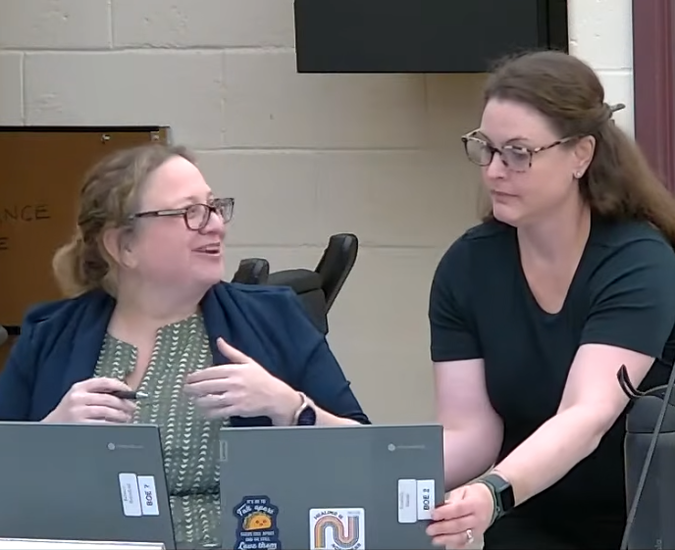
— Still frame from April 14, 2026 Guilderland School Board meeting
As Rebecca Butterfield, left, decries student-facing cuts, sister board member Kimberly Blasiak provides her with a list of those cuts on her laptop.
GUILDERLAND — On April 14, the school board here unanimously adopted a $134 million spending plan for next year.
District residents will vote on the budget on May 19 and will also vote on a $1.7 million bus proposition, reauthorizing capital-reserve funding, and filling three school-board posts.
The tax-levy increase is up 3.42 percent, which is under the state-set limit, requiring a simple majority to pass. Guilderland gets about two-thirds of its funds from local property taxes.
Since no state budget has been adopted — the deadline was April 1 — Guilderland’s budget is based on aid numbers the governor presented in her executive plan.
Spending is up about 5 percent over the current year’s budget.
The district closed a sizable gap by deciding to draw about $2 million from its savings rather than making 5-percent across-the-board cuts, which had riled the public as stipends for many popular clubs, activities, and athletics were initially to be cut.
As Superintendent Daniel Mayberry presented the plan on April 14, he cautioned, “Remember with the budget … it’s what you think will happen. Obviously it’s subject to change. There’s a lot of things going on globally that can impact that …. We’re really managing the risks of too much money left over at the end or not enough left at the end. So you’re either running a surplus or a deficit.”
No money is being put into reserves and Mayberry told the board, “If there is not $2 million left over at the end of the year, you will not have that money to roll into the next budget so that could potentially compound issues in next year’s planning process.”
“You’ve spent what you have”
Early in the board’s hour-and-a-half-long discussion on the budget, member Rebecca Butterfield recommended the $8,200 budgeted for Yondr pouches be spent instead on student-facing programs.
The pouches allow high school students to carry their cell phones with them but make them inoperable. The state, starting this school year, requires students’ phones to be inaccessible during the school day.
Mayberry said the pouches are in the budget because the district is shifting its culture.
“I do not anticipate we will be buying Yondr pouches forever,” he said, “but I do anticipate for a period of time until we really get the culture shifted and get people committed to no use of the phone.”
Board members went back and forth on funding Yondr pouches and also on another relatively small expenditure — $10,000 for tennis-court wind screens, which are torn — and they also discussed using funds set aside for three teaching posts that are added when class sizes balloon over thresholds if residents move in over the summer or if homeschooled or private-school students enroll in the public schools.
“I don’t think there’s any line item in the budget that is negligible ….,” said Butterfield. “We did a good job using the reserves to bring back some of this stuff but there’s a lot of things that are still not included, including some really pivotal positions.”
“You’ve pretty much spent what you have,” said Mayberry.
Board President Blanca Gonzalez-Parker asked, with the three floating posts, if that money were redistributed now and then it turned out, with more students arriving, the teachers were needed, “Is that a reason that we can dip into our savings?”
“Not the way I look at it,” said Mayberry. “You’re basically using a credit card for a recurring expense.”
Just before the board was set to vote on the proposed budget, Butterfield circled back to her initial point, this time suggesting “we use our unrestricted fund balance to fund two items that are currently in our budget that should not be ongoing purchases.”
She was referencing the $8,200 for Yondr pouches and the $10,000 for wind screens. That would free up roughly $19,000, Butterfield said, to pay for two-tenths of one of the cut positions.
Peter Stapleton was the only one of the nine board members who did not vote in favor of Butterfield’s amendment.
In the midst of the earlier board discussion, as members were ruminating on what it would mean if they had a split vote on the budget proposal itself, Stapleton had said, “The tough thing about this right now, is that potentially there’s no good solution … What does a ‘no’ vote actually mean by a board member?”
He went on, “It’s not that we don’t support the district. It’s not that we don’t value what is being done and what the district stands for. I think the difficult thing in this entire process is that we have factors that require us to make cuts …. I think this budget as presented is the best that we can do right now.”
Board member Meredith Brière agreed then that “this is the best we can do right now.”
She went on, “We also have a first-year superintendent who’s been learning our district …. We’ve all agreed that changes need to be made district-wide, right? It can’t continue this way. Utilizing fund balance is a way to get through this specific budget year, in order to make major changes that take into consideration the drop-off in birth rate … We want to plan for a better future for this district.”
“If people vote the budget down, more cuts are going to happen,” said board member Tara Molloy-Grocki.
In the end, all nine board members voted for the $133,900,025 spending plan.
Looking ahead
During the board’s lengthy budget discussion, Mayberry said, looking ahead to next year’s budget process, “We’re going to do some steps, leading up to and before budget season to address some of the information requests and questions … so that you will have more of that background knowledge of what we actually do within our buildings, within our programming.
“So that when the budget season actually arrives, we hopefully have given you a better perspective of all the things that are Guilderland to help in that planning for what comes next in the 2027-28 school year.”
For decades, Guilderland had seated a Citizens’ Budget Advisory Committee. The committee met for months in public sessions along with board members as department heads presented their various spending proposals and were questioned ahead of finalizing the budget.
That process was streamlined in 2010 when Marie Wiles became Guilderland’s superintendent. Mayberry succeeded Wiles this school year.
On Monday, Mayberry told The Enterprise of the $134 million proposal for next year, “It’s not a perfect budget but we got through.
“So I think the challenge budget-wise — and you see this in a number of other districts around us — is the tax-levy-cap formula … will cause the same thing to happen in every school district at some point because it restricts your revenue without looking at your expenses in a meaningful way.”
Guilderland faces an added burden, Mayberry noted, because of tax certiorari cases in which the district drained its reserves, eventually taking out a bond, to pay tax refunds to Pyramid and others that were successful in challenging their assessments in court.
“Taxes that would have been generated have now been redistributed across everyone in the community,” said Mayberry.
His plan for next year, he said, is to “gather more information for the board in advance of the budget season itself to really help understand the district operations … so that they have a frame of reference when you get to the budget season.”