An intimate look at the people who long ago lived on and loved what is now Thacher State Park
— Photo from Myers Family
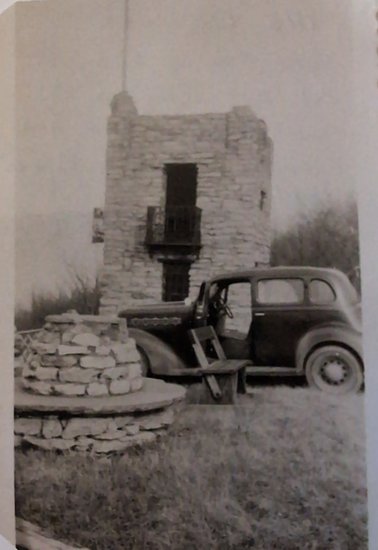
C.W. Holler built this tower from the rocks Herman Wilhelm Antemann had collected to build a house; the house was never built because his wife died. The tower was built where the house would have stood at the point near the edge of the cliff of Glen Doone.
To the Editor:
Historically, property owners often applied names to the place where they lived much like how Thacher Park was called Indian Ladder Farm at one time.
Property naming was an important method of identification even before and after standardized street numbering became common in the mid-19th Century.
Property names were often derived from the owners family name, history of the buildings, someone’s occupation, the surrounding geography or sentimental, aspirational, or humorous references.
Wealthy owners named manors after their ancestry titles. A local historical example is Rensselaerswyck Manor owned by the Van Rensselaer family beginning in the 17th Century and encompassing the present-day Capital District of New York.
This practice of giving names to property spread to the middle class to add value and identity.
Ferncliff Park
After the Thachers donated their 350-acre Indian Ladder Farm on top of the primary Helderberg Escarpment cliffs to later be known as John Boyd Thacher State Park, the custodians of the park, The American Scenic and Historic Preservation Society, recorded in a report in 1922, that there was an adjacent private park on the southern border of Thacher Park called Ferncliff Park, also known as Helderberg Mountain Park.
The multiple land owners of these neighboring properties wanted to establish a sanctuary for wildlife. In an advertisement from The Altamont Enterprise around that time, public notice was given of the private park.
“To whom it may concern: the undersigned by virtue of the Conservation Laws do hereby set aside that tract of land, to be hereafter known as “Ferncliff Park” on the Helderberg Mountain, within the Town of New Scotland, and more fully described hereinafter, as a private park in order to therein propagate and protect all fish, birds, quadrupeds, of every kind and species whatsoever.”
To sum up the rest of the advertisement, the tract included all lands situated on or near the Helderberg Cliff and extending back from there to a distance of upwards one and a half miles — extending along said cliffs the entire distance from that point on or near the said cliff on the easterly boundary of the property owned by Kenny Parish, near the old reservoir of the village of New Salem, to Thacher State Park. The reservoir was near the current entrance to Beaver Dam Road off Thacher Park Road.
It appears that Ferncliff Park included 15 different properties.
There is a map of this same park titled the Helderberg Mountain Park. It included the lands of Frederick Clark Myers whose property was called “Cliffhaven.” It was located in an area below Dan O’Connell’s summer retreat, and sometimes political headquarters, on Beaver Dam Road.
Known locally as “Uncle Dan,” O’Connell would have politicians and candidates, including presidential contenders, make the “pilgrimage” to the Beaver Dam Road house, rather than traveling to meet them. The property provided a scenic panoramic view from which you could see Albany. He had a swimming pool and an ice house with a beer tap and was known for the prized fighting chickens he raised there.
It is said he lived there until his death in 1977 at age 91.
Antemann and Myers families
The Myers family was related to Herman Wilhelm Antemann who owned much of the property that is now the Glen Doone, Yellow Rock, and Greenhouse picnic areas of Thacher Park.
For some years now, I have been corresponding with George Taylor “Tad” Myers and his brother, Edward Chase “Butch” Myers, and more recently, George’s daughter, Janet Myers Holley, about their family’s association with the properties they owned near to and in Thacher Park.
Their great-grandfather, Herman Wilhelm Antemann, came from Germany and was a noted woodcarver, goldsmith, and gemologist who set up a jewelry shop in Albany during the late 1800s.
He became friends with Theodore Hailes of Hailes Cave renown. Hailes brought Antemann to his summer camp in the Helderbergs.
Soon after, Antemann bought property for himself and his daughters where the Glen Doone Picnic Area is now.
It is shown on a map from that time period that Antemann had that area divided into “Cottage lots” and proceeded to build summer homes there for his family’s two daughters, Elizabeth and Katherine.
A third daughter, Augusta “Gussie,” died at 1 year of age.
These cabinets were described as beautifully rustic, with birchbark wallpaper and split-sapling wainscoting and trim, and native stone fireplaces and were decorated with beautiful woodcarvings by H.W. Antemann. He also planned to build a home for himself and his wife.
His daughters, Elizabeth, known to visitors as “Aunty Beth” or “Aunt Betty,” and Katherine would occupy the cabins. The road into the cabins off Route 157.
The Thacher Park Road, was marked with a log post painted bright red and called the “Red Post Road.” It generally followed the current entrance to the Glen Doone Area.
There are still two stone pillars inside the picnic area near the site of Elizabeth’s cabin.
Also still existing are the posts that fenced off her property from the rest of the park until her death in 1954. Her cabin was torn down by the park administration soon after, as were all historic structures in the park, considered attractive nuisances that the park could not maintain.
The Glen Doone Area is named after a place in the novel “Lorna Doone,” written by R.D. Blackmore in 1869, about a 17th-Century historical romance set in the wild Exmoor region of England. The Doone family is a fictitious group of outlaws that reside in a hidden valley called Glen Doore.
It is described as a “beautiful” yet sinister place, surrounded by high, steep cliffs and dense, untamed scenery. I believe the site was named in part for the ravine that separates the Glen Doone area from the overlook parking area.
The Green House Area is where an early American home stood that was painted green, and the Myers family referred to it as “Aunt Milly’s House.” This Green House belonged to Great Aunt Wilhemina Antemann, Herman’s sister, who married Harry Kleese just after World War I.
This property connected to the Myers property of approximately 100 acres called Cliffhaven.
Across from the Green House area was a lot called “Albright Place” on the maps, and just west of that was “Antemanns Spring Lot.” George Myers writes that he and his parents, Frederick H. and Ruth, spent a summer at the Antemanns’ cabin and had indoor plumbing from water supplied by the spring.
That was when George was si6 years old, in 1935.
The Glen Doone Area was known to the family as “Felsenruhe,” with Felsen meaning rock or cliff and Ruhe translating to calm, quiet, peace, or rest — encompassing both the absence of noise and a state of tranquility or relaxation. A place where one can find peace of mind, Antemann meant it to mean “Rest on a Rock.”
Antemann may also have recognized the similarity of rock formations to the Hochvogel Mountain of his native Germany as well as the cliffs on Rugen Island, or the Gerolstein Dolomites and cliffs along the Danube River.
“Felsenruh” was a gift to his daughter Beth. After his wife, Elizabeth Huber Antemann, died in 1898, he never built his home there.
He married his second wife, Louise Hettinger, at the Green House.
The rocks he had gathered for his home were later used by his friend J.W. Holler to build a stone lookout tower on the point at Glen Doone.
The remains of the foundation are near Yellow Rock creek and the Yellow Rock Waterfall. It was later referred to as “Holler’s Folly” by park folks who lived there.
The tower was said to be a little more than two stories high and could be seen from far away.
Aunty Beth
Beth Antemann was probably the last private citizen to occupy property along the cliff that is now within Thacher Park. At the time of her death in 1954, she was living in Slingerlands and using her cabin at Glen Doone as her summer home.
She was almost 83 years old when she died. She had sold her beloved “Felsenruhe” property to the state in 1918 with the caveat written into the deed that she could remain on the property and use it until her death. Park officials kept the public from her property by erecting a chainlink fence.
She was described as a slender, active outdoors woman, who was a naturalist that loved birds and kept tame racoons. She would invite and entertain the Audubon Society. She made friends with many young people and adults.
One of them was a young Dalton Marks who as an adult told me how much he and other children loved Aunty Beth. She would invite them in for snacks and to talk about nature.
That was during the 1940s. He went on to be quite a man himself, mentoring and befriending young and old. Among so many life achievements, he was a principal at Duanesburg High School and an instructor of paleontology and ecology for the Helderberg workshop.
Look him up; he died in 2012, an amazing man.
After Beth died they had an auction of her things.
The newspaper reported that everything went including Navajo blankets and rugs except a remarkable frieze of Indian Scenes which Beth’s father made around the walls. The Myers family believes the cabin to have been looted and then burned down by park administrators.
George Myers said she was very generous and had a positive side that had guidelines for what she deemed “acceptable behavior.” After school, George would meet the city bus going from Albany to East Berne in New Salem. His Aunt Betty as he called her would be on the same bus, returning from work at Antemanns Jewelry Store on Maiden Lane to go to her summer home in Thacher Park.
His dog “Brownie” often met him in New Salem having come down from their home on the mountain to meet him. Since the other 10 to 15 passengers didn’t mind, Brownie would ride home with George.
Brownie was a very polite dog; George’s only fear was that Aunt Betty would say “No!” But George begged and she relented, although George had to promise to go up and dump her outhouse tray.
He writes “Yeeah!” Brownie benefited most as he continued to ride the bus up the “hill” back home for nearly three years in good weather, always knowing exactly when to go up to the exit door to be let out. He got to be a favorite co-rider with the bus patrons. Aunt Betty was less favored because she refused to let anyone “light up” a cigarette as was the custom as the bus entered country travel.
She’d glare at the offender, or three, and demand that they “Get rid of those smelly things!” And they did!
George would hide his head and refuse to recognize her.
Being an outdoor person, Aunt Betty would relish walking in the evening on “Her Park Property,” looking carefully at each parked car she met. If that car moved at all, she was reputed to bang on the roof or fenders of the offending auto with her cane, crying, “You stop that! I know what you are doing and I want you to stop!”
George witnessed this himself and it was confirmed by others with some thinking it was not amusing.
From riches to rags
George and Ed Myers’s grandfather, Frederick C. Myers, married H.W. Antemann’s daughter Katherine in 1900. He was 20; she was 26.
Frederick C. bought a “hardscrabble” farm up in the Helderberg, according to George, and rebuilt the old Secor farmhouse into a large home with a big formal dining room, a huge kitchen with commercial appliances and a business office called the “Sunroom.”
The living room had a back-to-back fireplace and the house had a wrap-around porch to the east and south.
F.C. Myers’s son, Frederick H. Myers, married the actress Ruth Irene Taylor, his first wife, whose stage name was “René Titus,” noting her maiden last name. George wrote that he believed his mother is the woman standing on the right, in front of Hailes Cave, in the photo adorning the cover of the Arcadia Publishing book titled “John Boyd Thacher State Park and the Indian Ladder Region.”
In the photo, he says she was with her “German beau” around 1921 or ’22. She studied “natural acting” in New York City and played parts in legitimate theater for many years.
George goes on to say that his Dad was a “Back Door Johnny” of a (then) wealthy family, and they were married in the fall of 1922. Their marriage lasted 26 years and, after the divorce, she’d say, “I should have married that German boy.”
F.C. Meyers had become a successful businessman and upon the marriage of his son, F.H. Myers, to Ruth Taylor, he gave them a summer home built on the north portion of the old Secor Farm plus 8 acres as a wedding gift.
George grew up there with his parents, Ruth and Frederick H. Myers, during the Great Depression and beyond, from 1930 to 1947.
The stock market crash of 1929 came and George’s grandfather, F.C. Myers, tried to re-invest all his funds just before the final hour and succeeded in losing it all. And not just his investment funds; he lost his brokerage business, his Locomobile Auto Agency, his warehouses, everything including three homes in Albany and offices on Western Avenue.
He became despondent and became suicidal.
This period of time was critical for the family as H.W. Antemann died in May 1928 and then F.C. Myers died in Dec. 1929.
George tells us that the extended family of Myers went from “riches to rags,” reversing the common idiomatic phrase.
George’s brother Rick, F.H. Myers Jr., and George graduated from Voorheesville’s high school — Rick in 1943 and George in 1947, when the new elementary school was also the high school.
After high school, George attended the New York State Ranger School at Wanakena in 1950 for an associate of science degree in forestry and land surveying. After 16 years in tropical forestry in Central America and West Africa, he returned to the United States and worked for General Electric Aerospace Research and Development.
Commerce
George’s dad, Frederick H. Myers, and his brother, Rick, operated a restaurant at the family home on Thacher Park Road that continued under the name “Cliffhaven.”
Three other restaurants existed on the Thacher Park Road nearby. One was called Helderberg Cold Spring in 1924 and the Indian Ladder Lodge in 1932 — both run by the Osterhout Brothers. The Lodge was later known as Oliver’s Rock Farm and later burned down as the High Chaparral.
Also, on the corner of Indian Ledge Road was “Kings Krest” operated by the King family.
The park drew many visitors so businesses succeeded on the road into the park. The main source of meat for the Cliffhaven Restaurant was from the chicken coops on the north end of the property where George built his home when he returned from Africa.
George and Ed Myers are half brothers. After their dad divorced George’s mom, Ruth, in 1948, F.H. Myers married Mildred Chase in 1949. Mildred Chase Myers lived with Frederick H. and their sons, Ed and Dick, at Cliffhaven until 1958 when they moved toPennsylvania.
Ed Myers’s time at Cliffhaven was from 1951 to 1958. In his heart, it is still his home, and while growing up at Cliffhaven his family also referred to it as the “House on the Hill.”
He says the restaurants’ commercial sized wood-fired oven helped keep the house warm in winter and that by the time he came along the stove was the last remnant of the restaurant. Cliffhaven was very large and served as a temporary home for most of Ed’s relatives, some longer than others, but he says all were welcomed and loved.
They planted apple and cherry trees. Jams and jellies were always in good supply. On a warm June day, Ed and his niece Bethany were picking strawberries while their moms were in the kitchen making jam. Their strawberry field was in front of the house down to Thacher Park Road (Route 157).
They were small wild strawberries and eventually the pair of them got close to the road. Across the road was a significant cliff, part of the main escarpment you notice when driving beside it as you look into the valley below. In 1956, there was much less forest growth obstructing that view between the road and the cliff.
A car stopped and a woman came over to Ed and Bethany and marched them back up to the house, apparently fearing for their safety. Ed continues his story to say, for a flatlander it was a steep driveway and when they got to the house she was very winded. Their mothers met them as they approached the house and this lady read the riot act to them about small children and the dangerous nearby cliffs.
Then she huffed down to her car, and as she left, his mom said “City folk” and sent them back to pick strawberries down by the road. In the 1950s, most families had one car and so when Ed’s dad went off to work at General Electric, his mom was stuck on the mountain.
So when the new snack bars at Thacher Park opened around 1954 or thereafter, Ed’s mom got a part-time job there and he would walk with her along an old logging road that came out where the snack bar was, and return home alone.
When his Dad was transferred to General Electric Aerospace in Valley Forge , Pennsylvania he sold the house with half the land. The other half went to his brother Tad, who later built a house where the old chicken coop was.
Ed still lives in Pennsylvania and through the years has kept a watchful eye on the happenings of the Helderberg Mountain. He still visits his cousin’s family who live close to the park and attended its Thacher Park centennial celebration.
When families document their history like the Antemann-Myers family, especially when it is intertwined with a prominent public place like John Boyd Thacher State Park, they provide an intimate context, that official records often miss, through their family photos and personal stories, ensuring that unique cultural heritage and ancestral connections are not lost.
This effort brings history alive, anchoring us to our past, fostering pride, and offering future generations a relationship with what came before us.
Timothy J. Albright
Meadowdale