GCSD plans to use $2M from savings to balance $134M budget
The Enterprise — Michael Koff
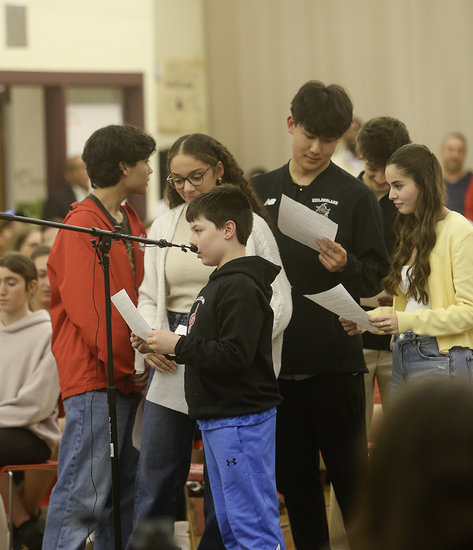
A bevy of students lined up to speak to the Guilderland School Board about the importance of arts.
GUILDERLAND — Students, parents, and teachers turned out in force on March 31 to tell the Guilderland School Board about what they valued after the district had proposed cutting stipends for many clubs and cutting seven teams for young athletes in order to close a budget gap.
But many of the 26 speakers cut short their planned comments because the session opened with Superintendent Daniel Mayberry saying the teams and clubs that had been on the chopping block would be restored to next year’s spending plan.
“I’ve never seen a room with this many people in it be this quiet all at once,” Mayberry said to the standing-room-only crowd.
Guilderland has now drafted a $134 million budget for next year, about $7 million more than this year’s spending plan, a 5.27-percent increase. The current proposal closes what remained of a $4.1 million gap by drawing about $2 million from the district’s fund balance and reserves.
“The use of fund balance in this budget, as given direction by the board, is to prioritize the funding of student programming,” said Mayberry. He also said, “The vast majority of all expenses related to things that we do in a school will touch a student at some point in time. Many of them are direct. Some of them are not.”
In recent years, Guilderland had been working to increase its fund balance since it was less than its Suburban Council peers.
The draft still calls for about $87 million to come from local property taxes, a 3.42-percent increase over this year, which is below the state-set levy limit, meaning just a simple majority vote is needed to pass the budget.
About two-thirds of the budget is covered by property taxes and most of the remaining third is covered by state aid. The state has run past its April 1 deadline for adopting a budget so Guilderland is basing its state-aid estimates on the governor’s proposal.
Since the school board reviewed a previous draft of the 2026-27 budget, Mayberry said, there is a projected increase in interest of $300,000 and a projected $200,000 available from the fund balance, so the board could use those $500,000 to make further restorations or could put funds the district’s rainy-day account.
Mayberry presented the board with three options, ranging from about $90,000 to $100,000, for including in the 2026-27 budget: restoring a teaching assistant for special education and a TA for high school math; restoring two special-education TAs; or restoring co-taught Spanish at the middle school and a part-time art post at the high school.
While board members deliberated for over an hour, no consensus was reached. A special meeting may be called or the board may decide at its next meeting on April 14, when it is slated to adopt the budget. The public will have its say on May 19.
District residents will also elect school board members on May 19. The nine-member board has three seats up for election: those currently held by Kimberly Blasiak, Rebeca Butterfield, and Peter Stapleton.
Petitions with 44 signatures of district residents are due by April 20. The unpaid posts are for three-year terms.
Public comment
Most of the 26 speakers — some of them with comrades by their side — extolled the worth of school programs that had been slated for cuts.
A Guilderland graduate who now plays baseball in college said, “I know what it feels like to sit on the sidelines to wonder if I even belong. But thanks to the freshman mod team, I had a chance to grow, to practice, and learn what it means to push myself. That opportunity changed everything.”
Nancy Cavillones, a mother of three, said she was “preaching to the choir” when she told the board cutting activities that are a “lifeline for our children” could cause a domino effect with lasting consequences.
She concluded with a quote from Peter Drucker: “Long-range planning does not deal with the future decisions, but with the future of present decisions.”
Violet Clemente, an eighth-grader at Farnsworth Middle School, told the board, “Not every student finds their place in academics or athletics.” She said the school’s theater group, Mask, “provides friendship, leadership skills, and connects us to our school community”
Seven students came together to the microphone to speak for the value of music and arts. “We learn teamwork, trust, and how to support each other to create something bigger than ourselves,” said one.
Altamont parent Keegan Prue hit a conciliatory note, as did many of the speakers, when he said, “While I understand this budget cycle requires sacrifices, I appreciate the leadership the board has shown and the purposeful adjustments that Superintendent Mayberry just detailed.”
Prue spoke of the value of teaching assistants and of low student-to-teacher ratios and urged the board “to continue pushing to maintain student-facing positions.”
Elizabeth Schofield, a kindergarten teacher, said she had come to read a statement from 63 school employees urging the board to reconsider cutting teaching assistants in first grade but, since those posts were being restored, she said, “Instead, I will say thank you from the bottom of all of our hearts.”
Megan Bender stood with other fifth-grade teachers from Pine Bush Elementary School to ask that a fifth-grade section at the school not be cut next year.
With larger class sizes, Bender said, “The classroom begins to feel less like a place of learning and more like an overfilled lifeboat. Every child is on board, but there are simply not enough resources, time, or space to ensure each one is truly supported.”
“Budget shortfalls do not happen overnight,” a parent told the board. “They are a result of decisions made or not made over time. When those failures directly impact students, there should be accountability.”
Amanda Jo Wilsey, president of the Guilderland Music Parents and Friends Association, acknowledged the district “is facing serious financial challenges” but urged not reducing arts programs.
“Students from all backgrounds, including English language learners, students with disabilities, and economically disadvantaged students are finding a place in these programs,” Wilsey said of the arts.
She noted that equipment funding had dropped from $27,000 seven years ago to zero dollars for the second year in a row. She also said, “The music administrator has absorbed the fine arts department,” taking away from support of both music and arts programs.
Finally, Wilsey noted that 71 percent of voters supported last year’s capital project that included new music space, which she said indicates support for investing in the arts.
Students spoke on the worth of the National Art Society ; Donate Life, which “teaches students that they hold the power to make informed decisions about organ donation … that one day can mean the difference between life and death”; and the National Business Honor Society.
Parent Kyle Unser told the board, “I know you all have an impossible task, but seeing the response for the initial budget cuts was telling, and it has kind of energized this community to now be on point. We will be watching. We will definitely be more involved … What can we do to help?”
Board views
After an hour of listening to public comments, the board spent more than an hour discussing their views on the budget.
The board’s non-voting student member, Paarth Sarecha, started the discussion, saying he had talked to teachers who believe the Yondr pouches, in which students put their smart devices so that they are not used during school hours, are essential.
“They have brought dramatic change to this school,” said Sarecha, stating that the $8,000 for the pouches was well worth it.
New York state now requires cell phones not be used in schools from bell to bell but leaves it up to individual schools on how to accomplish this.
Board member Meredith Brière said she had been self-searching, thinking about her priorities as a parent and as a board member.
“Utilizing fund balance this year is the right call to get through the shortfall in order to then completely restructure the district,” she said.
Kimberly Blasiak said she was “a little crushed” that none of the speakers had advocated for keeping the special-education teacher’s post and teaching assistant post slated to be cut.
“My son graduated from Guilderland and his TA … and his teachers that understood it and they got him there,” she said.
She said special-education students may not be able to speak up for themselves and their parents “are afraid to come in and speak for their children for fear of retaliation, which is a real fear.”
Rebecca Butterfield, like Brière and Blasiak, said she appreciated the hard work that has gone into building the budget. She went on, “I really appreciate the community output. This is amazing.”
She hoped everything could be restored and wondered if the district could save money by not buying touch-screen computers for the youngest students.
Students need time to get used to touch screens before they take required state tests for which they have to show their work, Assistant Superintendent for Curriculum and Instruction Rachel Anderson said.
Board member Peter Stapleton repeated his earlier call for long-term planning and budget projections. “What will next year look like? What will the year after that?” he asked.
Tara Molloy-Grocki said she was “really happy” the first-grade teaching assistants were being restored but she is concerned about the reductions in special-education staff and about reducing a fifth-grade section at Pine Bush Elementary.
If she had to choose one of the three options presented by Mayberry, Molloy-Grocki said she’d choose the second one, which would restore two special-education teaching assistants.
Vice President Katie DiPierro suggested using unassigned teaching posts in the proposed budget for the fifth-grade class at Pine Bush, or for co-taught students at the high school.
Kelly Person suggested using more of the money in the fund balance.
Mayberry responded, “We just have to be careful so there is risk in spending all of the fund balance ….”
Assistant Superintendent for Business Andrew Van Alstyne added, “If we don’t have a $2 million surplus next year, that is a hole we are starting out with, right? So if we zero out fund balance, we’ll start out with that $2 million hole …That’s the fiscal-cliff idea; it can fall apart really rapidly.”
Board member Nina Kaplan noted the $2.4 million increase in health insurance costs: “You can’t sustain that, right?”
She also said, “I keep thinking about declining enrollment down the line and how that’s going to affect aid as well. This is a plea to the state to please listen ….”
Board President Blanca Gonzalez-Parker saved her views for last.
“We may need a fourth option …,” she said. “Many of us are in support of restoring special-ed TAs. And, it just looks like we need to see if there’s any stone that’s not been turned over.”
Gonzalez-Parker went on, “I’m tired of feeling frustrated about the nickel-and-diming that keeps taking place every year. I feel like, over the six years I’ve been on the board, the cuts always come to the student-facing activities …. I have yet, in my six years on the board, to be presented with something that looks at administrative cuts ….
“My expectation is that next year we will not be in this position and our students will be prioritized, and that, if we use our fund balance this year, it is to get us from point A to point B — and point B should include restructuring and administrative cuts. I’m sorry if I’m hurting people’s feelings, but I think, if you were to take a poll across the district, that is the area that needs to be trimmed.”
“Just remember, we did cut one administrative post,” said Mayberry.
The proposed budget cuts the district’s director of Diversity, Equity and Inclusion, a post that was created in 2021.
In his opening presentation, Mayberry had compared Guilderland with the 12 other districts in the Suburban Council, and said Guilderland was 9th in its student-to-administrator ratio, 10th in its student-to-principal-and-assistant-principal ratio, and third in its student-to-class-teacher ratio.
Gonzalez-Parker asked Mayberry what his thoughts were on having the budget finalized.
“You just have to come on the 14th ready to make that final decision,” Mayberry said of the board’s April 14 meeting. “I don’t think we’re any farther ahead tonight than we were last week … I think we’ve got a little bit of clarity on some things, but I don’t know that we’ve arrived at a final destination.”