What is chaos and whom does it serve?
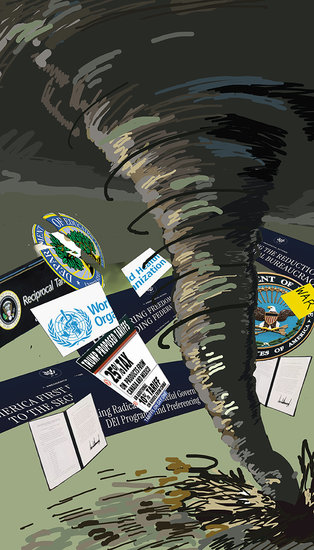
Art by Elisabeth Vines
The Roman poet Ovid described Chaos as a shapeless heap in which all the elements were jumbled together in a rude and unformed mass — discordant and confused.
The word “chaos” has soared in usage of late. We heard it locally soon after Donald Trump’s Jan. 20, 2025 inauguration.
The Guilderland Chamber of Commerce hosted its annual event for local government leaders to address their constituents.
Our assemblywoman, Gabriella Romero, then new to her job, said she had been hearing from constituents because of the “federal chaos.”
“People have been talking to us a lot about the executive orders and the immigration-related consequences,” she said. “People have been talking to us about the uncertainty … the scariness. People are afraid.”
Her office has been working with the Hispanic caucus and other organizations to do “know your rights” presentations, Romero said. “Our office was flooded and we were getting tearful constituents coming to us and, for me, as a new member, that was very scary. I wasn’t expecting that.”
Similarly, Guilderland’s supervisor, Peter Barber, said the town got calls from worried people after Trump, on Jan. 27, paused federal grants and loans that had frozen trillions of dollars, leading to mass confusion and legal challenges. Two days later, Trump rescinded the directive but proceeded with a review to eliminate spending on “woke” ideologies.
Barber went on, “I have 186 residents in our town, including 44 children, who depend on House Choice support. We got calls from those people. They’re worried. They’re panicking about what happens.”
A year later, in his State of Town address, given in February, Barber returned to the theme of “chaos” in Guilderland caused by the federal government. One example he gave was the axing of a $100,000 federal grant that Guilderland had received to replace its town-hall generator. “The president decided to cancel anything involving DEI, diversity, equity, and inclusion,” said Barber. “I have no idea how that grant has DEI, but the bottom line is: It’s gone.”
Barber went on to note the rich diversity of the Guilderland community and said, “ICE in our community is a concern for residents.”
At the 2025 Guilderland session soon after Trump’s inauguration, our state senator, Patricia Fahy, said, “Uncertain, unprecedented, unstable times is an absolute understatement … I, too, am alarmed. We may be facing international wars … The announcements each day continue to shock and awe.”
Throughout the year, we covered a series of roundtables hosted by our congressman, Paul Tonko, where we heard of chaos again and again.
The ostensible reason for all of the cuts was to end government “waste, fraud, and inefficiency” as the Republicans framed it. But, in a recent one-year look back at the axing of 264,228 federal jobs — heavy on cuts to agencies that oversee climate science and adaptation — The New York Times found that, while the Department of Government Efficiency, led by Elon Musk, initially boasted it could reduce federal spending by $1 trillion, one year later, federal spending has only gone up.
Library leaders met at the Bethlehem Public Library after President Trump’s March 14, 2025 executive order, “Continuing the Reduction of the Federal Bureaucracy,” that named the Institute of Museum and Library Services among seven agencies he determined were “unnecessary.”
At that session, AnnaLee Dragon, director of the New York State Library Association, said she had gotten a notice on a cancellation of funding just the day before — “in the dead of night” — on which the association still has money outstanding.
“It’s studying the trauma that frontline library workers are facing with book bans and challenges and this increased politicization of libraries …,” she said. “Books have become political, right? That has led to a lot of public outbursts, issues at library events, and issues with books …. We’re not trained to deal with people screaming at us and threatening us. We’ve always been a trusted institution.”
Leaders of local food banks also spoke of chaos caused by federal cuts.
Sister Betsy Van Deusen, chief executive officer of Catholic Charities, which covers the Albany Diocese’s 14 counties, spoke of the impact her 11 pantries and three soup kitchens were feeling.
“Crime is going to increase,” Van Deusen said, “because desperate people do desperate things. And what we’re doing in this nation right now is we’re making people desperate. We’re making them afraid. We’re creating chaos.”
In August, leaders of historic sites spoke not just of the chaos caused by cuts to their programs and institutions but also of the chaos caused by Trump’s push to erase history.
Cara Macri, who directs Preservation Services for the Historic Albany Foundation, pointed out the value not just of “one important building” but of people’s individual homes, which preserve the historic fabric of communities.
“We provide technical services for people so they can repair and maintain their homes,” Macri said.
Marci had spoken to a woman the day before the roundtable who was “absolutely in tears” because she was worried about losing tax credits that would allow her to “repair her home so she could still live in it.”
The chaos caused by the attempt to erase history especially hurts minorities or groups that have been marginalized and fought for equality.
“At the Stonewall National Monument in New York City, references to trans and bisexual people were simply removed,” it was noted. Others at the roundtable spoke of how this applied to recognizing the labor movement, or Black civil rights, or women’s push for equality.
Trump issued an executive order titled “Restoring Truth and Sanity to American History” that says federal sites should portray the United States’ “unmatched record of advancing liberty, prosperity, and human flourishing.”
Tariq Zahran, the director of Cultural Resources for the National Parks Conservation Association, referenced the QR codes that the Trump administration has installed at national parks so visitors can report “negative” comments from rangers or in displays or films.
Zahran said that responses through the QR codes are instead showing “Americans at large love what the Park Service stands for … We’re starting to see that there is this huge backlash against the erasure of our history, and constituents across the board seem to respect that the Park Service are experts in doing this work and they’re able to convey it in a way that is factual and true.”
Local health leaders met at Whitney Young, Albany’s Community Health Center, to discuss federal cuts to Medicaid and the Essential Plan, which is the state’s health-insurance program designed for low- to moderate-income adults who don’t qualify for Medicaid.
Rose Duhan, president of the Community Health Care Association of New York State, described centers like Whitney Young as the “safety valve” for the entire health system. “If people cannot get access to preventative care,” she said, “then those chronic conditions are going to become exacerbated.”
A conservative estimate is that, because of the federal bill, health centers will lose $200 million in revenue in the coming year, she said.
“Our patients often get better when they’re understood, when they’re connected, and when people treat them who sometimes look like them,” said Angela Doe, chief behavioral health officer at Whitney Young.
“The work that the health centers do is the cornerstone of preventive care … a cornerstone of health,” said Elizabeth Whalen, who served as Albany County’s health commissioner during the pandemic and is now the medical director of the Office of Public Health for the state’s health department.
Addressing the nation’s “epidemic of chronic disease,” in “a reactive manner is not cost effective and it is not patient effective …,” said Whalen. “There are no winners when we have cuts like this.”
A year ago, we wrote about a roundtable our governor, Kathy Hochul, held on the chaos created by tariffs. After the Supreme Court ruled on Feb. 20 that Trump’s tariffs were unlawful — and he then imposed a 10-percent tariff on most products and countries worldwide — Hochul has held a series of roundtables across the state, including here in the Capital Region.
Hochul has also called, as other governors have, for the return of the illegal funds. For New York, that totals $13.5 billion. The Budget Lab at Yale calculated that the average New York household has faced an estimated $1,751 in added costs due to tariffs since they were enacted last year.
Listening to just one orchard owner, Jim Bittner, shows the complex ways tariffs have hurt not only households, which are paying more, but farmers and business owners.
“The biggest problem we have with what’s been going on with trade and tariffs, and I think every business person will tell you,” Bittner said, “is the chaos, confusion, and uncertainty.”
There’s the problem of fertilizer prices going up 30 percent and the cost of specialized equipment and tractors that Bittner gets from Europe and Asia.
An orchard needs to replace 5 to 10 percent of its trees every year or it will go out of business, Bittner said, but, with the market uncertainty caused by tariffs, orchard owners don’t know what to plant.
“We don’t export a lot of apples from New York,” said Bittner, “but we depend on the growers in Washington to export to Asia because if they don’t have those markets, those apples come here and lower our prices.
“Canada and Mexico are the two biggest export markets for American apples. We’re not on good terms with either country and it’s really made it more difficult for the marketers of those apples. Trade relations take a long time to build. When you have a customer in a foreign country, it’s a relationship. They’re not built or rebuilt overnight.”
Several roundtable participants, from western New York, near Niagara Falls, to the North Country, which depends on visitors from Canada, also spoke of the failing of once-steady relationships that sustained tourism. Vacationers, they said, are now traveling to other countries and building sustaining relationships there.
But we were heartened by Tariq Zahran’s comment: “We’re starting to see that there is this huge backlash against the erasure of our history, and constituents across the board seem to respect that the Park Service are experts in doing this work and they’re able to convey it in a way that is factual and true.”
Factual and true: Chaos cannot reign where facts and truth prevail.
When two American citizens were shot dead by federal agents on the streets of Minneapolis last month, rather than call for a thorough investigation so facts could emerge, President Trump simply pronounced that the victims were terrorists.
When a preliminary report from a United States investigation determined that our country was responsible for a deadly Tomahawk missile strike on an Iranian elementary school, Trump said, “In my opinion, based on what I’ve seen, that was done by Iran … They’re very inaccurate, as you know, with their munitions. They have no accuracy whatsoever. It was done by Iran.”
The next day, the Pentagon said that, if there are more civilian deaths in Iran, they would be the fault of Iran’s government. In the first two weeks of war, more than 1,200 Iranian civilians were killed, 10,000 were injured, and over 3 million were displaced.
War, of course, is the ultimate chaos. And Trump got our nation into the current war without Congressional backing, and with no clear plan on what was to be accomplished or how it was to end.
Oil prices have gone up 40 percent since the start of the war and yet, at the same time, the Trump administration is bent on ending renewable energy projects that would free us from dependency on oil while also helping our environment.
The human toll of war is incalculable.
We’ve spent a year listening to the hurt caused by this chaos. We’ve written about people losing their homes, struggling to feed their families, closing their businesses, losing their medical care, having their sense of identity stripped away.
Only one person looks to be consistently benefiting from the chaos he has caused: Donald Trump has gained wealth and power. Isn’t our government supposed to provide for the people?