GCSD board seeks ways to close $4.1M budget gap without hurting students
The Enterprise — Melissa Hale-Spencer
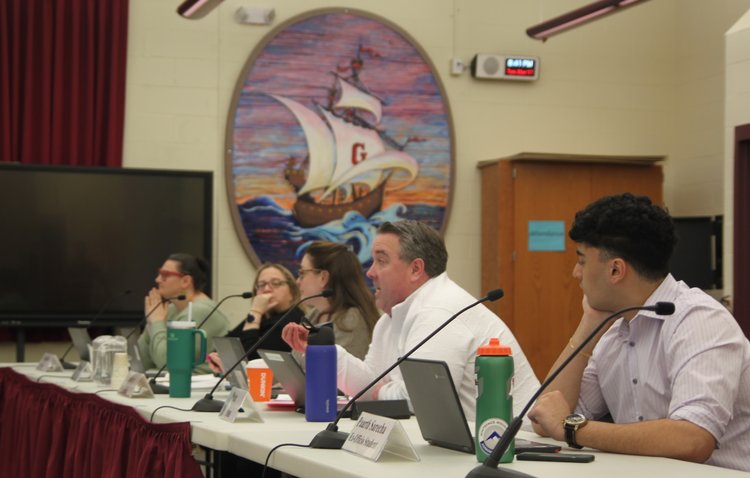
Board member Peter Stapleton, second from right, drew the only applause of the evening when he said the board had to figure out how to fund some of the programs being cut.
GUILDERLAND — The crowd was subdued on Tuesday night as school board members expressed dismay over proposed cuts to balance next year’s budget.
The week before, Superintendent Daniel Mayberry had told the board that, in the middle of February, the district was faced with a $4.1 million gap between projected revenues and expenses. School leaders then identified $2.3 million in proposed cuts, which Mayberry detailed for the school board on March 10.
That still leaves a $1.8 million shortfall. So there are more cuts to be made.
On March 17, about 70 people listened as administrators answered questions from board members. The nearly three-hour session concluded with a handful of people from the gallery asking questions or making recommendations.
The last questioner was Andrea Unser, a Guilderland graduate with two children in the district. She said she didn’t want to move out of the district and asked, “How are we going to stay competitive?”
“Right now, it’s going to be a challenge,” Mayberry responded. He said, “We’re walking a tightrope.”
Two-thirds of Guilderland’s budget is funded by the local tax levy. Guilderland’s maximum allowable levy increase for next year is 3.42 percent.
Assistant superintendent for Business Andrew Van Alstyne estimated to stay within that cap, raising $87 million, the estimated tax increase for the average Guilderland assessment would be $193.
To override the state-set levy limit, requires a supermajority vote — more than 60 percent — as opposed to a simple majority vote if the district stays under the tax cap.
To close the budget gap, by raising $89 million in property taxes, an increase of 5.58 percent, the estimated hike for the average Guilderland assessment would be $193, Van Alstyne calculated.
He also noted that 99 percent of school budgets that stayed below the tax rate in New York state passed last year while only 60 percent of the budgets that pierced the cap passed.
The school board, which will hear public comments on the budget on March 31, is slated to adopt the budget on April 14; the public will have its say on May 19.
If the budget were to be voted down in May, Van Alstyne explained, Guilderland would have one more chance, in June, for a vote. If the second vote failed, it would freeze the tax levy at the previous year’s number, resulting in a “very austere” budget.
Board members made various suggestions, ranging from calling on the community for sponsorships to dipping into reserves.
Board member Nina Kaplan asked what would preclude Guilderland from using its reserve funds.
Van Alstyne responded that the single biggest threat is “using one-time funds for recurring expenses.”
Board member Tara Molloy-Grocki threw up her hands and asked why neighboring districts aren’t experiencing a similar shortfall.
Van Alstyne responded that Guilderland entered into the pandemic with less savings than other districts and that it suffered from a wave of tax challenges, which resulted in large reductions for the value of Crossgates Mall and other properties. After Guilderland used up the reserves it had set aside for paying back over-levied taxes, it took out a bond, which it will be paying for more than a decade, he said.
“We’re all arriving at the party at a different time,” said Mayberry. Guilderland is first because of the tax certiorari cases, he said.
Board member Meredith Brière called it “absolutely crazy” to add to the fund balance in a time of fiscal stress.
Board member Rebecca Butterfield said that the draft budget is in many ways antithetical to the goals expressed by stakeholders in an online survey.
“I don’t think anyone on this board wants to cut these things,” said board member Kelly Person.
Board President Blanca Gonzalez-Parker requested a spreadsheet detailing what can be spent from the district’s different reserves.
As various administrators came to the lectern to answer board questions, they all stressed that none of them wanted to make cuts; rather, they were tasked with recommending 5-percent reductions in order to balance the budget.
“I know what being a team player is,” said David Austin, the district’s athletics director, as he explained how he settled on cutting seven teams that are a fourth level in their sport.
The overall savings from those cuts he estimated totaled $50,000 to $60,000.
Austin said it would make the remaining teams more selective; not all the players would be absorbed.
Brière worried that children from poverty-stricken homes would be left out, encouraging a pay-to-play system
Gonzalez-Parker asked if it would be detrimental to students relying on athletics for college scholarships.
“My opinion is yes,” said Austin. “It could turn away some kids before they really blossom.”
“I think we, as a board, need to come up with a solution,” said Butterfield.
Board member Peter Stapleton drew the only applause of the night when he said the board had to figure out how to fund some of the programs being cut.
“I continue to be dismayed,” said Butterfield of the student-facing cuts.
“As this night goes on, I’m so profoundly sad,” said board member Kim Blasiak.
After the meeting ended, Gonzalez-Parker summed up for The Enterprise what she sees as the board’s view: “As a group, we believe what was presented to us was not balanced or equitable for our students,” she said. “We would like something absent student-facing recommendations and considering other ways.”
Asked what those cuts might be, she said, “Administration.”
Budget overview
“We can’t offer everything and do everything that we want to do and still come within the financial guardrails that we have within the state of New York and how we fund our schools, unfortunately,” said Mayberry on March 10 as he presented the budget.
Mayberry went over the results of an online survey in which 425 “stakeholders” participated, showing their top priority was maintaining low class sizes, followed by preserving rigorous academic programming.
Third-tier priorities included increasing teaching assistants, supporting students who need academic help, and preserving a wide variety of electives. This was followed by continuing support for social-emotional learning and then preserving offerings in the arts and athletics.
Van Alstyne said, “The budget choices we make are part of much larger structural challenges the district is looking at and trying to address for the long term.”
He noted the strong support — roughly three-quarters of voters — for the current $127.5 million budget in which spending increased 1.88 percent and the tax levy was up 2.22 percent.
Van Alstyne displayed two graphs to illustrate Guilderland’s two biggest problems. First, while net enrollment is currently flat — up 12 students for next year — there is “a deeper enrollment crisis,” he said. There is nearly a 100-student gap at the elementary level.
The district currently serves 4,788 students supported by 967 employees, which includes 511 teachers, 430 support staff, and 26 administrators.
Van Alstyne’s second slide compared, over the last decade, the increased cost of health insurance (up 88 percent) with salaries (up 42 percent) and the tax levy (up 27 percent).
“For the second year in a row,” Van Alstyne said, “our health-insurance increases are larger … than our overall tax cap.”
The district’s health-insurance increase for next year is $2.4 million, which is up 10.8 percent.
Other areas of significant increase for Guilderland next year include an 8-percent hike, of $1.1 million, in special-education costs; a 15-percent increase, of $892,000, for transportation; and a 13-percent increase, for $827,000 for operation and maintenance.
Mayberry said serving students’ increasing level of needs is a national problem.
“While we may be getting fewer students,” he said, “some of those students do have greater needs than what we have traditionally seen over the past 10 to 20 years.
Van Alstyne notes rising energy costs and transportation costs are also universal.
“The tax cap is posing a real challenge to school districts across the state,” Van Alstyne said.
He noted, “The state finally funded Foundation Aid fully but hasn’t really updated or changed the formula in almost two decades now. And this is a real challenge because expenses change, the structure of education changes, the expectations and the requirements for public education change, the impact of student need changes.”
Although final state-aid numbers aren’t known until the legislature adopts a budget — often past the April 1 deadline — the governor’s budget slates Guilderland for a 4.77-percent increase in state aid overall.
Proposed cuts
Mayberry, on March 10, read a long list of proposed cuts, and the savings they would bring, which are posted to the district’s website.
While most of the cuts involve eliminating stipends for clubs and activities or reducing staff hours, the proposal calls for cutting the post, created in 2021, of the district’s director of Diversity, Equity and Inclusion.
“We still plan to continue our DEI work,” said Mayberry. “We still will be funding the TOSA [teacher on special assignment] position, which provides direct support to teachers and students in the classrooms and in the programs that we currently offer related to DEI.”
Other posts slated for elimination include first-grade teaching assistants and some special-education teaching assistants as well as a utility worker position.
At the elementary level, two sixth-grade sections, at Lynnwood and Pine Bush elementary schools, would exceed the district’s recommended class sizes.
Cuts would be made to elementary art and reading staff and first-grade teaching assistants would be eliminated. The Positivity Project would be eliminated as well as the enrichment supplies budget.
At the middle school, co-taught Spanish would be eliminated as would a studio art class and the TV studio position. There would be reduced enrichment offerings.
Stipends would be eliminated for Charlotte Award; Community Service; FACS Cares, collaborative community programs designed to support family well-being and child protection; Future Cities; MASK, which puts on plays; Math Counts; Organic Garden; Peer Mentors; Stage Band; TV News; and Vocal Thunder.
At the high school, a science teacher position would be cut and hours would be reduced for teaching social studies, art, physical education, and music. A library clerk position would be cut and monitors’ and aids’ hours would be reduced.
Stipends for these high school activities would be cut: Alliance; Art Club; Chemistry Club; Fall Play; Feminist Club; Garden Club; Investing in DECA, virtual simulation where members manage a portfolio of stocks, bonds, and mutual funds; Masterminds; Math League; Model United Nations; National Art Honor Society; Pep Band; Photography; SADD, Students Against Destructive Decisions; Science Olympiad; Shakespeare Society; Students for Inclusion; Tri-M Music Honor Society; and Vex Robotics.
Cuts to athletics would include eliminating: 9th-grade modified boys’ and girls’ soccer, girls’ basketball and softball; freshman football; freshman boys’ basketball; and freshman baseball.
For special education, one co-taught instructional position would be eliminated through attrition and five six-hour special-education teaching assistants would be cut.
After reading the list of proposed cuts, Mayberry said, “The budget year is challenging for staff, administration, the board of education, our community, and most importantly, our students and our families …. There are many things we want to keep but we are just not able to do so under the existing market and economic conditions that we have.”
He concluded, “It’s important that we come together as a district in productive ways to ensure that we finish the school year as positively as possible for all of our students.”
Gonzalez-Parker responded, “Some of those things were hard to hear. I think all of us recognize it took a lot of time and effort on everyone’s part, including the delivery of that information.”