Despite village objections, Guilderland ZBA approves home-school center
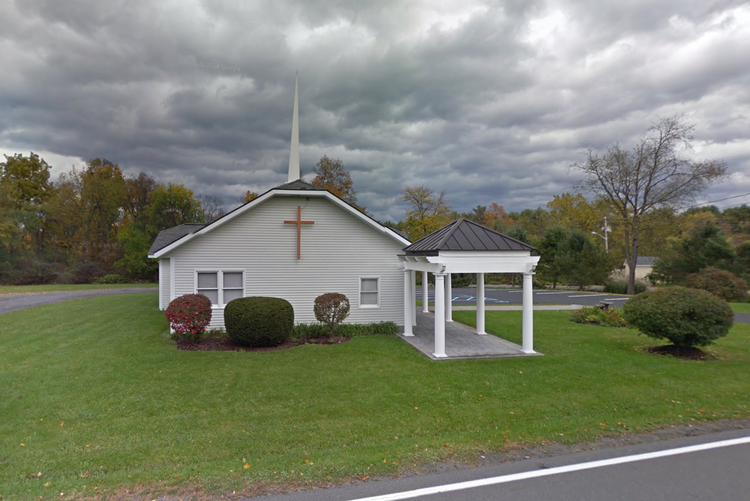
— From Google
The Guilderland Zoning Board of Appeals recently approved a home-school resource center for 6378 Gun Club Road.
GUILDERLAND — The Guilderland Zoning Board of Appeals on March 4 approved a for-profit home-school resource center on the town border with Altamont.
On separate votes related to the proposal — an interpretation of the proposed use and approval of the project itself — the tally was 4 to 1, with James Zieno twice casting the dissenting vote.
Zieno’s vote was the only one Acton Albany could afford to lose because the Rural Guilderland Referral Committee — which has the ability to weigh in on town projects within 1,200 feet of the village boundary — was not in favor of the proposal, stating it was “not consistent and does not meet the criteria set forth in the previous” town-issued special-use permit.
The zoning board had the ability to disregard the committee’s opinion if a majority plus one — meaning four members of the five-member board — voted to proceed contrary to the recommendation.
Applicants Joseph and Katie Coffey plan to use the 2,760-square-foot building at 6378 Gun Club Road as what they call a “learner-driven community resource center” for homeschooled children ages 4 to 11. The facility is affiliated with the national Acton Academy Network.
On March 4, the Coffeys described their operation as an enrichment and socialization hub — and said it was not a school, a daycare, or a curriculum provider. The board was told there would be “guides” to supervise children — at first, it will be two guides for nine children, who choose their own activities.
The Acton Academy Network provides a loose programming framework but does not impose a curriculum, Joe Coffey told the board; parents are responsible for meeting the state’s homeschool requirements through an individualized home instruction plan (IHIP).
On the regulatory front, Zieno brought up that Acton Albany could be classified as a school-age child-care program under the portion of state law that defines such a program as a non-residential facility providing child daycare to seven or more enrolled children under 13.
But the applicants drew a careful legal distinction between their operation and regulated categories. The Coffeys’ attorney, Mary Beth Slevin, argued that the facility was not a daycare under state Office of Children and Family Services regulations because all enrolled children have filed IHIPs with their school districts, making them legally enrolled homeschool students rather than children subject to daycare oversight.
The board’s chairwoman, Elizabeth Lott, acknowledged Zieno’s concern but said it fell outside the zoning board’s jurisdiction. Determining whether a state agency would classify the operation as child care is a question for that agency, she said, not for the town’s zoning board in an interpretation proceeding.
6378 Gun Club Road
The Gun Club Road building has been owned by Jeff Thomas’s family foundation since 2006, the same year a special-use permit was issued allowing not-for-profit entities, which Acton Albany is not, to operate from the site.
Since Acton Albany is a for-profit operation, the zoning board had to deal with two issues on March 4: interpret the undefined term “community center” in the town zoning code and decide whether to amend the original special-use permit.
Guilderland’s zoning code allows for “community center[s]” in the R20 residential zone, in which 6378 Gun Club Road is located, but the term is not defined anywhere in the code.
When this happens, the zoning board is vested with the power to define the undefined.
The 2006 special-use permit was granted for the property to operate a “community center” run by the not-for-profit Community Caregivers, but because the Coffeys’ operation is a for-profit LLC, they needed an amendment to the permit that removed the not-for-profit restriction, or a new variance request if the use didn’t qualify as a community center.
Mayor’s view
During the March 4 meeting, Altamont Mayor Kerry Dineen told board members that the referral committee’s review found the Coffeys’ operation did not meet the conditions of the original permit because it’s for-profit, and that the village’s formal position was that the Coffeys should pursue a use variance rather than an amendment to the existing permit.
Dineen then raised additional concerns.
The property is served by village water despite lying outside Altamont’s boundaries, and the village has suspended acceptance of new outside water connections. Dineen said a formal water contract would be required with any new commercial user and that a water-usage study promised to the village had not been provided.
She also noted that the Coffeys’ Short Environmental Assessment Form described the use as a daycare/educational facility — children dropped off daily, picked up, with tuition paid — and that parking on Gun Club Road is a concern given the absence of a road shoulder.
Lott noted the village’s independent authority over the water connection but did not attempt to resolve the issue, stating the village would address it through its own process.
On usage, the board accepted an explanation from building owner Jeff Thomas that the facility’s water consumption with 30 students (the maximum that will be allowed) would not exceed that of a two-family home.
The determination
As the board deliberated the definition of “community center,” Lott offered an expansive interpretation: the common understanding of “community center,” she argued, was a facility intended for public use that benefits the community; neither not-for-profit status nor universal availability to every resident was required.
She then deployed a series of analogies: the Guilderland Senior Center serves only seniors but no one disputes its classification; the YMCA is privately owned, charges membership fees, and gates access, yet is universally understood as a community center; a for-profit museum that opens its space to the community for civic events also functions as a community center.
The board then voted, 4 to 1, in favor of Lott’s definition of “community center,” with Zieno’s “no” vote grounded in his view that Acton Albany functionally resembles a regulated program and that the board should have obtained a legal opinion from the town attorney before proceeding.
As the board moved on to what to do about amending the special-use permit, Lott’s reasoning tracked her earlier analysis: the Thomas Family Foundation’s continued ownership of the building provided an institutional not-for-profit layer even with a for-profit tenant, and the YMCA comparison demonstrated that community benefit does not depend on tax status.
On the vote, 4 to 1, Zieno’s objection was informed by the village of Altamont’s concerns: that the use is sufficiently different enough from the 2006 approval to warrant a fresh permitting process, with new agency referrals, a new environmental review, and a more formalized role for the village.
The majority concluded the underlying use category remained the same.