Guilderland renews 10-year franchise with Spectrum as use declines
The Enterprise — Michael Koff
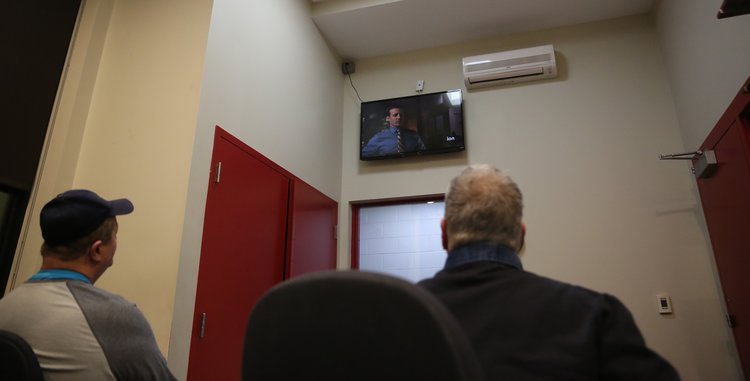
Volunteer firefighters watch Spectrum TV at the Westmere firehouse.
GUILDERLAND — Guilderland’s town board recently authorized the renewal of a 10-year franchise agreement with Spectrum for allowing the company continued access to public infrastructure.
The agreements are legally required contracts under federal law, in which cable operators must obtain permission from local governments before providing service to residents.
Along with that non-exclusive permission, cable companies are authorized to install and maintain their infrastructure in public rights-of-way. For this, cities, towns, and villages receive 5 percent of the company’s revenue derived from the operations within their municipal borders.
Guilderland’s latest agreement with Spectrum, it was noted on Jan. 20, includes for the first time a $25,000 public-access grant that will be used to improve the town’s broadcasting and information-technology infrastructure.
It was also noted during the Jan. 20 board meeting that the agreement includes a “density requirement” designed to connect rural access to broadband, with Spectrum agreeing to extend its service to any area with a minimum density of 20 residences per mile of cable.
Resident Karen White, having only glanced at the agreement earlier that day, said, “My first question is: This 5 percent that was just mentioned, how much does that amount to every year?”
Supervisor Peter Barber did not have the number immediately available.
These types of agreements have been very lucrative for local governments, but in recent years, amid widespread “cord-cutting” by customers, cable franchise payments have flattened or, as is the case in Guilderland, declined.
Cord-cutting refers to the deliberate cancellation of cable or satellite television subscriptions in favor of alternative viewing methods, specifically internet-based streaming services.
Between 2018 and 2025, adoption of the practice accelerated dramatically, with the number of cord-cut households more than doubling in that time, from approximately 37 million to about 77 million by 2025. Over the same period, traditional cable-TV households have steadily declined, from 90 million to 69 million, according to industry data.
In response, cable companies in New York state have, over the past half-decade, stopped reporting publicly how many subscribers they have in a specific city, town, or village.
In filings made to the state Public Service Commission, which has oversight of New York’s utilities, these regulated monopolies cite the need to keep the “proprietary” information out of their no-competitors’ hands and redact their subscriber figures — meaning these publicly-traded companies are trying to keep shareholders and the markets from seeing those rates.
But, even without recent subscriber rates, the information that is publicly available paints a picture of an industry long in decline. For example, in 2012, Spectrum had 10,200 customers in Guilderland while the most recent available information, from 2019, places that figure at about 6,000.
But there’s almost always a paper trail when the government is involved.
In Guilderland, for example, total annual franchise payments over the past 10 years have declined from $615,000 in 2016 to an expected $550,000 this year.