Bethlehem down to two choices on elementary-school rezone
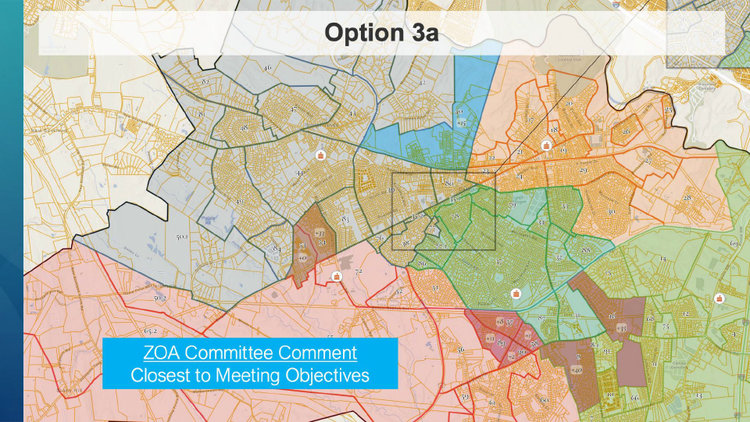
— From the Bethlehem Central School District
These elementary school rezoning options are under consideration by the Bethlehem Central School District.
BETHLEHEMM — After Clarksville parents came out in force at recent Bethlehem School Board meetings, their students are no longer in danger of being shifted once again from the school they attend.
For months, because of too many students at two elementary schools and too few at three others, the board of education, a separate rezoning committee, and the public have debated a number of options to reshuffle students, ultimately arriving at two — called 3A and 3B. A decision is expected to be made at the board’s Jan. 21 meeting.
The two options share a common architecture: Each moves approximately 145 students, both shift the same core neighborhoods between buildings, and each satisfies the district’s mathematical requirements for balanced enrollment.
The difference lies in a single neighborhood: Westchester Woods, administratively designated as Neighborhood Planning Unit (NPU) 51.
Under Option 3A, Westchester Woods remains at Eagle Elementary School, preserving a walking route parents describe as safe, established, and central to their community identity. Under Option 3B, Westchester Woods moves to Hamagrael Elementary School, which restores a connection that existed before previous rezoning but requires busing rather than walking.
The capacity crisis
The dilemma is driven by a capacity discrepancy: The district’s Glenmont and Eagle elementary schools are over-enrolled by approximately 110 students combined. Conversely, the district’s remaining three elementary schools — Elsmere, Hamagrael, and Slingerlands — have a combined 15 classrooms not currently used for general instruction.
The urgency exists despite the fact that total enrollment in the Bethlehem Central School District has declined 21 percent since 2006, from 5,026 students in the 2006-07 school year to 3,982 in 2024-25.
Yet buildings are more crowded than ever.
The reason is a policy shift toward lower class sizes. To support differentiated learning and student wellness, the district now targets 18 students in kindergarten and first grade, versus as many as 29 before the pandemic. Prior to COVID-19, some fifth-grade sections reached as many as 29 students.
The district now operates under significantly lower targets:
— Kindergarten: 18 students;
— Grade 1: 18 students;
— Grade 2: 19 students;
— Grade 3: 20 students;
— Grade 4: 21 students; and
— Grade 5: 22 students.
These smaller classes consume more physical space. The district is, as a facilities report noted, “using more classroom space to house fewer students, creating a bottleneck that cannot be resolved without shifting the geographic footprint of the student body.”
To deal with the issue, the district's capital planning committee explored two paths: building new wings at Eagle and Glenmont, or redistributing students across the existing five-school network.
A new wing at either school would cost approximately $15 million to $20 million per building — a capital expense that requires voter approval. With construction estimated to take between 18 and 24 months, leaving the district operating over capacity in the interim. Redistricting requires only administrative action that increases annual transportation costs by about half-a-million dollars.
Clarksville
Having served as the center of the eponymous rural hamlet since 1948, Clarksville Elementary was closed by the Bethlehem Central School District in 2011, amid declining enrollment. Enrollment was actually increasing in the area served by the Clarksville school but declining elsewhere in the district.
School board members at the time cited a $1 million budget gap, and said closing the school would save the district $900,000.
The school has since become a station for the Albany County Sheriff’s Office.
At the time of its closing, Clarksville Elementary was the lone elementary school of six in Bethlehem school district that was in the town of New Scotland; the other five are in the town of Bethlehem.
After Clarksville Elementary closed, its students were assigned to either Eagle Elementary or Slingerlands Elementary — most ended up at Eagle.
Among the recent reshuffling proposals, Clarksville students were once again slated to be on the wrong end of rezoning — being moved en masse to Slingerlands — but Clarksville parents showed up for their kids at school board meetings to protest, resulting in the bulk of students from Clarksville remaining at Eagle Elementary under options 3A and 3B.