No change on Altamont’s tax hike but legislators explore remedies
Enterprise file photo — Michael Koff
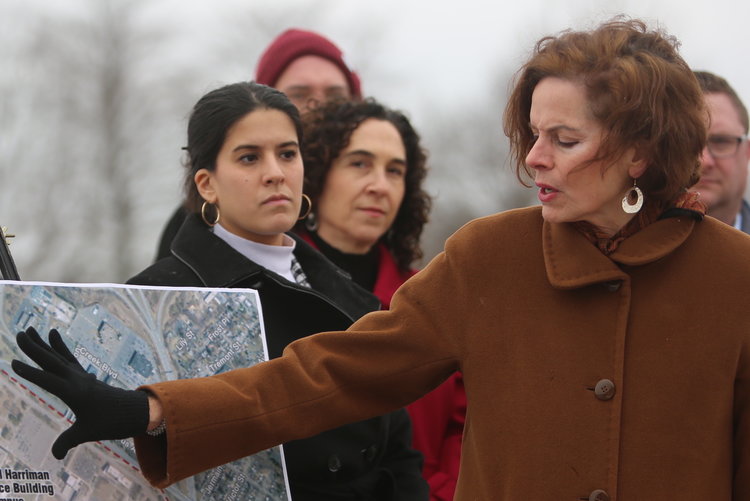
Assemblywoman Gabriella Romero, left, and Senator Patricia Fahy, right, in January pushed legislation that would redevelop 7 acres of the Harriman campus with housing and commercial space. Now the legislators are teaming up to explore legislative remedies to ease Altamont’s town tax burden.
ALTAMONT — Following weeks of back-and-forth over the town’s raising of villagers’ property tax bills by 162 percent, Altamont and Guilderland have vowed to work together moving forward, but there doesn’t appear to be any immediate relief in sight for village property owners.
The increase followed an audit from the state comptroller’s office that said Guilderland had to shift the way it used sales-tax revenues from Albany County.
At a Dec. 3 village meeting where Guilderland officials came to describe their dilemma, Altamont resident Mike Hill said, “At the end of the day, State Comptroller Tom DiNapoli didn’t raise my taxes. I mean, you guys did … I know you’re in a bit of a bind but I’ve seen recommendations disputed before.”
Hill noted the added tax burden for Altamont residents would continue in future years without legislative change and suggested checking with Assemblywoman Gabriella Romero and Senator Patricia Fahy.
Guilderland Supervisor Peter Barber responded, “I’ve already reached out to both Romero and Fahy and they are looking into it.”
The Enterprise reached out, too, and found both legislators are exploring legislative remedies.
Romero’s communications director, Asia Harris, said in an email to The Enterprise, “Our office is working diligently on looking into this matter and has done extensive research. We have identified soliciting a second legal opinion from NYS Attorney General Letitia James’ office as a potential next step that the town could take.
“We are also in regular contact with Town Supervisor Barber and Senator Pat Fahy to work collaboratively on finding ways to address this at all angles, including exploring a legislative fix.”
Fahy’s office responded to Enterprise inquiries with this statement, “I am deeply concerned that Village of Altamont residents are now facing a 162% increase in their property tax bills for the upcoming year, at a time when families are struggling just to afford the basics ….
“My office has been in contact with Town Supervisor Peter Barber and Altamont Mayor Kerry Dineen to explore the possibility of a legislative remedy. Given the unique circumstances between the Village of Altamont and Town of Guilderland, including a large population discrepancy and overlapping shared services, the law should aim to accommodate an already functional relationship rather than ‘fixing’ what isn’t broken.
“My office is actively researching the extent to which any legislative solution can prevent this situation from recurring while preserving the fiscal health of both local governments. If the statutory language is outdated, I will consider drafting narrowly-tailored legislation alongside Assemblymember Gabriella Romero to correct this fiscal imbalance.”
The village tax increase came after an audit by the Office of State Comptroller, which found that the town’s allocation of sales-tax revenue was incorrect according to a 1965 New York state sales-tax allocation law.
The audit asserted that the town should have used sales-tax revenue to reduce property taxes in the B and DB funds — funds that do not include the village — to zero before applying any remaining sales tax to the A Fund — the town-wide tax bucket, which includes Altamont.
In early November, the Guilderland Town Board unanimously adopted a $47.7 million budget for next year that decreases the average town property town tax bill by $16 but increases village residents’ taxes $200 to $300. Two weeks later, Altamont Mayor Kerry Dineen was before the town board, asking why she had to learn of the increase from The Enterprise, while calling for changes going forward. “I don’t think this increase should stand,” Dineen said.
During the Dec. 3 Altamont Board of Trustees meeting, residents and trustees alike expressed concern and frustration over the confidentiality of the audit and its findings, especially since the conclusions directly impacted property taxes before they could be publicly discussed, with one resident stating it felt like “taxation without representation.”
Barber largely agreed with the observations, telling attendees when he asked the comptroller’s office, “How can I keep something confidential if I have to have public hearings on this budget?”
The response, he said, was, “Well, that’s your problem.”
Barber told attendees of the Dec. 3 village meeting that the town disagreed with the interpretation, arguing that the law states “reduce,” not “reduce to zero,” and that the OSC’s interpretation forces Guilderland to treat village residents differently from other Guilderland residents.
Barber said, if the state intended for the taxes to be eliminated, it would have used language like “eliminate” or “reduce to the maximum extent possible.”
“So,” Barber told attendees, “the town board had to decide a couple of things: One, screw the comptroller and just do what we’ve always done,” which he said was “not a good thing to do because part of the process is we have independent auditors who come in and they want to make sure we’re following the comptroller’s guidance.”
He continued, “And two, we have to file an annual financial disclosure report that says that we’re complying with what the guidance is [from the comptroller’s office]. It’s so frustrating because I think they’re wrong, and I have reason to believe that they know they’re wrong, but the auditors basically have to follow the legal advice that they’re given.”
Issues and proposed remedies
There was an acknowledgement from both sides that a communication breakdown between the town and village exacerbated the results of the audit, and to address the issue the municipalities plan to reinstate regular executive meetings, enhance transparency during the budget process, and collaborate on legislative advocacy.
A primary step identified to improve communication between the village and town was the re-establishment of direct, regular contact between the mayor and supervisor. During the Dec. 3 meeting, it was noted that the mayor and supervisor used to meet frequently, but the practice had fallen out of routine.
To prevent future surprises, Barber and Dineen agreed to discuss scheduling meetings specifically structured around critical times of the year, such as the budget season. The goal of the meetings would be to share information that might otherwise be siloed due to confidentiality or bureaucratic processes.
Dineen suggested that, prior to the town holding its public budget workshops, village trustees or the mayor herself should review the numbers with town officials. This would allow trustees to understand potential impacts and answer residents’ questions proactively, rather than learning about changes through the newspaper.
Former Mayor James Gaughan inquired about the role of the Guilderland Town Board’s village liaison, to which he was informed it was a position held by Altamont resident Amanda Beedle.
“My question is: Have, did you reach out at all as a liaison on any level over the last four years, not just about the budget?” Gaughan said. “I’m just interested in how a liaison operates from Guilderland to the village.”
Beedle’s answer made it rather clear there hadn’t been much communication.
“I’m at every community event here in this village,” Beedle said.
Gaughan interjected, “No, I’m talking about with the officials here.”
Beedle, in response, said Barber was the town’s “first liaison” to the village.
Gaughan, referring to an earlier comment made by Beedle that the mayor and supervisor should meet monthly said, “The first thought that came to my mind,” given that the supervisor oversees a big town and is very busy, is “that the liaison should play a role in that as well. So going forward I hope to see that happen.”