Topographic model of the Helderbergs should remain at Thacher Park
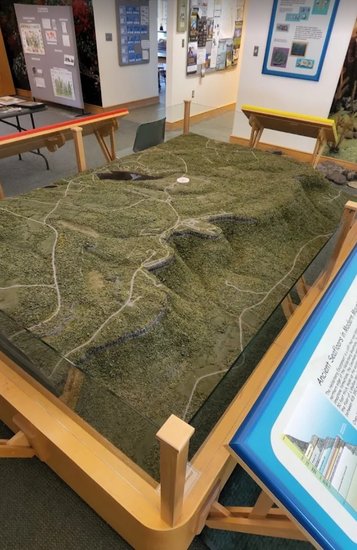
— Photo by Cyan Fox at Emma Treadwell Thacher Nature Center
This three-dimensional topographic floor model of the Helderberg escarpment has been a focal point at the Emma Treadwell Thacher Nature Center.
To the Editor:
The New York State Office of Parks, Recreation and Historic Preservation has announced a campaign to update exhibits at the Emma Treadwell Thacher Nature Center on Thompsons Lake.
The nature center is an integral part of John Boyd Thacher State Park, serving as an educational resource for understanding the natural environment within the park. It provides year-round programs, exhibits, and trail access connecting visitors to the park’s diverse habitats.
The nature center opened in July 2001 and is located on Thompsons Lake due primarily to a funding endowment given to the people of the state of New York from Martha and Fred Schroeder.
Their donation inspired an important relationship with the Office of Parks that sparked the nature center’s construction and provided an endowment that continues to support future staffing and educational programs. Without the Schroeders, this nature center may never have existed!
Before that time, in 2001, the state of New York had failed to provide any interpretive venue or indoor visitors’ center for Thacher Park. The park was created from a donation by the Thacher family in 1914.
So, during the first 87 years that the state of New York owned Thacher Park, the state never felt it was worth investing in a visitors’ center for Thacher Park even though people come there from all over our nation and the world, some specifically for scientific research, others for recreation.
I will commend the state of New York for doing a great job building infrastructure and adding park land, trail systems, bathrooms, a dearly missed Olympic-sized swimming pool, which unfortunately closed in 2007. While the public was promised a reasonable replacement that had funding, it never came to fruition.
In the last two decades, the Office of Parks has done wonderful things for Thacher Park. The park is controlled by the Saratoga Capital District Regional Office in Saratoga Springs.
There are so many positive improvements to the park in the 21st Century that I applaud them for. To name just a few, at the core of Thacher Park are the new bathroom facilities, playgrounds, roads, general maintenance and upkeep of trails, buildings and picnic areas.
Everyone working there, from the regional office to the staff on premises to Friends of Thacher Park volunteers, deserve to be proud of the accomplishments they have achieved on the behalf of the citizenry who use the park.
One of the crowning accomplishments is the construction of the visitors’ center, which opened in May 2017, one-hundred-and-three years after the park opened. This is what I had been advocating for all my life.
The center was a $4 million project and is located at the trailhead for the Indian Ladder footpath, below the cliffs. It is the interpretive center for everything found at Thacher Park.
When the Emma Treadwell Thacher Nature Center was built years before the visitors’ center, it served as both a nature center and visitors’ center. Now that there are separate venues, the Office of Parks correctly wants to make the nature center geared more toward the natural environment and devote more of the visitors’ center to geological and human history while still keeping a little of both at each site.
When the nature center was opened, the most prominent display in the entrance as you came through the double doors was, and still is, a three-dimensional topographic floor model of the Helderberg escarpment at Thacher Park.
It is a model that physically shows a visitor what the terrain looks like within and around Thacher Park from the lowlands of the valley floor up the talus slopes, to the cliffs of the escarpment, Indian Ladder Gulf, and Cave Gulf, the Horseshoe Area formation, the waterfalls and creeks as well as the upper land and ledges behind the cliffs, the picnic areas and roads and everything back to Thompsons Lake.
This beautiful model is an important asset to the educational experience at Thacher Park as can be supported by the initial investment that the Office of Parks made in creating it, and giving it a place of prominence, displaying it and keeping it in the public arena for almost 25 years.
Well, now they don’t want it anymore!
It is not included in the remodeling of the nature center and as of this writing there is no plan to move it to the visitors center. If you've never seen it, I suggest you go to the nature center and look at it before it is gone. This decision to be rid of it comes down from the regional office in Saratoga.
I have been trying to convince them that there is a place for it at the visitors’ center. They want to find a new home for it but not at Thacher Park.
When they say there is no room for it, I say: Where there is a will to save it, there is a way! The on-site staff does not make these kinds of decisions.
The park was recently named a National Natural Landmark, which I believe the regional office does not think is important enough to include on the signs entering the park that the acknowledgement would detract from its prominence as a state park. What nonsense.
Since it is a National Natural Landmark the topographic model is all the more important as an educational tool at the visitors’ center.
If you feel the same way I do, call the regional director’s office in Saratoga Springs and speak to the regional director, Alane Ball-Chinian, at 518-584-2000, ext. 222 or email her at with your views.
Nothing tried, nothing gained.
If that doesn’t work, call the commissioner of state parks or your political representatives. Remember, we taxpayers paid for it; we should have a say!
Timothy J. Albright
Meadowdale
Editor’s note: Alane Ball-Chinian responded about the Office of Parks’ plans for the topographic floor model, “We have not decided what we’re doing. We’re investigating all the opportunities.”