Guilderland must legislate to preserve its history
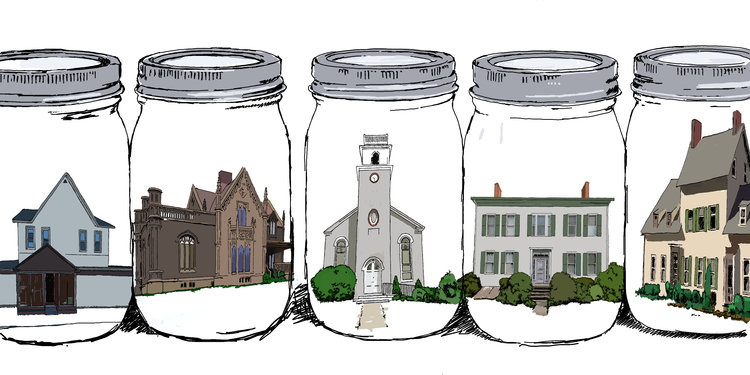
Art by Elisabeth Vines
The Sioux have a traditional saying: “A people without history is like the wind on the buffalo grass.”
The wind makes its mark as it passes through, but it leaves no record; it is temporal, only a fleeting whisper. We need to pay attention to our local history, to learn from it, to preserve it, and to let it inform our future.
We wrote those words on this page in 2002, soon after the town of Guilderland had adopted its first-ever comprehensive land-use plan. We had urged the town to do so for years.
“The Town of Guilderland,” the 2001 plan said, “envisions itself as a distinctive suburban and rural community ….”
At that time, nearly a quarter-century ago, we applauded efforts neighborhood groups in Guilderland were making to acquaint residents with neighborhood histories as the next logical step in realizing the plan.
“We have to understand what we have in order to preserve it,” we wrote. “If we don’t want our town to become one ubiquitous suburban sprawl, we have to walk the streets of McKownville, as a group did earlier this month, and hear about its history in order to see what distinguishes it from other neighborhoods.”
The zeal for honoring history has grown and flourished in McKownville over these past decades as, in 2018, a handful of residents began the arduous process of applying for designation as a historic district through the New York State Office of Parks, Recreation and Historic Preservation — an effort that came to fruition in 2023.
A year later, in May 2024, a roadside marker was unveiled for William McKown, who opened a tavern in the wide-open space along the Great Western Turnpike in 1803 and for whom the hamlet is named.
John McEneny, the Albany County historian who spoke at the unveiling, made a heartfelt plea for people to remember their regional roots. “We had a lot of individuality, and that individuality is disappearing …,” he said. “There’s cities and then there’s suburbs and they’re all sprawl.”
“Each of us is a unique person,” McEneny said. “Each neighborhood is unique and, unfortunately, people don’t learn it at the kitchen table like they used to. They don’t listen to the different generations.”
As McKownville shows us, an interest in history can start with the efforts of a dedicated few and grow to embrace many.
We commend Guilderland for, after three years of work, adopting an update to its 2021 comprehensive plan last month. Now comes the hard work of adopting legislation that will make the new plan’s vision a reality.
Due to a push this spring from former town board member Laurel Bohl, the updated plan has a chapter defining the town’s character. “Every town needs to have some identity to it ….,” Bohl told the Guilderland Town Board in March. “Without that, we will be, in my opinion, rudderless.”
The chapter begins with a definition of town character as “the unique set of qualities and attributes that define a town, shaping its identity and atmosphere …. Essentially, it’s what makes a town feel distinct and memorable.”
Among Guilderland’s defining characteristics, the chapter notes, are not just the town’s natural features but also its “built environment.”
“The history and culture of the town may include historical buildings and places, cultural events, and traditions in the community,” says the updated plan, noting, “The importance of town character includes providing a sense of place, belonging and identity for residents.”
The first of six key objectives the plan lists to preserve Guilderland’s character is to “protect unique architectural styles, historic buildings, and natural landscapes that contribute to Guilderland’s identity.”
Another is to balance growth with preservation so as not to degrade the town’s unique qualities.
We published a letter last week from three members of the Nott family whose family had lived at Norman Vale from 1829 to 1978. The grand historic home, often referred to as the Nott House, stands on Nott Road in Guilderland.
Built between 1770 and 1780 by the Veeder family, and occupied by Peter Veeder, the first clerk of the town of Guilderland, until 1810, Norman Vale was added to the National Register of Historic Places in 2009.
The estate has a storied history, much of it recorded on our pages. It was the home of Eliphalet Nott, the fourth president of Union College, which was founded in 1795 as the first non-denominational institution of higher learning in the United States. Nott was president for 62 years, from 1804 to 1866, and was the longest-serving college or university president in the history of the United States.
Eleanor Roosevelt is said to have visited often, and a wing on the second floor was known as the Eleanor Roosevelt Wing.
The Notts who wrote to us said they are “shocked and appalled” that the Norman Vale estate has been dismantled in recent years, its acreage subdivided for development.
They reference recommendations from the New York State Historic Preservation Office, including “siting any new construction so that it maintains a clear separation between the historic building and new properties. Tree line buffers should be maintained or established to screen views to the new houses. In addition, design of the new construction should be sympathetic to the surroundings and the historic building. Avoid out of scale designs or tall structures, use natural cladding materials as much as possible, and employ appropriate colors.”
“Most of these critical recommendations were not followed,” the Notts write, “and Norman Vale’s historic character and stately nature has suffered greatly as a result.”
Of course, once a family sells its property, it has no say over what will happen to it afterwards. And of course a town cannot afford to buy and preserve every historic structure within its boundaries.
Guilderland has done an admirable job of preserving and maintaining both the Mynderse-Frederick House in Guilderland Center and the Schoolcraft House on Western Avenue.
But Guilderland would be wise to look to the neighboring town of New Scotland to see actions it can take to encourage preservation of historic properties — thereby preserving town character — without making outright purchases.
In 2019, Alan Kowlowitz of Voorheesville, as president of the New Scotland Historical Association, proposed a law “to ensure that historic structures and sites in our communities are identified and preserved in such a way that enhance community character without impinging on property owners’ rights or requiring public expenditures.”
A joint New Scotland-Voorheesville Historic Preservation Commission was established, which Kowlowitz heads.
The commission is an advisory-only entity, offering input not just to New Scotland and Voorheesville’s building departments but also to the town and village boards, as well as each municipality’s planning and zoning boards.
For decades on this page, we have called for the towns and villages we cover to document their historic buildings to catalog their built history, which distinguishes them from every other place on Earth.
New Scotland did just that, establishing a registry of historic places in both the town and village. To be included, a site or structure must meet one of three criteria: be associated with a person or event important to town or village history; typify a type or period of construction or be the work of a master; or produce information on prehistory or history.
Recognition of historical significance does not place any restrictions on the property; the designation is purely honorary but it raises public awareness about a property’s importance.
Some towns, like Clifton Park, go further than New Scotland, incentivizing property owners with tax breaks to encourage them to preserve their historic buildings much the way Guilderland does with property owners willing to commit to not developing their land.
Under Kowlowitz’s leadership, Voorheesville and New Scotland were awarded a grant from the Preservation League of New York State to fund a cultural resource survey.
“You can’t preserve what you don’t know,” Kowlowitz told us in 2021 in anticipation of the survey.
The experts chose three places in New Scotland for potential designation as national historic districts: Voorheesville, Tarrytown, and Indian Ladder Farms.
The report by Hartgen Archeological Associates says that the transformation of the town from an agricultural area to mature communities after the arrival of the railroad in 1863 is recorded in the built culture of the village of Voorheesville, the hamlet of Tarrytown, and Indian Ladder Farms.
“The Mahicans formerly owned the lands currently known as Onesquethaw and the Hamlet of Tarrytown before it was lost to the Mohawks during the Beaver Wars in 1628,” the report says. In 1685, Teunis Slingerland, a trader from Beverwyck, now Albany, and his son-in-law, Johannes Appel, purchased the Onisquotha Patent, a 300-acre tract north of the Coeymans Patent.
Throughout the Revolutionary War, the report notes, the Onesquethaw Valley was a hotbed of Tory sympathy. It also says that the Onesquethaw Creek was important in the colonial era because it produced valuable farmland as well as a strategic trade route between the Hudson River and the Native Americans living in the Mohawk Valley.
Tarrytown, said Kowlowitz, represents a farming community from the early 19th Century. “The structures there have coherence,” he said, citing the several farmhouses and a church all built of limestone. He cited other places with historic limestone buildings that draw tourists.
Similarly, Kowlowitz said, consistency is the key to Indian Ladder Farms being chosen as a potential national district with its shingled buildings from the early 20th Century.
Kowlowitz said the next steps are to educate the public about the value of these three potential national historic districts and also teach about what a historic district means.
“People have a false impression that it restricts what people can do on private property,” he said. “That is not the case.” He wants to make people aware of the advantages like grants and tax breaks.
“I’m interested in history,” said Kowlowitz, who worked for the New York State Archives, “but I think historic preservation should also support other things that a community wants to accomplish.”
Enthusiasm for preserving history has become contagious in Voorheesville. The village bought a turn-of-the-last-century foursquare — once home of Voorheesville’s first mayor and later a hardware store — with the idea of tearing it down for more parking.
But, on learning the building has “good bones,” the village instead hosted a forum last month during which residents enthusiastically pitched ideas ranging from turning it into a museum or a maker space. Knocking it down would have been like pulling a front tooth from the smile of South Main Street.
Kowlowitz is right in his belief that historic preservation can improve quality of life and help economic and community development.
“Tying historic preservation to those things makes it an inviting thing for people that maybe just have a slight interest in history or no interest in history,” he said, “but can see how it can help a community’s sense of self and place and actually materially help our community.”
“Providing a sense of place, belonging and identity for residents” is precisely what Guilderland’s new plan calls for.
On the eve of our nation’s 250th celebration of its founding, the town of Guilderland should act to preserve its history to make a better future.