Parity in sports at GCSD: Football accounts for higher boys’ funding
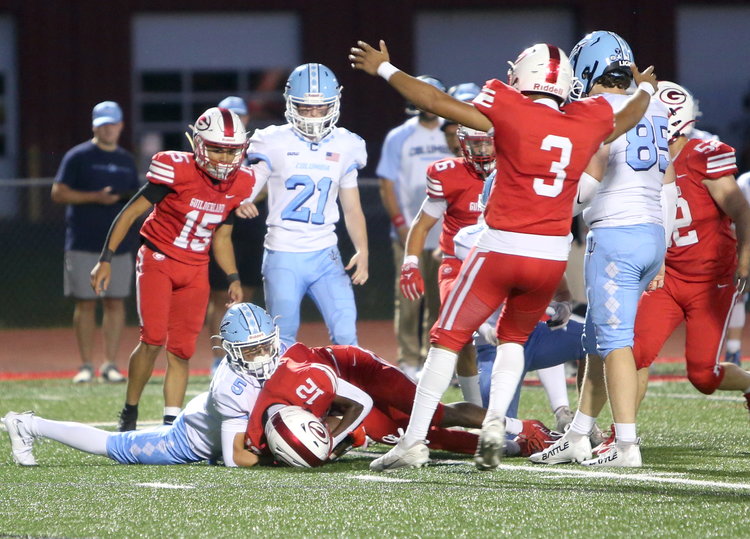
Enterprise file photo — Michael Koff
Costly shoulder pads and helmets are put to good use during Guilderland’s home opener on Sept. 12 as Rubin Reed smothers the ball after a Columbia fumble while teammate Abdo Baraeya celebrates. Costs for football insurance and equipment are a large reason why boys’ athletics at Guilderland Central cost more than girls’.
GUILDERLAND — Spurred by questions this fall from girls who play sports, Guilderland’s athletic director, David Austin, gave the school board a full report on parity in sports across the district.
While the district’s 83 teams are nearly equally divided between boys and girls, a slightly higher percentage of boys participate in interscholastic sports and more is budgeted for their programs, largely because of the cost of football, Austin said.
On Sept. 9, parents of girls on the tennis team had raised concerns about safety issues on the high school’s tennis courts because of cracked and uneven surfaces.
On Sept. 30, members of the varsity and junior-varsity field-hockey teams and their coach, Jennifer Sykes, asked for an assistant coach.
The Nov. 18 school board meeting opened with a showcase of successful student athletes and with two requests for sports support.
Molly Fanning, who coaches varsity golf, and six of her team members pleaded the case for an assistant coach as did the parent who heads the booster club.
Girls’ golf began in Guilderland in 2019 and has grown steadily since then.
“This season we had a record 16 golfers on the team, the most in the Suburban Council,” said Fanning, also noting the team won its league tournament and had five golfers qualify for sectionals.
When the team plays away and only eight girls go, the other eight are left behind without supervision. “Having an assistant coach would allow for the girls to have more attention at practice, and it matches having four foursomes on the course at once,” said Fanning.
The board also heard from the parents of ice hockey players — a team called Storm combines players from five schools — requesting transportation to after-school practices.
“Equity between sports is a fundamental expectation within our district. Other athletic programs receive district transportation,” said Mia Sullivan, one of several parents who addressed the board.
She said ice hockey players must either rely on upperclassmen to drive them to the rink in Schenectady where they practice — which “raises a significant safety concern,” she said — or must be driven by parents, which is problematic as many players have two working parents.
Superintendent Daniel Mayberry said he had been trying to find a solution but there are no buses available at the times practices are held. Most teams practice at the school and don’t need transportation, he noted.
“We can’t promise transportation that we can’t deliver,” said Mayberry, adding he will continue to look at it.
The hockey season is currently in limbo for Section 2 because the referees are in a contract dispute.
Athletics overview
In his overview of Guilderland’s athletic programs, Austin was accommodating about the bottom line: While he advocates to meet the needs of burgeoning teams, he said, he understands budget constraints don’t always make his requests obtainable.
“We anticipate it will be a difficult budget season,” said board member Rebecca Butterfield as board members discussed sports funding.
“We make sure all sports programs have what they need to operate safely,” Austin said. “But also, we’re putting them in positions to be successful.”
Guilderland students in 7th through 12th grades are eligible to play interscholastic sports. The district has a total of 42 male teams and 41 female teams.
Teams that have been added in the last five years include three varsity teams — girls’ golf, girls’ wrestling, and girls’ flag football; one modified team — boys’ volleyball — and Unified Bocce, a team with both boys and girls that includes students with disabilities.
About half of Guilderland’s female students participate in one sport and 24 percent participate in multiple sports while 56 percent of male students participate in one sport and 29 percent participate in multiple sports.
“I’m proud of these numbers,” said Austin. “To me, you’re talking about a program that impacts one out of every two kids that are walking the hallways in grades 7 through 12 …. We’re providing a ton of students with a positive experience, one that they’ll remember the rest of their lives.”
During the three years affected by the pandemic, from 2019-20 to 2021-22, the girls’ teams got about $40,000 less than the boys’ at about $200,000.
In the three most recent years, from 2022-23 to 2024-25, the girls’ teams got about $56,000 less at about $260,000 compared to the boys’ roughly $316,000.
A Title IX compliance audit covered three school years, from 2018-19 to 2020-21. Title IX is a federal law that prohibits sex-based discrimination in any school program that receives federal funding, including athletics. The 1972 law mandates that female and male student-athletes must be provided with equitable opportunities, though not necessarily identical ones.
“The auditors concluded overall that the girls’ and boys’ athletic programs are relatively equitable,” Austin reported, adding, “We’re a couple years removed from this audit, but not a ton has changed since then.”
Coaching stipends, the audit noted, are point-based and determined by contract language with no difference between girls’ and boys’ team coaches. The 2018-19 transportation for boys’ teams was higher, but otherwise equitable.
More was spent on uniforms for girls than for boys. In the last four school years, 20 sets of uniforms have been purchased for boys’ teams while 22 sets have been purchased for girls’ teams.
Uniforms for varsity teams last for five or six years, Austin said, and then are passed down from varsity players to younger players. “Our modified kids, you know, they’re often getting uniforms that are 15 years or older and not sized properly for 7th- and 8th-graders,” he said.
Equipment expenditures were higher for boys’ teams with the football program being the major driver of the difference.
Austin went over at length some of the reasons the football program is so costly.
Football alone has separate teams for seventh-graders and eighth-graders rather than a combined modified team as other sports have. Austin said this is important for safety reasons since football is a contact sport and a year’s difference in age can make a difference in an athlete’s size.
“That’s our only sport that offers five levels,” said Austin, comparing it to girls’ flag football, new this past spring, which has just one level. “So there’s some discrepancy there,” he said.
Also, Austin said, “There’s a difference in insurance costs” with a high-contact sport like football driving up costs.
In addition, football equipment needs to be reconditioned. “In order to operate that sport safely, we are required by law, all right, to turn our equipment in at the end of each season,” he said.
Last year’s cost for reconditioning football equipment was $9,262, Austin reported.
Also football helmets, which cost about $300 each, have a lifespan of just 10 years, he said, while shoulder pads cost from $150 to $180 a pair.
Austin went over the rubric used to determine the pay for coaches and assistant coaches. The stipends are determined by contract and the rubric is based on 10 criteria, including the length of the season, the number of players on a team, the safety risks, and the maintenance of equipment.
Salaries this year range from about $168 on Step 1 to roughly $242 on Step 5.
Booster clubs, Austin said, often pay for assistant coaches that the school district isn’t funding. There is no state guidance on assistant coaches, he said.
Board member Kelly Person asked if the booster clubs paid assistant coaches the same amount as the district.
Austin said he didn’t know, adding, “The less I know, sometimes the better.”
Volunteers or not, he said, assistant coaches must have proper coaching certification.