Recalling the men who rode the rails: ‘Before you judge a man, walk a mile in his shoes’
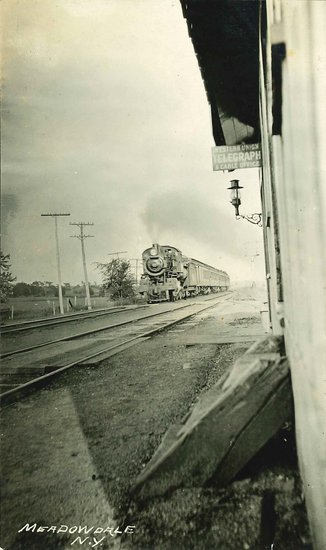
— Postcard from Timothy Albright
The Meadowdale Train Station on the Delaware & Hudson line between Voorheesville and Altamont in the early 20th Century. The men in the picture are Sid and Millard Smith, sons of Jonas and Hannah Relyea Smith.
To the Editor:
I want to tell you about the homeless people who used to travel the railroads in the late 19th Century and early 20th Century. Back then, they were referred to as tramps, hobos, and bums. A tramp is defined as a homeless person who travels from place to place on foot.
A hobo is defined as a homeless person who lives by asking for money or food or as a person who travels from place to place in search of work, often stowing away aboard freight trains.
A bum is a person who tries to get something by begging.
I’m bringing this to your attention because of the renewal of train traffic on the Norfolk Southern line through Voorheesville and Altamont. I’m sure many of the people who live in these places are unaware of how many homeless people came by this way in the early days of the railroad.
History
Let me start with a little railroad history.
Construction of the track passing through Voorheesville and Altamont began at Albany in 1851 and started service in 1863, connecting to Binghamton in 1869. It provided passenger and freight service as the Albany and Susquehanna line. This line was later leased by the Delaware and Hudson Canal Co. in 1870. Its course was generally east to west.
The other railroad that went through Voorheesville, following a south to north path, was the New York West Shore and Buffalo Railway beginning in 1880 and passing through Voorheesville in 1883.
When the railroad crossed the Delaware and Hudson it necessitated the name for the train station at Voorheesville being called “The Union Depot.” The New York Central System took over this track in 1885 offering freight and passenger service, while ending its passenger service in 1959.
The Delaware and Hudson railroad ceased its passenger service in 1963. The Chessie System and Seaboard Coast Line, unofficially known as the Chessie Seaboard Exchange, or CSX, formed in 1980 and took over the New York Central line, operating the double-tracked line that continues through Voorheesville today.
The SMS Rail Service is a short line that took over the D&H from Voorheesville to the west in 1994, while the eastern portion to Albany has become the Albany County Helderberg Hudson Rail Trail, a 9.8-mile paved multi-use path.
Through a legal process known as “railbanking,” the rail corridor is preserved for potential future rail use.
The SMS Rail line refers to the founder, Stewart M. Snible, while also being alternately known as the Safety Management System. Norfolk Southern terminated its lease agreement with SMS from Voorheesville west, in 2021, so that it could upgrade the tracks for larger train traffic.
Norfolk Southern started a project known as the “East Edge Service” that would create a connection allowing a double-stack freight car intermodal corridor connecting Chicago directly to Boston.
This overhaul to the railroad, in part, cost an approximate $64 million investment, replacing miles of rail and many thousands of cross ties, crossing improvements, and bridge repairs.
This will allow the 9,000-foot long trains with double-stacked freight cars to travel from the Midwest to New England, possibly cutting transit times by 10 hours.
The Weidmans’ view
Now that you know some background history of the railroads, which many so-called tramps and hobos used, I want to again tell you what my friend Catherine Weidman, who was a teacher, historian, and journalist, had to say about them during her lifetime.
She lived from 1912 to 2003 on Koonz Road in Voorheesville, near the D&H tracks that cross Hennessey Road.
This is from Kay:
“One evening when we old folks got to remembering the good old days, we talked about tramps. ‘Tramps used to be a common thing,’ said her husband, Ken. ‘One could trust them more than you can many folks today. Some days we fed two or three tramps. Some tramps followed the railroad tracks. Some came by the road, just moving along slowly. Tramps who went long distances used to ride in empty box cars. Railroad “dicks” or “bulls" were always after them, rounding them up, and some could be cruel and brutal.
“One tramp had many papers folded up in his pockets. Pop asked why he had the papers. The fellow said, ‘I lie down to sleep along the road and put the papers over me, cover up so the mosquitoes don’t bite so much.’
“A certain tramp who came around a few times had a big black Newfoundland dog with him. Once, two fellows came in here just about dark, didn’t ask for eats, said they weren’t asked to sleep in a barn. The folks asked the young men if they had any supper. They said ‘No’ so we fed them.
“Then Pop gave them horse blankets we kept upstairs over the bannister in the hall. He took the men into the barn where there was hay in the mow. Didn’t take them thru the stable past the horses.
“Some horses around here had been stolen, and folks didn't trust tramps so much just then, well, the tramps slept in the hay.
“When Pop got up and out at 5:30 in the morning, they were gone.
The blankets were folded up neatly and laying on the breast-girth.
“Pop used to tell folks about a tramp who followed the cow path up from the railroad and asked for something to eat. He was told to wait by the horse-block by the corner of the house. Every place had a horse-block in those days, to drive up to, to get in and out of any road wagon. Ma filled a plate from supper-time and Pop took it to the traveler at the horse-block.
“He looked at the well-filled plate of bread, meat, potatoes, and pie and said, ‘Boy, now that’s a good load.’ My Ken saw lots of tramps in the early 1900s.
“Since the D&H Railway extended along the Weidman Farm, near the Black Creek (now a swamp, but then it was farmland and pasture because they drained it) tramps could easily follow the cow lane to the farm buildings.”
Kay continues to write that she remembers seeing a few tramps in Schoharie County as a young girl.
Tramps were, I believe, wanderers with no home, no family, and no work.
They would work for a handout. That was the difference, I think, between a tramp and a hobo. A hobo wanted to have the lifestyle of being footloose and fancy-free, to live without working.
I guess the fellow in another anecdote Ken tells must have been a hobo instead of a tramp. He was clever. The story went that a tramp came looking for something to eat.
The folks said they’d give him food if he sawed some wood. The man went to the wood pile then returned to the door, complaining that he was hungry and wanted to eat first. After he'd eaten, he went back to the woodpile, but soon disappeared.
A note left on the wood read , “If anyone asks you, tell them that you saw me, but didn’t see me saw.”
Tramps had a way of telling each other, by piling up stones, where one could get food.
“It was a rule around the country here,” said Ken, “not to feed the fourth tramp in a day. If number four came, he was told to go along, to try the next place, maybe they hadn’t fed three there.
“The tramps never got nasty, only went away. Ken told about the ‘tramp days’ of Uncle Bill Weidman who worked at Schenectady G.E. and was asked along with other unmarried men of that time, when work was slow, to take the summer off and he’d be kept on the books to return to work later.
“Bill took off, and went west looking for work. Later he told his folks, ‘It gives one an awful funny feeling when you get so hungry and rap on a door, and a big girl comes to the door and yells, ‘Ma, there's another tramp here.’
“Playing the tramp paid off though for Uncle Bill. General Electric took him back and he had part-time work during the Depression when he later had a family to support. In the end, he received his pension.”
Yesterday’s tramps seemed to have self-respect. They were just down on their luck. They didn’t look much different from other people. Sometimes one might carry a few belongings tied on a stick over his shoulder.
Tramps, like gypsies and the old-fashioned train whistle, are now a part of nostalgia of days gone by: Kay remarked how young folks never experience things like gypsies and tramps nowadays.
That was written in the 1970s. She goes on to say how she missed seeing gypsy fortune tellers at the Altamont Fair and that, in the early 1920s, the passing of a gypsy train was an exciting, colorful, and sometimes fearsome part of their lives.
There were two dogs she took note of. The first was “Railroad Jack,” who rode the D&H train and got off at Voorheesville and stayed at the station. Everyone knew him at the railroad stations as he got off and on the trains whenever he wanted. The other was a short-haired dog called “Bum Gree,” who traveled all the time and slept in the railroad station office.
Today
In 2026, the state of homelessness presents a complex, polarized picture that is a severe crisis fueled by a lack of affordable housing. The overall number of Americans without housing has continued to rise from previous years.
Last year saw an increase in encampment sweeps and enforcement of bans on public sleeping.
Federal and local strategies are increasingly shifting away from “Housing First” toward mandated, service-oriented, or involuntary removals from public places and spaces. Unhoused individuals face higher risks of illness, injury, and lack of access to care with chronic conditions worsening.
The situation of street homelessness is a national situation that remains critical with millions still on the brink of housing instability.
The solution in part requires a combination of incre-sing affordable housing stock, providing rental assistance, and offering supportive services like mental health care and job training.
You can volunteer or donate to shelters and advocate for, rather than criminalize, unhoused individuals. Support food banks, and missions, with money, food, clothing, or time. Treat the homeless with dignity.
Simple human actions like making eye contact, smiling, and engaging in conversation can help people feel seen and respected.
Can you imagine what it would be like this winter to be homeless?
Before you ignore another homeless person on the street, just remember that they could be someone you knew, down on their luck, a friend or relative, and they have a story.
Remember the “Golden Rule” spoken by Jesus: “Do unto others as you would have them do unto you.”
A poem by Mary T. Lathrop in 1895 contained a phrase, “Before you judge a man, walk a mile in his shoes.”
Get it? Good!
Timothy Albright
Meadowdale