Will the Berne Town Board step up to help its residents and prevent a flood?
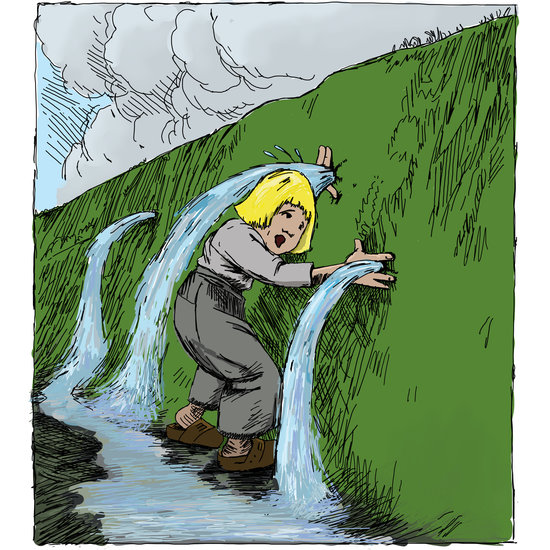
Art by Elisabeth Vines
We embrace Abraham Lincoln’s view of government.
“The legitimate object of government,” he said, “is to do for a community of people, whatever they need to have done, but can not do, at all, or can not, so well do, for themselves in their separate, and individual capacities.”
Although we all know of Lincoln as the president who issued the emancipation proclamation, to free enslaved African Americans, and who led the nation to fight a brutal war that would keep the union whole, he was also a president who created chances for the common man, the everyday citizen.
He set up land-grant colleges across the nation, like New York State’s Cornell, that taught practical skills like farming, engineering, and science. He signed the Homestead Act, opening government lands to small family farmers, giving each family 160 acres to try farming for five years.
At a time when our federal government has turned away from helping everyday Americans — lifting restrictions that protect our environment and reduce the ravages of climate change, for example — in favor of benefitting big business, the rich and powerful, the onus of serving the people falls more heavily on local and state governments.
Berne has an all-new town board that has the chance to serve its citizens after the former board declined that obligation.
At the board’s Feb. 11 meeting, Supervisor Joseph Giebelhaus read a letter from the president of the Helderberg Lake Community Association who wrote that the association and its recently created sister organization, the Helderberg Lake Restoration Corporation, want to work collaboratively with the town board to secure funding.
At issue is the dam that was built in 1926 to create the lake.
In 2017, the state’s Department of Environmental Conservation declared that the dam was “unsound” because of cracks in the concrete and an uneven spillway crest.
The Helderberg Lake dam is a high-hazard dam, meaning its failure could result in widespread damage to homes and roads or cause substantial environmental damage or loss of human life.
If the dam were to fail or be removed — engineers have estimated the cost of removal at nearly the cost of repairs — the homes that now surround a beautiful body of water would, instead, surround a mud pit.
In 2021, the Helderberg Lake Community Association submitted a petition to the town of Berne to create a tax district so that residents would pay the town back for the $445,000 repair costs for over 30 years at 4-percent interest.
Fifty-two out of 73 of the proposed district property owners — about 71 percent — signed the petition. A handful of residents who objected to the petition spoke out at public hearings and discussions held by the board.
Our reporting in April 2022 showed Councilman Leo Vane suggesting lake association members take out individual loans to fund the repairs, which would, across 50 people, be $10,000 per person — a strange proposal given that a major point brought up by lake residents in opposition had been their poor financial state, which, of course, would factor into any bank’s decision to qualify them for a loan.
Councilman Thomas Doolin expressed concern that accepting the proposal would set a precedent for the other groups that manage dams in the town. We would argue that the town should back the creation of a tax district for any community in town in need of money to repair a high-hazard dam.
Several of the board members implied it was the association’s fault, for years of neglect, and they should have to pay the price. The Enterprise reviewed decades of DEC inspection reports of the dam and learned that, while there were indeed problems with the dam, both physical and administrative in nature, it was ultimately in compliance with state regulations until 2016.
Supervisor Dennis Palow asked why, if “everybody’s talking about the lives and people dying,” people are allowed in the lake at all. The dam is not considered to be in imminent danger of failure; otherwise it would be classified by the DEC as “unsafe” rather than “unsound,” according to DEC regulations.
Councilwoman Anita Clayton wondered if the water level could be lowered. However, the DEC spokesperson told The Enterprise that the water level would have no bearing on the dam’s safety rating and so would not be an adequate solution.
Ultimately, the spokesperson said, the “simplest solution” is to “move forward with the currently approved and permitted plans” to repair the dam.
“If the dam remains in violation,” the spokesperson said in an email, “it could lead to DEC issuing an Order to have the dam repaired or removed in order to gain compliance with Dam Safety regulations.”
Later that month, the town board unanimously rejected the association’s proposal to create a tax district to fund dam repairs with Palow’s resolution saying it would create legal and environmental liabilities for the town.
Afterwards, Helderberg Lake resident Bob Marriott wrote to us, describing the way in which homes along Onesquethaw Creek might be washed away if the dam were to fail. “Berne had the opportunity to easily do what it could to prevent such a catastrophe,” he wrote, “but chose to take the easy way out and do nothing.”
The lawyer representing the lake association, Dave Brennan, asked, “Why does the town government even exist, in your town or any town?”
He answered himself, in Lincoln’s vein of thought, “To serve the residents. The residents — a strong majority — put in a petition under town law to form a district to tax themselves to pay for this. They’re not putting you on the spot. This is what the job of town government is … You don’t exist in a vacuum, just to have meetings. You have to serve the residents.”
Berne has not always been callous towards its residents’ needs.
We covered an earlier town government in Berne as it worked through a laborious process to finally get a sewer system — the town’s first — that was needed for the homes and businesses in the hamlet of Berne.
The town started planning in the late 1990s, designing a system to help those with substandard septic systems and contaminated wells, while complying with an order from the state’s Department of Environmental Conservation, which found pollution in the Fox Creek.
Houses and businesses were built in the hamlet long before modern conveniences like washing machines for clothes and dishwashers that tax old-fashioned systems. Users started connecting to the new sewer system in 2014 and have had their needs safely met since then.
Local governments can draw on residents’ expertise as happened in Berne with its sewer system and happened in Westerlo as that Hilltown received a $1.7 million federal grant to make high-speed internet a reality in parts of town that are too rural to make it worth the while of private companies to run cable.
It was the work of a citizens’ committee, backed by an enlightened town government, that is bringing that Westerlo project to fruition.
Similarly, the town board in Renselaerville is following Lincoln’s philosophy of doing for a community of people what they cannot do separately.
A citizens’ committee, backed by the town board, has been overseeing a total renovation of the hamlet’s water district, which serves 79 homes, after flaws in the current system allowed for high levels of haloacetic acids, which develop as a result of the disinfection process.
Because the water is pulled from Lake Myosotis, an exposed water source, more treatment is necessary than if the water comes from underground. Several well sites have been identified and the plan is to transition away from using water from Lake Myosotis.
The committee has been working with Sustainable Growth, a business based in South Westerlo, which in turn has drawn on the expertise of a not-for-profit run out of Syracuse University, the Environmental Finance Center. SU-EFC has used Rensselaerville as a model of community success.
The project has been awarded over $3million through the Drinking Water State Revolving Fund Base Hardship program.
Similar to the sewage situation in the hamlet of Berne or to the current situation at Helderberg Lake, the need for action in Rensselaerville came because of a government directive — the haloacetic acids had exceeded federal safety limits.
The difference is in how the town government reacted. The new Berne Town Board now has a chance to help its residents.
The DEC extended the dam repair permit held by the Helderberg Lake Community Association, which had an original deadline of October 2023, until March 2026.
The association’s president wrote that it has received two grants from the Albany County Soil and Water Conservation District and has applied for state grants for dam repairs while it is still considering a special tax district and trying to get that tax district through the county or the state.
The new town board has a chance to do what the association has asked and work cooperatively with it.
The dam needs to be repaired. At the worst, if the dam gave way, lives and homes could be lost; at the best, if the dam is removed, the homes, without a lake, would lose value.
So here’s where the Berne town government could and should step up, as Lincoln advised, to do for a community of people, what they need to have done, but can not do, at all, or can not, so well do, for themselves.