Remembering when old horses were not shot; they lived out their lives on the farms where they were worked and loved
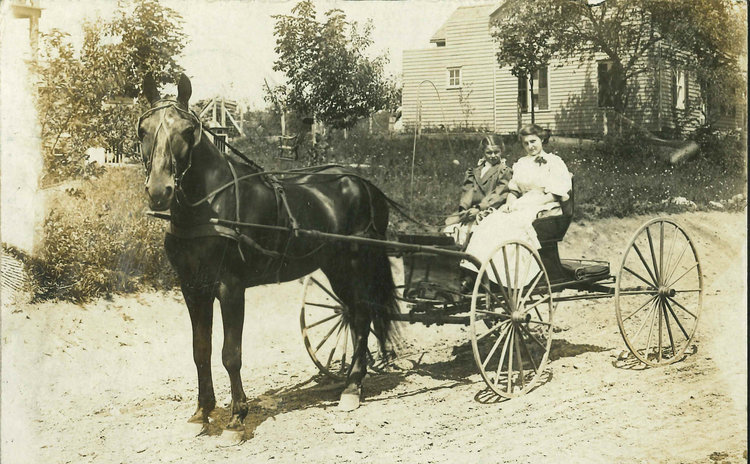
This 1906 postcard, postmarked from Berne, was sent to the writer’s aunt in Livingston Manor — “a grand picture of my sister, myself, and her horse.”
To the Editor:
In our modern world of fossil fuels and electricity, many of us have forgotten our ancestors’ close relationship with their horses.
The value of a good horse rivaled that of man’s best friend, the domesticated dog. Some would argue the horse had a much more important and integral association with man than the dog. This observation is not meant to diminish our wonderfully lovable canine companions.
During the 19th Century, before and after up until the end of World War II, for many people, especially in rural areas of our country, horses were the primary indispensable power source. As a form of transportation, before the invention of the locomotive or automobile, if you didn't have a horse, you were walking, or running, on foot.
If you've ever ridden a horse, you know what a euphoric wondrous feeling it is to be on the back of one of God’s creatures that I and many also consider to be a beautiful animal.
When a horse runs at a gallop, which is the fastest pace of a horse, with all its feet off the ground at once in each stride, that is a feeling like no other.
To be astride a living animal, reaching top galloping speeds of possibly 25 to 30 miles per hour, nothing else can compare. Wild horses can reach 30 to 35 mph when fleeing, and highly trained racehorses (for example, Thoroughbreds) can exceed 40 to 50 miles per hour. Horses on average walk at 3 to 4 miles per hour, trot at 8 to 12 miles per hour, and canter at 10 to 17 miles per hour.
Quarter horses bred for exceptional speed over short distances, and high performance ranch work, like cutting, reining, and versatility are known for their “cow sense,” and can perform short sprints at speeds up to 55 miles per hour.
Horses have historically worked in diverse roles.
A horse is defined as a large plant-eating domesticated mammal, typically weighing between 900 and 1,200 pounds, varying significantly based on type. While large draft horses often weigh 1,600 to 2,200 pounds or more, they are characterized by solid hoofs, a long mane, and a tail. They are used for riding, pulling loads, and racing.
Horses are social animals with significant endurance encompassing by some estimates over 600 distinct breeds. Despite the high number of breeds, all domestic horses belong to the same species, Equus Caballus.
They were domesticated around 4000 BCE in Central Asia and evolved from their small ancestors over 55 million years. While they originally evolved in North America, science explains they disappeared from here, 6, 000 to 10,000 years ago and were reintroduced by Europeans in the 15th and 16th centuries.
The horses brought by the Spanish spread rapidly, becoming integrated into indigenous cultures by the early 1600s. Horses were essential to agriculture and replaced oxen for plowing and improved efficiency in farming. They were necessary for hauling heavy materials, and served as the “engine” for personal travel, mail (the Pony Express), and early mass transit like stagecoaches.
Horses were critical in warfare for cavalry, moving artillery, and supplies. Aside from being used for labor, horses were and still are used as symbols of status, and are integral to the sport of racing. They are also used by mounted police and for entertainment.
The Weidmans’ memories
Locally, my late friend Catherine (née Ostrander)Weidman wrote about her and husband Ken’s memories of early 20th-Century times with horses.
“There are Old Timers who sorrow to see livestock and horses standing out in sub-zero weather, covered with snow or freezing rain,” she wrote in the 1970s. “Farmers sheltered their animals in barns or sheds and bedded them down with straw. Fastened horse blankets onto the backs of their faithful beasts of burden.
“Betsy and Dick and Harry [horses] were comfy standing in their stalls while their owners toasted by their crackling wood fires.
“It took time, care, and money, in a day when cash was not easy to come by, to give tender loving care to stock and horses.
“The stables had to be cleaned of course. What a job that would be for today’s animal lovers! Time taken from sports, skiing, snowmobiling, skating, and T.V. watching.
“Horses sometimes lived to be 30 years of age. Old Jack, on the Weidman Farm, Koonz Rd., was 36 when he died in 1934. There was Old Dan who lived to be 33 and Old Harry raised by Clickman across the Black Creek on the Old Beebe homestead sold to Ken’s grandfather Jim Beebe on Koonz Rd., who also lived to be 33.
“Somehow I believe if these horses had been forced to withstand the icy blasts of storms, the pretty white horse, Old Jack, might not have been living out his old age when I came to Koonz Rd., in 1933. Nor would Old Dan or Old Harry have lived to be 33.
“Did you ever notice how, sometimes, folks less able money-wise, to shelter animals expend more effort to give them care? Here’s an interesting test for an animal owner: Just leave a barn door open when the temperature dips to zero, or a snowstorm rages.
“Maybe those animals that raced indoors were pampered or spoiled, you say. Sure horses and cattle need fresh air and exercise. That takes time and caring!
“An owner and family members used to walk their horses daily or put them outside for a ‘breather’ in bad weather when no farm work was done.
“Abe Koonz was the local horse doctor. He and his wife, Mate (née Albright) Koonz lived on the Voorheesville-Altamont Rd., in a house that was destroyed by fire to build the major powerline we see today.
“Old horses were not shot in those days. They lived out their lives on the farms where they were worked and loved.”
Kay went on to write about all the horses neighbors owned by their names and history, but I would like you to read this poem she wrote in 1972:
The Old Stable
By Kay Weidman
These wooden stalls once stabled proud horses
And sometimes a skinny colt on wobbly legs
While in the rear, along the outer wall
Sets of harness hung on wooden pegs.
This heavy door was rolled wide open
By the farmer passing into the barn
His animals stirred and whinnied in greeting
Turning toward him huge eyes, loving and warm
He touched each rump as he passed by
He used to call each horse by name
He used to stop to let Betsy nuzzle the apple
He brought in his pocket when he came
The old horse stable is empty now
Save for being used as a storage space
A pitchfork or two, leaning in a corner
Hoes and rakes an old man used ’round his place
Worn horse collars, britching, headstalls, reins
Our horses trappings are all musty gray
Some chunks of wood are piled in a stall
In another rests a retired sulley-plow
A horse-drawn cultivator and a stone boat
Antiquated implements stored in an unused box stall
The dust and rust of years is upon them
The harness, unmended, dangles from the wall
The smell of old leather lingers strongly here
One reminisces of a long-ago yesterday
When horses stood munching hay in mangers
Where now there’s only aroma of old hay
Time was when brass collar fittings were gleaming bright
When the farmer worked with brush and curry comb
So that he knew, clucking as he drove, with leather clacking
On the horses backs, that his team made a pretty show
O! This Old Stable stands deserted now
Above old harness hang cobwebs in crazy array
Swarming bees are buzzing in the corner
But nothing chases my dear memories away.
Catherine Weidman was a school teacher most of her early years. She taught at the small cobblestone schoolhouse on School Road just outside of Voorheesville in the town of Guilderland at the intersection of Stone Road.
For one to fly …
These days, when horses become too old, injured, or unprofitable to maintain, they are often referred to as “unwanted” and can face several detrimental fates. While domestic slaughterhouses for horses closed in the United States in 2007, tens of thousands of American horses are transported annually to Canada and Mexico for slaughter.
This process is considered highly cruel, involving long journeys without food, water, or rest, with many horses suffering injuries or death in transit. I ask you to please support groups combating the abuse of horses!
While working at Indian Ladder Farms all my life, I imagined the lives of the horses who worked there before my time. It was clear to me by the evidence left behind that they took good care of their horses and that horses were important and loved. You can imagine the dependence farmers had on horses before the automobile and tractors.
They were valuable to everyday life. I occasionally found horseshoes sticking up out of the ground and saved every one. Those horseshoes provoked me to think of the lives of those horses and what they meant to the lives of people, to the hard work they performed and the building of our United States.
Many horses are held fondly in memory as I helped to care for horses in my youth and believe that someday when fossil fuels are used up whether 100 years from now, or a thousand years from now, horses will make a huge comeback.
The world of mankind will be a much different place than it is now. I like to use quotes and this one describes how I felt when I was young and for the first time rode a horse at a gallop: “For one to fly, one needs only to take the reins,” wrote Melissa James.
I hope I can do that again someday. I hope you get to do that someday!
Timothy J. Albright
Meadowdale