As Berne seeks to return case to federal court, Crosier pushes for trial
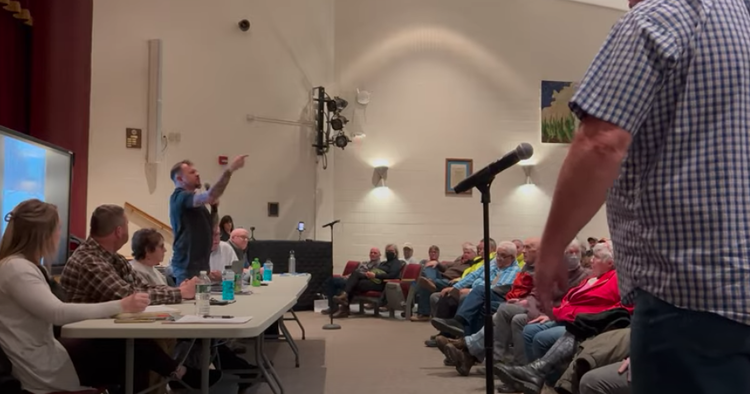
— Still frame from video recorded by Ron Jordan
Then-Berne Supervisor Dennis Palow, at the dais, gestures to Albany County Sheriff’s deputies to remove Kevin Crosier, who’s standing to the right side of the frame, from a public hearing held on Feb. 20, 2023.
BERNE — Kevin Crosier is pushing for his case to go to trial in state court while the town of Berne is asking the state court to wait until its appeal to federal court is heard.
Crosier brought his suit against the town of Berne after the town board refused to apologize for removing him from a public hearing on Feb. 20, 2023.
The town of Berne had removed the case to federal court but, on Dec. 11, 2025, in a nine-page decision, U.S. District Judge Anne M. Nardacci remanded the case to the Supreme Court of New York, Albany County and also ordered that fees and costs — which total about $11,000 — be covered by the town.
Crosier told The Enterprise in December that he would still be willing to settle with the town.
“I would try to,” he said. “Of course, it would be in the best interest of the town.”
Separate from the recent $11,000 in fees, Crosier said, “The town’s racked up close to $50,000 in court costs, which they have to pay regardless whether I win or lose.”
Crosier surmised that the town wanted the case heard in a federal court because “they thought that they would get more sympathy … they thought that it would be a bigger jury pool to pull from.”
The latest legal exchange, in 2026, involves a Jan. 28 letter from Kevin A. Luibrand to the Albany County Supreme Court judge hearing the case, Christina L. Ryba, and then a Feb. 6 response from the town’s attorney, Olivia G. Reinhardt, with the firm Johnson & Laws.
Luibrand writes that Crosier sued the town in 2023 “for various freedom of speech allegations under both New York State and federal law.”
After the case proceeded in Ryba’s court, “through discovery with multiple depositions,” Luibrand writes, Berne “filed a notice of removal of the case to federal court alleging that because the New York case contained a First Amendment cause of action, removal was required ….”
Crosier then filed a motion in the federal court to remand the case back to state court on the grounds the removal was untimely.
A court conference is scheduled for Feb. 24 during which Luibrand anticipates that the town will argue the case in state court is stayed because the town has filed an appeal to Judge Nardacci’s decision.
Luibrand argues that the town’s “purported appeal to the Federal Court is not appealable” and goes on to argue that the law “contains no stay provision whatsoever, and in fact, states the opposed.”
He writes that “federal law specifically directs that the state court proceeds with the case and there is no basis to stay the case any further.”
Luibrand concludes with Crosier’s request that a jury trial date be set by the court.
Reinhardt responds that the state court should abstain from exercising jurisdiction while Berne’s “legitimate appeal” is pending before the United States Court of Appeals.
She asserts that Crosier attempted “to seize upon a ‘typo’” and that the Jan. 28 letter to Ryba asserts for the first time that the town’s removal to federal court was premissed upon diversity jurisdiction.
Crosier’s argument that the removal to federal court “was premised upon anything other than subject matter jurisdiction … is disingenuous at best,” Reinhardt writes.
Diversity jurisdiction is a subset of federal subject matter jurisdiction, which requires parties to be from different states, allowing federal courts to hear state-law claims.
Reinhardt quotes from the town’s Notice of Removal, which says the removal is based on Crosier’s addition of a “civil rights claim against the Town of Berne.”
She goes on to assert that Crosier’s original complaint “did not cite to any statutory basis for the award of prevailing party attorney’s fees.”
In the event that the state court decides to exercise jurisdiction while the town’s appeal is being considered, Reinhardt writes that the town should have 60 days to review the existing record and to conduct discovery relevant to the new claims and new allegations.
The hearing
Crosier, a former town supervisor, is a Democrat while the board members in 2023 were all backed by the GOP. The current board has four Democrats and one Republican.
Crosier, the first person to speak before the board at the Berne-Knox-Westerlo auditorium on Feb. 20, 2023 about its draft ATV law, said two sentences — “Thank you for allowing me to speak this evening. It’s the town board’s responsibility to protect the health, safety, and financial stability of our community” — when then-Supervisor Dennis Palow interrupted him and tried to draw attention to a photo he had brought up on a large monitor that he said was of Crosier riding a utility vehicle on a roadway.
The apparent purpose of the photo, which had already been making the rounds on social media, was to show Crosier using one of the kinds of vehicles that the proposed law would allow on town roads, where they are currently prohibited except to cross from one property to another. Crosier was among a great many people who had spoken out against the law, in letters to the Enterprise editor and at the Feb. 20, 2023 public hearing.
Palow ordered Albany County Sheriff’s deputies to forcibly remove Crosier from the hearing.
Crosier’s attorney at the time, Jeff Baker — who was present to speak to the legality of the ATV law — told the town board members at the hearing that they had broken federal law by removing Crosier.
“By making the Albany County Sheriff’s Department complicit in your illegal action, you have violated the federal civil rights of my client ...,” Baker said. “I strongly suggest that you apologize to Mr. Crosier for your behavior, or the town may very well likely face a lawsuit, for which it will also be responsible for attorney’s fees, for violating the First Amendment rights of somebody who was just addressing the board.”
The audience cheered at this.
Court history
Baker subsequently sent a letter to Palow and the other town board members, demanding a formal apology. When no apology was forthcoming, Crosier proceeded with a lawsuit, filing a suit in state Supreme Court — the lowest rung of a three-tiered system — on Dec. 11, 2023, alleging violations of his freedom of speech.
In April 2023, Crosier sent a notice of claim to the town of Berne, stating that the award for damages would be determined by a trial, but not less than $100,000.
Crosier’s suit alleges two causes of action: his right to free speech under the New York State Constitution and his right to free speech under the First Amendment of the United States Constitution.
On June 27, 2025, Crosier filed a motion to amend his complaint, retaining the same two causes but referencing a federal law as the statutory basis for the action under the First Amendment.
On July 1, 2025, Berne removed the case to the Northern District of New York but the town’s right to file a notice of removal had expired on Jan. 17, 2024, thirty days after the original complaint was served.
Because Berne was “untimely,” the case must be remanded to New York Supreme Court, Judge Nardacci ruled.
“The standard for awarding just costs and actual expenses turns on the reasonableness of the removal,” she wrote.
She cited an earlier decision that found the appropriate test for awarding fees “should recognize the desire to deter removals sought for the purpose of prolonging litigation and imposing costs on the opposing party, while not undermining Congress’ basic decision to afford defendants a right to remove as a general matter matter when statutory criteria are satisfied.”
Nardacci found that Berne “lacked an objectively reasonable basis for removing this action” in response to Crosier’s amended complaint “long after the statutory deadline had passed and discovery in New York state court was nearly complete.”
Berne’s arguments, Nardacci concluded, “have no basis in law.” Moreover, she writes, Berne failed to respond to Crosier’s arguments whether an award of fees and costs is warranted,” thereby conceding.