Guilderland ZBA sides with neighbor over property owner in fence dispute
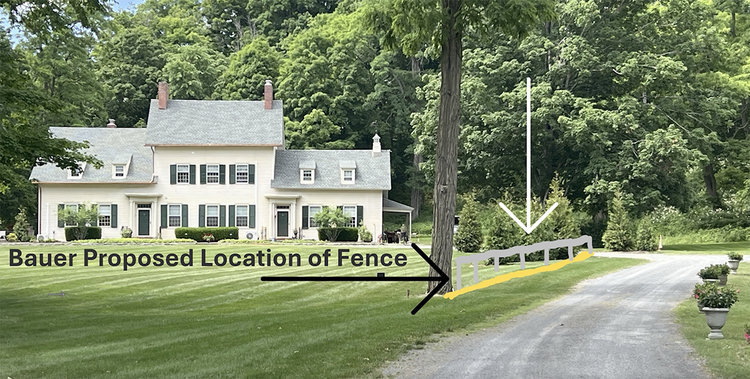
— Still from Matthew Reuter’s submittal to the town of Guilderland
The Guilderland's Zoning Board of Appeals recently agreed with the owner of the historic Norman Vale home that its neighboring property’s owner should not be allowed to install a fence along a shared driveway.
GUILDERLAND — The Guilderland's Zoning Board of Appeals recently voted to prioritize the “viewshed of [a] historic home” over a property owner’s right to install a code-compliant fence on his own land.
The board’s unanimous Feb. 4 vote overturned a building permit issued for a fence running along a shared driveway between the historic Norman Vale home and property at 3 Norman Vale Lane, reasoning the fence would obstruct the historic view of Norman Vale and because the property owner could not articulate a reason for erecting the barrier.
Norman Vale — also known as the Nott House or Nott Mansion — is located off of Nott Road on a shared private driveway, and is listed on the National Register of Historic Places.
The home was built between 1770 and 1780, according to a video submitted by Norman Vale’s owner and challenger of the building permit, Matthew Reuter, and “remains a rare example of rural Dutch vernacular architecture.”
Norman Vale was once home to John Tayler, New York State’s lieutenant governor for nine years in the 19th Century, between 1813 and 1822, and to Eliphalet Nott, who served as president of Union College from 1804 until his death in 1866.
The fence
The dispute centers on the parcel at 3 Norman Vale Lane, which is owned by Douglas Bauer who purchased the broader Norman Vale property out of foreclosure in October 2017. Bauer subsequently subdivided the estate into three lots, keeping two of the lots for himself, building modern homes on each of the subdivided parcels, and selling the historic house itself to Reuter in 2023.
Reuter’s historic 1 Norman Vale Lane home and Bauer’s modern home at 3 Norman Vale Lane share a driveway off of Nott Road.
In September 2025, Bauer was issued a permit to install 130 feet of four-foot high decorative metal fence along Reuter’s side of the shared driveway, which is on property owned by Bauer, who also received permission to install a six-foot tall wooden fence along the rear property boundary.
Reuter subsequently filed an appeal, arguing that the building inspector’s decision failed to account for his home’s historic designation. His appeal argued that Bauer had filed an incomplete permit application because it didn’t specify the material; that Bauer needed a variance; and that the fence would violate an easement agreement between property owners.
Public hearing
During the Feb. 4 meeting, Reuter told board members that he “moved to Guilderland three years ago to purchase this wonderful historic home,” Norman Vale, which he described as not just a personal residence but a community asset that deserves protection after enduring the “adverse” impacts of recent development, such as the subdivision that reduced the estate’s size to under three acres in, the construction of modern homes unsympathetic to the historic setting, and the desecration of the property’s private Veeder family cemetery.
Reuter’s girlfriend, Michelle Schneiderheinze, read a letter from the last Nott family members to live at Norman Vale that said in part they were “shocked and appalled” that Doug Bauer was able to subdivide the property and “build a large and imposing home in the side yard of Norman Vale.”
The letter quoted 2018 recommendations from the New York State Historic Preservation Office that stated in part “design of the new construction should be sympathetic to the surroundings and the historic building. Avoid out of scale designs or tall structures, use natural cladding materials as much as possible, and employ appropriate colors.”
Nott Road resident Kevin George told board members, “By installing a fence on the west side of the shared driveway, Mr. Bauer is in essence including the shared driveway in his front yard, which does not make any sense. If any fence were allowed to be installed, it should be in what is really Mr. Bauer’s front yard on the east side of the shared driveway, and well removed from the shared driveway back towards the fronts of his homes. It makes no sense to put any sort of fence on the west side of the shared driveway adjacent to the Norman Vale Estate.”
Guilderland resident Aaron Mair told the board that the visual setting of a historic property — what preservationists call its “viewshed” — is inseparable from the property itself, and that the proposed fence would be “more than just a structure of offense … it’s a structure of offense relative to an 18th-Century viewshed.”
Bauer and the board
Identifying himself as “the infamous Douglas Bauer,” Bauer said he felt “compelled to speak about the truth tonight because of so many things have been said, and my name has been mentioned. [I] did not intend to speak.”
Bauer went on, “But the reason I am is that the last time that I should have attended a meeting with the zoning board, I didn’t. I was out of town. I couldn’t … And there were many, many untruths said about me.”
He claimed that he had, in fact, been the one who saved Norman Vale from destruction, purchasing it out of foreclosure when it was at risk of being demolished. He then cited a study that was done when he purchased the property that said in part, “While the survey addresses a construction project on Norman Vale grounds, there is a strong sense in which this is also a historic preservation.
“Norman Vale was purchased, renovated, furnished with art and antiques … The intention of the 2017 purchase had been to preserve the house and modify the vegetation so that Norman Vale continues to be a visible historic landmark along Nott Road.”
Zoning board member Sharon Cupoli noted that a fence ending 130 feet up the driveway would not prevent someone from simply walking around it. When asked why he would not place the fence on the other side of the driveway, closer to his own property, Bauer replied, “There would be no reason to.”
Cupoli asked what was the reason for placing the fence on the Norman Vale side of the shared drive, Bauer said, “Because I think it would look good.”
After closing the public hearing, the board’s chairwoman, Elizabeth Lott, explained the question at hand: Had the building inspector properly interpreted the zoning code when issuing the permit?
The answer could be found at the intersection of two provisions in the code: Section 280-27A5, which allows for decorative fences up to four feet in height in residential front yards, and Section 177-4B231, which defines a historic structure as one listed individually on the National Register of Historic Places maintained by the federal Department of the Interior.
These provisions taken together, according to Lott, meant, because 3 Norman Vale Lane sits so close to a National Register property, the standard permission for a front-yard decorative fence could not be applied; in fact, no fence of any kind — decorative or otherwise, regardless of height — could be erected in the front yard of Bauer’s property because it would block the historic viewshed that remains visible from Nott Road.
During board discussion, Cupoli added what would become a second justification for denying the permit: While she could envision supporting a fence that served a practical purpose, Bauer’s appeared to serve none.
Lott would go on to “amend the motion to say not only will it block the viewshed of the historic home, but it is not serving any function that we can find.”
After the board voted unanimously to overturn the issuance of a building permit, Cupoli offered reasoning for her vote with which other board members agreed.
“I want to cite one thing,” Cupoli said. “I think this [meaning, her vote] is particular to this case. This is not something that I would necessarily say the average homeowner should be denied a fence in their front yard in following the rules.”
It’s the historical nature of what’s being preserved, she said, “and I want that to just go on the record that that’s more [the] reason why I’m doing it and not denying a homeowner his right to do what he wants to do.”