Ski lessons
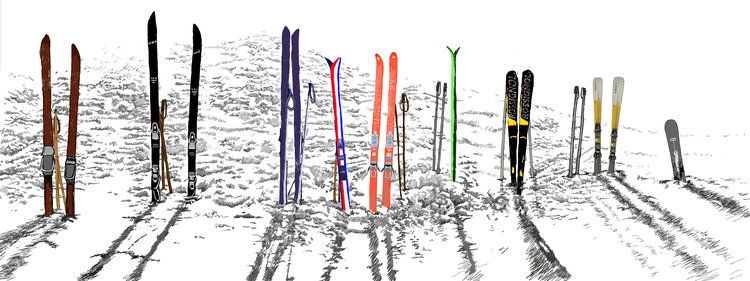
Art by Elisabeth Vines
My family didn’t go to church on Sundays. Summers, we climbed the Adirondack High Peaks. Winters, we went to the Helderberg ski slope.
I’m writing this on January 23 as we anticipate a winter snowstorm and arctic cold. Were the winters of my childhood crisper and the snow more plentiful — or is that just the rosy reverse lens of looking back from old age?
This I know for sure: The forecast of a snowstorm then filled me not with dread but with glee.
I am mindful to this day of what I learned on those ice-cold Sundays in the Helderbergs. And I am thankful for the lessons that have sustained me for a lifetime.
I remember Joe Riedle, yodeling as he skied with wild abandon through the glade.
He was German and had fought in World War II on the German side.
I remember, too, Stan Heidenreich, tall and imposing as he headed the ski school and demonstrated perfect stem Christianas. He had fought in the same war on the other side, in the United States Army’s 10th Mountain Division.
What I learned in watching these two men ski together or enjoy each other’s company during the warm meals afterwards is that human similarities can transcend even deep divides.
I remember Gus Angst with his long wooden skis, used to carve telemark turns; his white, white hair; and his other-worldly gaze. I was a child, and it seemed to me that Gus could talk to the birds.
I knew some of the commonest calls — the whippoorwill said its name, and the white-throated sparrow was forever lamenting “Poor Sam Peabody, Peabody, Peabody.” Those sounds, though, were linked to human words that I knew and could remember. The birds never answered my calls.
But Gus — Gus was different; he could make the birds sing. He’d call and they would answer.
My favorite book when I was eight or nine years old was about Dr. Doolittle who talked to the animals, and I imagined Gus did the same with birds.
This flight of fancy left me with a reverence for nature and for a human being who could know a part of it so well that it seemed he could transcend the limitations that left the rest of us confined to human speech.
I remember the long ski in from the road, across the wind-swept flats to the county slope. And then came the climb that at first seemed daunting. Alice Waterhouse taught me how to herringbone and how to sidestep to get up the hill.
“You just put one foot in front of the other,” she said.
With the herringbone, the skis are angled, leaving a track that resembles the tweed. Sidestepping, the skis are parallel, and their edges hold when it’s steep and slippery.
Alice must have been old even then, but that never occurred to me at the time. She was a sprite of a woman with a strong will.
She lived independently and pursued a career in chemistry at a time when most women confined themselves to home. She was among the first to climb all 46 Adirondack High Peaks and I admired her greatly.
You couldn’t whine around Alice, not because she forbade it, simply because she didn’t do it. Her “one foot in front of the other” philosophy got me up more than mountains; it got me through childbirth, and doctoral exams, and tough news stories. I’m hoping now it will get me through widowhood.
Years later, I brought flowers to Alice’s hospital room as she lay dying, so she could smell them although she could no longer see or hear. I lay next to her curled, shrunken body and wondered where the next foot would lead her. She taught me to keep going and I haven’t stopped.
Finally, I learned about the warmth that comes from sharing. It was a lesson that was repeated on countless family trips into the wilderness.
Once, I remember being lost with my family on a trailless peak. As darkness fell, we decided to bivouac. That night, we stayed warm by sharing the one tarp we had; we nestled together like spoons, my mother, my father, my two sisters and I.
But the act of kindness I remember most vividly came from the sort of sharing that involved self-sacrifice. I remember a Helderberg Ski Club trip led by Bob Campbell. He had a simple rule: Stay together.
A group of us were skiing in the Adirondacks. We had skins on our skis that would help grip the snow as we climbed to Marcy Dam from Heart Lake. The same skins would flatten in the other direction as we headed downhill, allowing us to glide.
I slipped by the edge of a brook, breaking through the ice, getting one of my skins wet as well as one of my mittens. The skin was useless now — an icy runner rather than an aid. And my hand was cold to the point of numbness. I began to feel desperate and hopeless as I struggled to keep up.
Bob Campbell noticed my plight and, without a word, he took off his own mitten and gave it to me. It was warm. He waved away my feeble protestations, then replaced my worthless skin with his own.
He sacrificed his own well-being for mine. When I objected, he said only, “We all stay together.” Now he would be cold, and behind, and hopeless, I worried. But, no.
A strong man, he was unfazed. He moved me to the head of the line, and skied right behind me. I felt the kind of euphoria people describe when they’ve witnessed a miracle. I surged on with new purpose, and have never forgotten his generosity. I have looked for chances to repay it in kind; I am still searching.
I am thankful for these lessons to this day and hope to live by them as long as I am able.
— Melissa Hale-Spencer, editor