Construction of $1.7B Wadsworth Center is underway
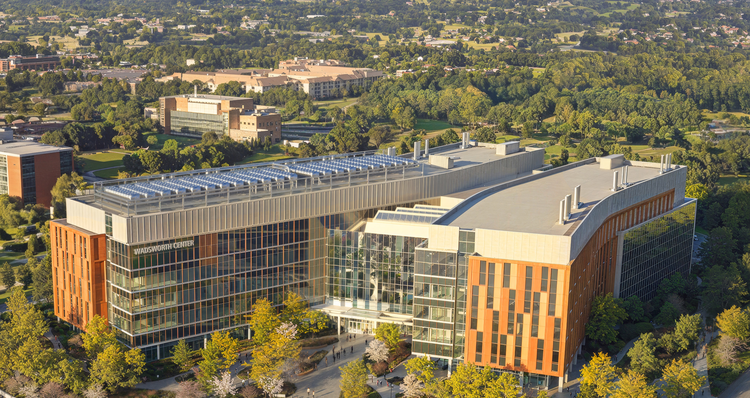
— Photo from governor.ny.gov
Renderings released this week show a five-story, 663,000-gross-square-foot laboratory.
ALBANY COUNTY— Although construction work had already started for the Wadsworth Center on the Harriman Campus, the governor’s office announced on Jan. 26 it is officially underway.
The $1.7 billion facility is expected to be complete by 2030.
Twenty-seven acres at the southeast end of the 330-acre campus has been designated for the project.
The office campus at the west end of Albany was planned in the 1950s by Governor W. Averell Harriman, for whom it is named. Surrounded by a ring road, it was built in the Albany Pine Bush next to the Albany Country Club, where the university’s uptown campus is now.
The Harriman office complex is adjacent to the University at Albany’s campus and includes UAlbany’s ETEC (originally an acronym for Emerging Technology and Entrepreneurship Complex).
The Wadsworth Center’s location next to UAlbany will build on academic partnerships that date back to the mid-1980s, according to a release from the governor’s office.
The new center is also adjacent to the state’s Department of Agriculture and Markets Food Laboratory.
The Wadsworth Laboratory was founded in 1901 and currently operates from five different sites, including one on Route 155 in Guilderland, also known as State Farm Road because of the facility there.
The new laboratory will house nearly 800 staff and, according to the governor’s office, and is being designed to adapt to evolving needs over its lifetime, with a strong emphasis on energy, efficiency, and sustainability.
The design-build team is a joint venture between Gilbane Building Company and Turner Construction Company, in association with HOK architects. The design for the new laboratory, released this week, shows a five-story, 663,000-gross-square-foot laboratory.
“The lab will allow the state to better predict and prepare for emerging threats to public health and will be one of the most authoritative public health laboratories in the country, impacting public health policy and practice at the state, national and international level,” said Governor Kathy Hochul in the release.
Wadsworth programs
The governor’s office highlighted these “nation-leading programs” at the Wadsworth Center:
— Public Health Emergency Response
Led detection and surveillance of the 2022 poliovirus outbreak, including identification of the first United States case of paralytic polio;
— Wastewater Surveillance and Diagnostics
Serves as New York state’s primary wastewater surveillance laboratory for the detection of emerging pathogens and antimicrobial resistance;
— Environmental Health Leadership
Functions as the state’s lead Safe Drinking Water Act laboratory and is a national leader in detection, monitoring, and reporting;
— Innovative Diagnostic Testing Pipelines
The center’s diagnostic developments outpace the Centers for Disease Control and Prevention in areas of testing for tuberculosis, Mpox, and influenza;
— Newborn Screening Program
Advances the screening of newborns for more than 210,000 babies annually for over 50 disorders, enabling early diagnosis and life-saving care; and
— Regulatory and Oversight Programs
Sets and enforces rigorous statewide laboratory standards, exceeding federal requirements and serving as a national model.
Reimagine Harriman?
Senator Patricia Fahy, an Albany Democrat, has pushed for creating a master plan for the redesign of the Harriman Campus and a year ago drafted a bill that would redevelop 7 of the 27 acres set aside for the Wadsworth Center with housing and commercial or retail space.
On Jan. 15, Fahy and Assemblywoman Gabriella Romero, a Democrat representing Albany, Guilderland, and New Scotland, held a meeting that drew about 100 residents to promote the legislation. While Fahy’s bill has passed the Senate, Romero’s proposed legislation has yet to make it out of committee.
The Wadsworth Center is designated as a Biosafety Level 3 facility, meaning it will handle dangerous pathogens like anthrax, and the Office of General Services, which manages the Harriman Campus for the state, along with the lab administrators, prefers to secure the site with a fence around the entire 27-acre parcel, making development impossible.
“For the last decade, I’ve advocated for the rebuild and consolidation of the Wadsworth Public Health Laboratory, and I commend the Governor for supporting this investment, which will lead us to regaining the world-class status of this lab,” said Fahy in the Jan. 26 release.
“This $1.7 billion investment in a state-of-the-art Public Health Lab for New York is the largest public investment in the Capital Region in decades and should be designed to ensure a positive multiplier effect for Albany, its tax base, retail, and related commercial investments,” she went on. “I look forward to working with the Governor and her team in an effort to attract a 21st Century workforce, ensuring we are creating positive multiplier impacts, and finally reconnecting an isolated Harriman Campus by developing a master plan for the redevelopment of the entire Campus.”
Romero said in the release, “With this consolidation of Wadsworth into a single, world-class laboratory on Harriman Campus that helps improve New York’s public health readiness, it’s vital that we create a space that can attract and retain a robust workforce right here in the Capital Region. I’m proud to be working alongside Senator Fahy to ensure the Harriman Campus is modernized and reimagined as a true community asset that drives long-term economic returns for Albany with no wasted space.”