Rensselaerville to hold hearing on consolidating voting districts
Enterprise file photo — Michael Koff
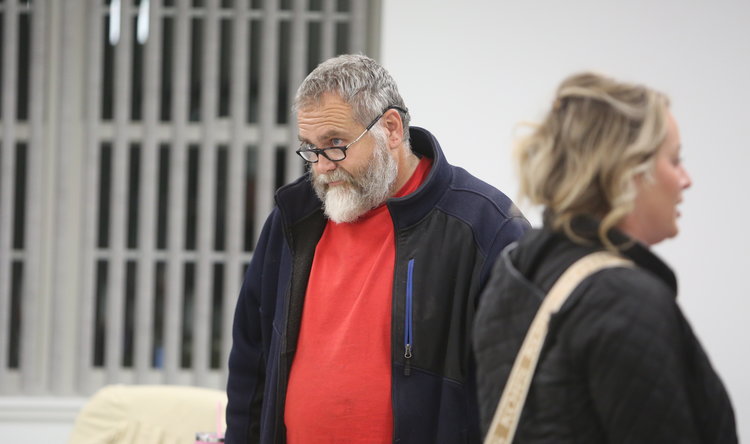
The East Berne firehouse is one of two polling places in Berne, pictured on Election Night 2025 as then-Highway Superintendent Randy Bashwinger waits for election results and Town Clerk Kristin De Oliveira walks by. De Oliveira kept her job; Bashwinger lost his. The town of Rensselaerville is considering consolidating its voting districts from three to one.
RENSSELAERVILLE — Supervisor John Dolce would like to consolidate polling places to save money.
The Rensselaerville Town Board has scheduled a hearing on the matter for 6:30 p.m. on Thursday, Jan. 22, at the town hall.
The town board considered consolidation in 2024 but did not act upon it. Rensselaerville currently has three polling places, one at each of its firehouses. Dolce has proposed using the town hall as Rensselaerville’s sole voting venue.
According to New York State Election Law, an election district cannot have more than 950 registered active voters, except when permission is granted by the county board of elections to have up to 2,000 voters.
The neighboring Hilltowns of Berne, Knox, and Westerlo each have two voting districts, each with between 1,000 and 1,400 voters enrolled within them, according to the Albany County Board of Elections. Rensselaerville has roughly 500 in each of its three voting districts, and the least total number of voters overall.
Several years ago, Albany County adopted an election mandate that has the county’s board of elections charge towns, villages, and cities for their election costs — often leaving municipalities unsure of the costs during their budgeting process.
At the Rensselaerville board’s Dec. 11 meeting, Dolce went over numbers saying Rensselaerville’s bill from the county for the three sites is “incredibly expensive.”
“This year,” he said of 2025, “with 1,192 people voting, it has cost the town $15,485.”
He compared that to Berne, which had 1,789 voters and cost $11,000; to Knox, which had 1,650 voters and cost $9,000; and to Westerlo, which had almost 2,000 voters and cost $11,900.
Dolce said of the February 2024 public hearing on consolidation, “We had different feedbacks.”
He also said, “There’s no reason for us to spend so much money for such a small outcome of voters.”
Councilman Ed VanAuken recalled, “If I remember right, at the public hearing, the biggest concern was the social event from the three firehouses … Some people also talked about that maybe don’t do it on a presidential election but start on a smaller scale, which is what you’re doing, right?”
Town elections had traditionally been held on odd years but a recent state law will pair them with presidential and mid-term elections on even years with the goal of increasing voter turnout for local elections.
Dolce listed numbers showing growing election costs for Rensselaerville and said, “This past year, we budgeted $12,500 because it wasn’t a presidential election year, and it came back at $15,000 — $2,500 more than the presidential election … It’s not sustainable.”
Dolce also said, “Not everybody’s going to be happy. I understand that. But our job is to watch the fiscal budget of the town of Rensselaerville.”
Answering a criticism that, with just one polling place, fewer people will vote, Dolce said, “Well, we only had 1,100 people vote.”
The town attorney, William Ryan of Tabner, Ryan & Kinery, said another public hearing is required. Asked why, he said, “Because the other one, you made a decision not to do anything, and this is new. You’ve got to give the people notice.”
Other business
In other business at its Dec. 11 meeting, the Rensselaerville Town Board:
— Agreed to a contract with the International Union of Operating Engineers Local 158, as described by Councilman Randall Bates, who used to be the town’s highway superintendent.
“I think it’s a fair agreement to all parties,” said Bates, noting that the three-year contract calls for 3-percent raises in each of the three years.
Health-insurance coverage is detailed better in the new contract, he said, and language was cleaned up. “In one year,” Bates said, “we can reopen the agreement with a memorandum to potentially change the health-insurance provider”;
— Heard a report from Highway Superintendent Jason Rauf on his department’s accomplishments for 2025, including paving 4.9 miles of town roadway. “We placed 3,300 tons of material on our additional dirt roads to bring them up to par through our regular summer maintenance,” he said.
He went on, “The parking lot project has been completed.” Rauf also noted the town was awarded a grant of $25,818 from the county’s Soil and Water Conservation District.
Rauf continued, “My goal was to purchase purchase a new truck, large truck, every four years with six large trucks; that makes our oldest vehicle 24 years and that would be a 24-year cycle so that is on track”;
— Heard from Dolce that the town’s code-enforcement officer and building inspector, Timothy Lippert, has been working closely with Tabner, Ryan & Kinery to bring violators to court. “A lot of people have really neglected the town of Rensselaervill and treated it like a dump,” said Dolce; and
— Heard from Ed Csukas, who chaired Rensselaerville’s Water and Sewer Advisory Committee, that a subcommittee has come up with a “short list” of possible well sites; the goal is to replace the hamlet’s water source with wells rather than Lake Myosotis, which has high levels of trihalomethanes (TTHMs) and HAA5 — a group of five haloacetic acids — that develop as a result of the disinfection process.
He also reported, in relation to the administrative order from the Environmental Protection Agency, that the committee received quotes on a new hatch for the tank as well as a mixers.
Further, Csukas recommended that the board move forward with the project using the engineering firm Tighe & Bond, which the committee had decided on “after a long process of deliberation.”
All four board members present at the Dec. 11 meeting voted in favor of retaining Tighe & Bond, subject to the town attorney’s review of the contract between the town and the engineering company.
Csukas told the board he would be stepping down as the committee’s chairman and that the committee recommended Gerard Wallace as the new chairman, starting Jan. 1.