A farm cathedral built by New Scots 126 years ago has been resurrected
The Enterprise — Dennis Sullivan
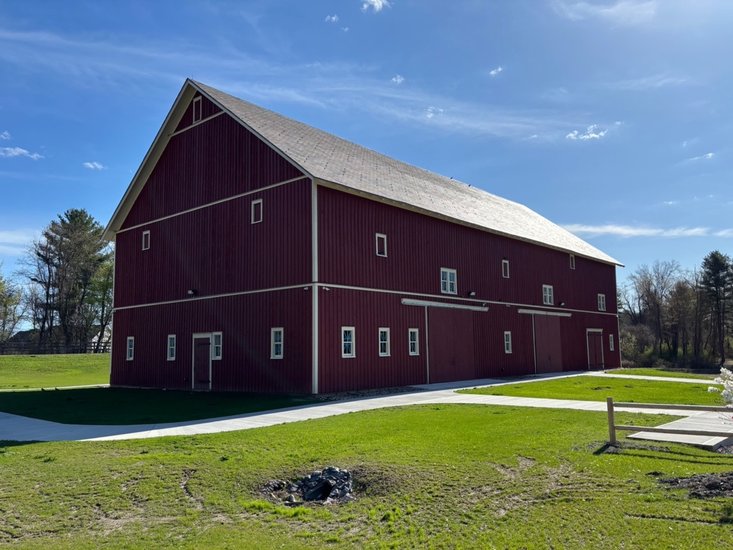
Frank Osterhout, master carpenter from Voorheesville, designed the newly restored Hilton Barn which was built from wood cut on the Hilton farm.
A lot of people think DOGE operations are over unaware that the Department of Governmental Efficiency has a sinister sister called DOGF, Department of Governmental Forgetfulness.
And unlike DOGE, which came to town riding on a chain saw, DOGF works like a silent aneurysm on the soul of a community, when folks let slip away the people and events that allowed them to get to where they are. When members of any collectivity lose such grounding, they start speaking like drifters in the old cowboy movies: “Just passing through, pard.” A cynic might call them freeloaders.
Which brings us to the famed Hilton Barn, located where Route 85A joins Hilton Road in the town of New Scotland. In last week’s edition of our paper, my colleague, Sean Mulkerrin, adroitly reported that New Scotlanders are taking such tortoise-size baby steps that it looks like the barn will never become an atrium of communal conviviality.
But, is there not a lineal connection between the Hilton family raising nationally-recognized prized livestock in that barn and Clayton A. Bouton High School being ranked the second best school in the Capital Region by U.S. News and World Report? Talk among yourselves.
To celebrate the advances made so far in shepherding the well-being of this treasure, devoted New Scotlanders have scheduled an open house at The Captain Joseph Hilton Town Park this Sunday, from 2 to 4 p.m., so we can see the genius of its inner being.
Because I am the historian of the village of Voorheesville and wrote about this barn 40 years ago, I was asked to put together a few words for Sunday’s event. What I’ve come up with so far, I share with our readers below.
Plans for a new barn
After the big barn on the Hilton Farm burned during the winter of 1898, James Hilton (son of the Captain of note) and master carpenter from Voorheesville, Frank Osterhout, visited the 1,000-acre Dutchess County estate of Levi P. Morton former governor of New York (1895-1896) and vice president of the United States (1889-1893).
The estate known as Ellerslie was located in Rhinecliff-on-Hudson. The two went down to study Morton’s barns on March 7 to see if they could come up with a design for their New Scotland project. The Morton and Hilton families knew each other well, both heavily engaged in the development of prize livestock‚ Morton with his Guernsey cows and the Hiltons with their Devonshires.
The Poughkeepsie Eagle reported in September of that year that both families won blue ribbons at the Dutchess County Fair. For his Devons, Hilton took nine firsts and two seconds and Morton in the Guernsey class garnered seven firsts and five seconds.
Raising of the barn
History says Hilton and Osterhout came away with a workable blueprint for their New Scotland project and began to advertise to the local communities that they planned to have a barn bee and hoped neighbors from far and wide would come and help achieve their dream. On Saturday, June 25, 160 neighbors turned up to buzz away under the direction of Mr. Frank Osterhout. The day was not long enough to finish the job — to the chagrin of many — so Monday and Tuesday were needed to fait accompli.
All the wood for the barn came from the farm. With a master’s eye Frank directed how each and every piece was to be cut. In late May, sawn planks were seen laying along the ground like pieces of an erector set.
Local raconteur, Ken Weidman, told me his father, John, told him that Frank’s mastery was so good that not a single piece of wood had to be cut a second time. They said the barn was the spitting image of Morton’s but pictures of the latter remain to be found. It might have gone down in flames like other of Morton’s barns.
Assuredly Frank’s cathedral — the word used by some — was among the largest barns in the state, running at 120 feet long, 60 feet wide, and 75 feet high, with a roof that needed 60 tons of gray slate for cover. The biggest barn at the time seems to have been one Morton built in 1894, which the Millbrook Round Table, a weekly in Dutchess County, reported as being 300 feet long.
Ken Weidman also averred that his father was Frank’s main man on the project and used to tell him when he was a boy: “I wish I had a dollar for every time I was over the top of that barn.”
Visitors from afar
Frank finished the Hilton barn in 1898 and two other landmarks in the town nearly 40 years later still using mortise and tenon joints. In the spring of 1990, the pride of New Scotland swelled, and justly so, when members of the Timber Framers Guild of America showed up to view Frank’s barns.
They were having their annual convention at Rensselaer Polytechnic Institute when Voorheesville resident Bob Morrison — who lived in the house Frank built for his family on Voorheesville Avenue — informed the framers that Frank had built beautiful barns in his town and in the thirties was still using mortise and tenon construction.
Lo and behold the Guild rented a bus and 50 of its members were on their way to New Scotland to view three of Frank’s cathedrals: the Hilton barn; the Abe Furman barn (corner of Normanskill and Font Grove roads); and the barn on the Gerard/Waldbillig Farm located where the Vly and Normanskill Creeks come together.
Once those master builders entered Frank’s Hilton cathedral there were non-stop oohs and aahs especially for Frank’s use of mortise and tenon in the Furman barn in 1936, many decades after that form of joinery had disappeared from common practice. The sponsor of the tour was the town’s first Historical Preservation Commission composed of Marsha Baker, Elizabeth Mason, Robert Parmenter, Madelon Pound, Marion Raymond, and Dennis Sullivan (Chairman).
The Hilton family
Standard genealogy texts say the Hiltons — the line that led to the Captain (1811-1891) — had come to the new world in the late 17th Century. The 260-acre farm in New Scotland, which the family called Devondale, was where the Captain and his sons raised their Devonshire cows.
For decades they entered their girls in county, state, and nationwide contests garnering hundreds of first-prize ribbons as their friend, Governor Morton, had as well. At home, Captain Hilton was engaged in local betterment projects such as getting the New Scotland Plank Road built; chartered in 1854, it ran from Rensselaerville to the City of Albany.
While a great improvement for commerce at the time, using planks to ease conveyance lost favor locally when Voorheesville gave birth to two major railroads in the mid-1860s. The records show the Captain remained involved in local projects such as organizing a chapter of the Grange (Patrons of Husbandry) in New Scotland in 1875.
Historical transmission
Older residents of New Scotland still remember the Hilton barn as part of Al and Shirley LeVie’s farm on the original Hilton property; the barn was sold to the Colonie Country Club, which eventually ceded it to the town.
It was moved from its original site — on State Route 85A facing (appropriately) Hilton Road — on March 29, 2016 to an acre of land across the road that the Mohawk Hudson Land Conservancy — under the leadership of Executive Director Mark King — bought and deeded to the town for the barn’s new home.
Later the conservancy purchased, and deeded to the town, an additional 15 acres with the proviso that the town keep the land forever green as a public park, a space for visitors to come and see and sing the praises of a piece of New Scotland’s history: the Hilton family’s and Voorheesville master-builder Frank Osterhout’s gem.
But the barn and the forever-to-be-green Captain Joseph Hilton Town Park would not have been possible without the generosity of Jennifer Hilton, one of the last remaining heirs of the Captain, who donated her interest in the barn and properties for the park; Peter Kelly and Barbara Kapuscinska, local residents passionate about the town and its agricultural history, also added to the fund that made the purchases possible.
All that can be said about the cathedral now is: Amen.