The child of Bethlehem teaches us to embrace a love that seeks nothing in return
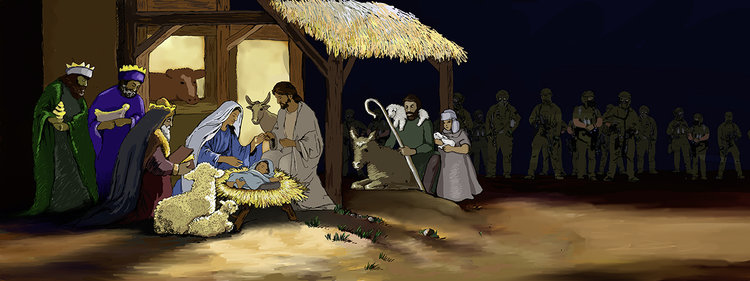
Art by Elisabeth Vines
For Jim and Wanda Gardner
When you strip away the tinsel from the Christmas message, you see right away that, when you buy into the child in the manger — the Nativity Scene — you also buy into the whole 33 years of the child’s life.
Thus, on Christmas morning you not only sing, “The blessed angels sing” from “It Came Upon the Midnight Clear” but also chant the beloved Negro Spiritual, “Never Said a Mumbalin’ Word” which goes:
“He bowed his head and died …
and he never said a mumbalin’ word;
Not a word, not a word, not a word.”
And if its refrains are unknown to you, there is tenor Anthony León’s performance of Moses Hogan’s arrangement, Elvin Rodríguez on piano.
I’ve not seen anything on Fyodor Dostoevsky’s take on the birth of the child Jesus but you can see from “The Brothers Karamazov” that he’s quite familiar with the whole 33 years of his life
In the story, a woman with money asks an elderly monk, Staretz Zosima, if it’s possible to prove the existence of God.
The priest says no intellectual argument or explanation seems to exist, but proof can be found in the practice of the “active love” Jesus announced on Christmas Day.
She said she thought of becoming a nun living out the “dream of forsaking all … full of strength to overcome all obstacles. No wounds, no festering sores could … frighten me. I would bind them up and wash them with my own hands. I would nurse the afflicted. I would be ready to kiss such wounds.”
Which is how Pope Francis treated the poor in his neighborhood inviting them to his apartment for meals — the apartment the digs of a simple man. He could never imagine throwing a grand ball for the rich and greedy in “Great Gadsby” style at a Mar-a-Lago estate while scads of poor — not far from where the champagne was being poured — were clawing away to put a decent meal on the table.
And the Washington billionaire who sponsored the gig is the guy who took away coupons from those souls that we, as an assembled Congress, had allocated for them through the Supplemental Nutrition Assistance Program (SNAP).
Dostoevsky’s rich lady was also a retributionist in that she wanted to be paid like “a hired servant, I expect my payment at once — that is, praise, and the repayment of love with love. Otherwise I am incapable of loving any one.”
It’s the quid pro quo ethic of an unconscious waif reflecting the economically-debilitating ethic of do ut des: I give so you can give something in return: feelings of reciprocity we all grapple with.
Zosima tells the woman to stay in her dream world because “love in action is a harsh and dreadful thing compared with love in dreams. Love in dreams is greedy for immediate action, rapidly performed and in the sight of all.”
Dorothy Day, the founder (with Peter Maurin), of the Catholic Worker Movement spent 50 years of her adult life offering food, shelter, and clothing to those in need, in person and face to face: A mumbalin’ word never left her lips.
In “The Long Loneliness: The Autobiography of Dorothy Day,” she tells how she came to embrace the child of Bethlehem, and was able to remain un-distraught by the loneliness that comes from embracing a love that seeks nothing in return.
Charles Dickens in “A Christmas Carol” shows he knows well the meaning of harsh and dreadful love. Indeed, he’s the fifth gospel of the New Testament: Matthew, Mark, Luke, John, and Charles.
And “A Christmas Carol” offers far greater insight on economics than Adam Smith’s “Wealth of Nations.” Scrooge’s transformation is the Sermon on the Mount grounded in the day-to-day language and thought of the poorest of the poor.
One Christmas Eve two men come to Scrooge and ask for a donation to help the “Many thousands [who] are in want of common necessaries; hundreds of thousands are in want of common comforts.”
Scrooge snaps, “I can’t afford to make idle people merry … they had better [die], and decrease the surplus population.”
The story came out in 1843 but Scrooge is among us still in Elon Musk and his genre who, following orders from the President of the United States, shuttered the United States Agency for International Development (USAID) that was offering life support to those in dire need — which has resulted in what Microsoft co-founder Bill Gates called “killing millions.”
A flabbergasted Gates told “The Financial Times” he still could not absorb, “The picture of the world’s richest man killing the world’s poorest children.”
“I’d love for him to go in,” Mr. Gates said, “and meet the children that have now been infected with HIV because he cut that money,” funds to allow every Tiny Tim in the world to have a life.
Being a billionaire is not the disease that causes savagery; Mr. Gates — himself once the richest man in the world — just pledged to give away his final $200 billion through a foundation he and wife, Melinda, started for “the cause of saving and improving lives around the world.” They’d already donated billions.
“People will say a lot of things about me when I die,” Mr. Gates said, “but I am determined that ‘he died rich’ will not be one of them. There are too many urgent problems to solve for me to hold onto resources that could be used to help people.”
How radically opposite is the billionaire in the White House calling Somalian immigrants “garbage;” a woman newspaper reporter a pig; another “ugly,” another “stupid” and endless other slurs reflecting mental savagery.
It’s the same guy heard on tape in October 2016 saying, “When you’re a star they let you [do this] … do anything … Grab them by the pussy. You can do anything.”
In his classic “Jesus: A Revolutionary Biography,” the revered Jesus scholar John Dominic Crossan says he understands how people treated as pigs and ugly bags of garbage can feel like they got “a boot on their neck … [and] envision two different dreams. One is quick revenge — a world in which they might get in turn to put their boots on those other necks.”
But, Crossan says, there’s another “world in which there would never again be any boots on any necks.”
In all his years of work on Jesus, Crossan kept coming back to the child of Bethlehem embracing a message so radical that Roman and Jewish authorities silenced him for it by execution.
The Christ child in the manger, anthropologist James Scott says, was calling for “a society of brotherhood in which there will be no rich and poor, in which no distinctions of rank and status … will exist … the abolition of rank and status … the elimination of religious hierarchy in favor of communities of equal believers. Property … held in common and shared. All unjust claims to taxes, rents, and tribute … nullified … a self-yielding and abundant nature as well as a radically transformed human nature in which greed, envy, and hatred will disappear.”
And yet Good Friday disbelievers continue to jeer: “Save yourself, if you’re God’s son! Come down from the cross!”
Jill Jackson and Sy Miller wrote a hymn that countermands the savagery of the current President of the United States whose mantra persists: “If they screw you, screw them back 10 times as hard.”
Jackson and Miller sing:
Let there be peace on earth
And let it begin with me;
Let there be peace on earth,
The peace that was meant to be.
They are the angel of Christmas today: “Do not be afraid. I bring you good news that will cause great joy for all the people.”
All people. ¿Entiende?
Thus, Happy Hanukkah; Happy Kwanzaa; Merry Christmas; Happy Midnight Winter Sun — and whatever words anyone else has to celebrate the love Jesus brought on Christmas day.